

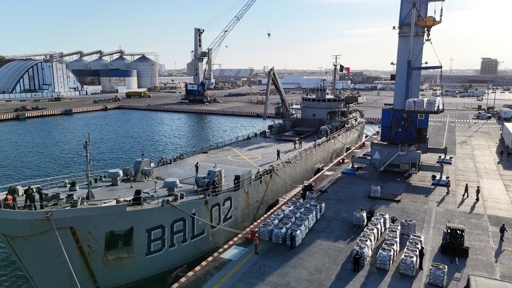
The government of Mexican President Claudia Sheinbaum announced the shipment of 814 tons of milk, meat, beans, rice, and other foodstuffs to Cuba on Sunday, February 8. The move came days after Cuban President Miguel Díaz-Canel presented a series of emergency measures being adopted by his government to mitigate the impact of the severe fuel shortage facing the island.
Cuba is currently facing a serious crisis, provoked by recent maneuvers from the US government which, emboldened by its massive military build up in the Caribbean and its recent bombing of Caracas, has sought to further tighten the blockade on the island, hoping to finally force the overthrow of the government. On January 29, Trump announced an executive order under which any country that trades hydrocarbons with Havana will see a 10% increase in tariffs on its products exported to the United States. The executive order was said to have targeted Cuba’s main energy suppliers: Venezuela, Mexico, and Russia.
Venezuela was already effectively forced to halt oil shipments to Cuba due to the naval blockade imposed by the US against Venezuela, which already resulted in the illegal seizure of a Cuba-bound Venezuelan oil tanker.
Russia, a country which, due to heavy sanctions, is the most decoupled from the US economy, has declared that it will continue supplying fuel to Cuba. The government has said that “the situation in Cuba is truly critical” and top government spokesperson Dimitry Peskov, said “We are in close contact with our Cuban friends through diplomatic and other channels.”
Mexico, for its part, announced that it was engaged in negotiations with the US over oil shipments. President Claudia Sheinbaum has openly declared her rejection of the Trump measure: “You can’t suffocate people like that. It is very unfair.”
She also promised that Mexico would continue to help Cuba in any way possible: “We will continue to support Cuba and take all necessary diplomatic action to resume oil shipments.” In recent days, after learning of the Trump administration’s “threat”. Mexico, one of the few countries that sent oil to Cuba, said it would consult with Washington to determine the extent of possible retaliation.
According to Cuban President Miguel Díaz-Canel, not a single drop of oil has entered the island in 2026, posing a serious threat to a country that depends heavily on fuel for its power grid and to keep transportation, health, education, and other key systems functioning. Government officials and political analysts have claimed that the recent measure seeks to annihilate the Cuban people.
Former Colombian President Ernesto Samper shared this opinion in a post: “SOS for Cuba. The genocide of the Cuban people is being prepared by suffocating their vital conditions for survival. A United Nations humanitarian mission could lead a deployment of humanitarian ships loaded with the fuel that the island needs today, like the oxygen we breathe every day to stay alive.”
Mexican solidarity with Cuba
For his part, the Cuban president said, regarding the Mexican shipment that departed in two ships from the port of Veracruz: “Thank you, Mexico. For your solidarity, affection, and always warm embrace of Cuba.”
Cuban Foreign Minister Bruno Rodríguez wrote on X: “We thank the Government of Mexico, under the leadership of President Claudia Sheinbaum, for sending more than 800 tons of aid to Cuba, amid the intensification of the blockade following the recent Executive Order by the US government. While some try to suffocate our population, sister nations extend their hand in solidarity.”
The post Mexico sends shipment of humanitarian aid to Cuba appeared first on Peoples Dispatch.
From Peoples Dispatch via This RSS Feed.
You must log in or # to comment.