

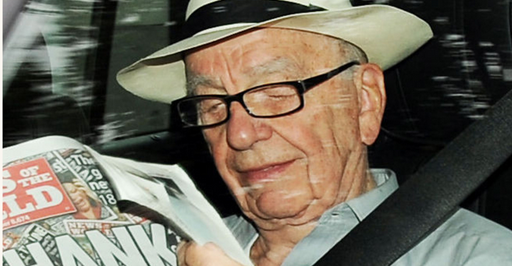

Rupert Murdoch–style journalism comes to California with a front-page call (California Post, 2/1/26) to arrest “violent” ICE protesters. (No injuries were mentioned in the accompanying article about the “downtown carnage.”)
Last week, Rupert Murdoch launched the California Post*,* a West Coast counterpart to his New York Post*.*
When I was growing up in New York City, the New York Post, under publisher Dorothy Schiff, was one of my favorite newspapers*.* I relished reading the columns in it by James Wechsler and Max Lerner, and its news coverage in general. The Post was a good paper.
In 1976 I went for a reporter’s job at the Post. I had been at the Long Island Press since 1964, with a journalistic focus on environmental issues. A specialty of mine was investigative reporting, for which I had received the George Polk Award and other honors.
For two years before the Press*,* my first job as a reporter was at the weekly Babylon Town Leader. My first big story from the start, and through my two years at the newspaper, was the plan of New York public works czar Robert Moses, a resident of Babylon, to construct a four-lane highway on Fire Island.
My journalism helped spur a grassroots movement against his highway. My pieces emphasized the alternative being pursued, creation of a Fire Island National Seashore, which in 1974 became a reality. This framed my lifelong journalistic direction.
Scrapping an interview
But there was talk at the Long Island Press of it being in trouble. This originated with folks there who had undergone the closure of other New York City–based newspapers.
So there I was on South Street in Manhattan for an interview with Paul Sann, executive editor of the New York Post. He had told me to telephone him from the street before going up to his office. And I did, to be told, “You wouldn’t believe, but Rupert Murdoch just announced he is buying the Post*.*” That stopped the planned interview.
The Press announced on March 25, 1977, it was shutting down. As the New York Times (3/26/77) reported the following day, the Press,
bowing to rising costs and increasing competition, ceased publication yesterday in its 157th year…. The final copies…rolled off the presses in the early afternoon carrying a front-page farewell statement expressing sadness…. Members of the…news and commercial staffs began arriving at the plant about 8 a.m., and they found copies of the first—and only—edition with the announcement that the paper was closing down, and that its 600 employees were without jobs.
Far, far too many newspapers—some very fine ones, and some in one-newspaper cities and towns—have issued such an announcement for many decades now.
‘In the hands of lunatics’
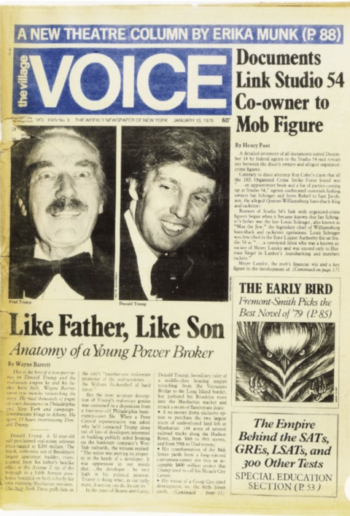
The Village Voice (1/15/79) in its Rupert Murdoch days—with a cover story by Wayne Barrett on Donald Trump.
But with that Boy Scout motto in mind, “Be Prepared,” I had made preparations. I slid into hosting a Long Island cable TV program, and syndicating the weekly column I had at the Press in Long Island weekly newspapers. And in 1976 I had been offered a part-time gig at the Village Voice, another one of my favorite newspapers in the city, which was still waiting for me. Plus, I got a call from SUNY College at Old Westbury, to teach one of the first investigative reporting courses in the US.
As for the Post*,* seeing what Murdoch had done in several months to what had been a quality newspaper—turning it into a far right-wing political sheet heavy on sensationalism—I knew it was no longer a place for me. Sann, at the start of 1977, left the Post after 40 years.
My first Voice assignment was to go to New Hampshire to cover a demonstration opposing the construction of a nuclear power plant in Seabrook, New Hampshire, 40 miles north of Boston.
The protest in Seabrook in June 1978, organized by the Clamshell Alliance, was a major story. Some 20,000 people demonstrated. Speakers included Dr. Helen Caldicott, founder of Physicians for Social Responsibility, who declared to the thousands there: “We’re in the hands of lunatics and at the crossroads of time. It’s time we rise up and say ‘this is our world, we want to live.’”
I wrote a story on it and sent it to the Voice*.* The editor I had been assigned to telephoned and said that, with Murdoch having purchased the Voice in January 1977, it couldn’t use this piece, or any environmental or energy articles I would write. (Murdoch owned the alt-weekly until 1985.)
So those are my early personal experiences involving Murdoch.
‘Ambition to set the news agenda’
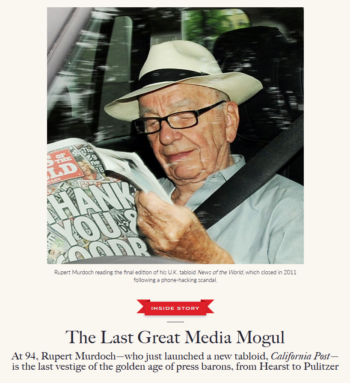
Gabriel Sherman (Air Mail, 1/31/26): ” Murdoch fostered a corporate culture where loyalty was often prized over ethics or the law.”
At SUNY Old Westbury, my teaching position became full-time, and among the courses I developed and taught was one I titled “Politics of Media,” focusing on racism and sexism in media, and on who owns media. Thus, I have studied Murdoch. This has included his activities in his home country of Australia, to which I was invited to give a lecture on investigative reporting to a university journalism program.
“I believe,” Gabriel Sherman (Air Mail, 1/31/26) recently wrote, “his most influential properties—Fox News, the New York Post and the Sun*—*have poisoned public discourse in the US, the UK and Australia.”
Sherman, who has written much about Murdoch through the years, said on Air Mail that Murdoch
has spent hundreds of millions of dollars to keep the New York Post alive. He aggressively expanded the Wall Street Journal after buying it in 2007. This week, at 94, he launched the California Post*—*a West Coast edition of his New York tabloid, complete with “Page Six” and an ambition to set the news agenda of America’s most populous state.
Sherman’s just-published book is Bonfire of the Murdochs: How the Epic Fight to Control the Last Great Media Dynasty Broke a Family—and the World.
Importantly, this Murdoch family fight concluded with Rupert’s eldest son Lachlan—who as Sherman relates “shares his father’s conservative politics”—inheriting the Murdoch media empire.
‘Not a fit person’
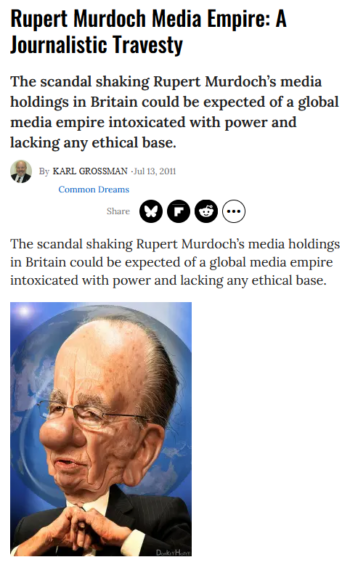
Karl Grossman (Common Dreams, 7/13/11): Murdoch’s media machine is the “most dishonest, unprincipled and corrupt of any media empire in the history of the English-speaking world.”
I have written (CounterPunch, 5/2/12) about how a committee of the British Parliament in 2012 declared that Murdoch is “not a fit person to exercise the stewardship of a major international company.” There was a phone-hacking scandal at his British tabloid News of the World at the time—in its wake, the tabloid went out of business—and also then Murdoch was attempting to take control of the British satellite system, British Sky Broadcasting.
The committee said Murdoch
turned a blind eye and exhibited willful blindness to what was going on in his companies and publications. This culture, we consider, permeated from the top.
The strategy of Murdoch, always arch-conservative in his politics, has been to start or take over and use media to further his political viewpoint.
He became a US citizen in 1985, because the broadcast licensing system in the nation for TV and radio stations requires that only US citizens hold a major interest in a station. Also required is that owners be of good character. He took US citizenship to create a media empire based in the media capital of the world, the US.
The holdings in the empire are vast. A very limited list includes: Fox News Channel, Fox Broadcasting Company, Fox TV stations (29 in the US), New York Post, Wall Street Journal, Dow Jones & Company, Barron’s, MarketWatch and HarperCollins Publishers. In Britain, he owns the Sun and the Times of London (once considered the most prestigious newspaper in the Western world); in Australia, the Australian, Herald Sun and Daily Telegraph*.* The list goes on and on.
“At Murdoch’s media companies,” writes Kerwin Swint in his book Dark Genius, “his operations are often used for expressly political purposes.” The New York Post
is not profitable in a financial sense for Murdoch, but it has been invaluable to him as a battering ram for political causes and vendettas…. He has skillfully used his media properties to advance political agendas, and conversely, has used those political assets to advance his media properties.
As I wrote on Common Dreams (7/13/11) in 2011: “Murdoch has made a travesty of what journalism is supposed to be about. And he has institutionalized this on a global level.”
And now he is spreading his media corruption to California.
From FAIR via This RSS Feed.