

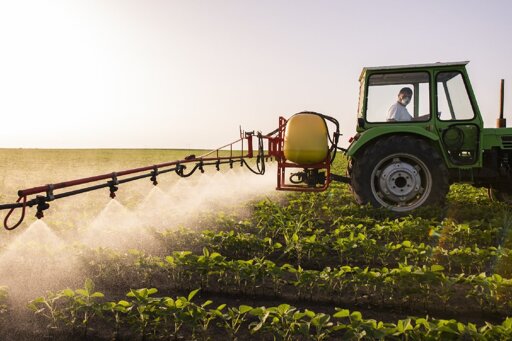
Regulators at the Environmental Protection Agency (EPA) announced late Friday the reapproval of the herbicide dicamba—a weedkiller that courts have banned twice because of its tendency to drift and damage crops and other plants—for use on soybeans and cotton. While the agency says the approval includes new restrictions that will reduce the chemical’s harms, watchdog organizations say it actually weakens protections.
“The Trump administration’s hostility to farmers and rural America knows no bounds,” Bill Freese, science director at the Center for Food Safety (CFS), said in a press release. “Dicamba drift damage threatens livelihoods and tears apart rural communities.”
Farmers have been using dicamba since the 1960s, but issues emerged about a decade ago, when it was first approved to spray on soybeans and cotton plants engineered to resist the weedkiller. Because farmers could spray it over the top of those growing plants, its use increased later in the growing season.
Farmers have been using dicamba since the 1960s, but issues emerged about a decade ago, when it was first approved to spray on soybeans and cotton plants engineered to resist the weedkiller.
But dicamba is prone to vaporizing, so it drifted on the air from those fields onto neighboring farms, forests, gardens, and wildlife refuges. When plants that are not resistant to dicamba are exposed, they can be weakened or killed. Tree leaves begin to cup and curl, for example, and soybeans that are not resistant might produce lower yields. Dicamba drift has damaged millions of acres of crops, orchards, and native plant and trees. It has pitted neighbors against each other, as drift from one farm can kill another farm’s entire vegetable crop.
In a press release, the EPA said it recognized drift created “legitimate concerns” in the past and that new restrictions the agency put in place to reduce risks will make it the “most protective” dicamba registration in history. It cited new measures, including cutting the total amount of dicamba that can be used annually and restricting applications when temperatures are high, since heat can increase drift. The EPA also said its analysis “found no unreasonable risk to human health and the environment.”
The American Farm Bureau Federation celebrated the decision, which it said was based on “sound science” and would provide farmers with certainty around which herbicides are available as they plan for the upcoming planting season. The Illinois Soybean Association sent out an email to its members announcing that dicamba use “would return under similar, but arguably more conservative rules than in past years.”
But Freese and other experts pointed to ways in which they say the registration also weakens protections that prevent dicamba from drifting. For example, past registrations prevented farmers from spraying soybeans after June 12 to ensure heat did not exacerbate drift, according to CFS. Now, the temperature-based restrictions replaced that provision. So, farmers will be able to spray year-round, but they’ll be limited to treating half of their acres on days between 85 and 95 degrees and will not be allowed to spray on days that are 95 degrees or hotter.
In the press release, the EPA said it “will work with state enforcement to actively monitor compliance, and violations will be met with serious consequences,” but the agency does not currently have field staff monitoring pesticide use.
Advocates at CFS have other concerns about the approval. They warn that the agency will no longer require that dicamba mixtures with other pesticides be reviewed to make sure they don’t make drift worse. They also note that buffer requirements intended to limit spray drift—which have proven ineffective in the past—remain in place. “For 10 years now, time and time again they have claimed the same—‘This time will be different’—and all the scientific and agronomic evidence shows their claims are false,” George Kimbrell, co-executive director and legal director at CFS, told Civil Eats. “It’s a harmful, toxic product, and moving the deck chairs around on the Titanic will not change the catastrophic iceberg ahead.”
Many prominent supporters of Robert F. Kennedy Jr.’s Make America Healthy Again (MAHA) movement who have largely supported the Trump administration expressed outrage over the approval.
On X, anti-pesticide activist Kelly Ryerson said the EPA’s decision would lead to “further destruction” of soil and rural communities. “No one should believe that MAHA is being upheld at the EPA at this point,” she posted. “Time for the President to step in and correct the crash course in this agency.”
Since November, EPA Administrator Lee Zeldin has been meeting with MAHA supporters and appearing at their events to allay their concerns about fast pesticide approvals and the rollback of regulations that prevent pollution.
While Zeldin has been eager to publicly frame other pesticide decisions, such as a recent announcement around ongoing paraquat research, as “MAHA wins,” so far, he has stayed quiet on the dicamba approval.
The post EPA Reapproves Weedkiller Dicamba Despite Concerns About Drift and Crop Damage appeared first on Civil Eats.
From Civil Eats via This RSS Feed.
Well, corporations love mass murder- especially when it’s slow and painful. Someone should tell them to stop. Stop it. Stop. Stop it.
They won’t listen though. No one’s ever stood up to them successfully before.
EPA has reinforced it’s laughable republican position as just another institution of extortion and lies.
This year has surpassed 2025… The handbasket decends quicker…
