

A couple of years after President Hugo Chávez came to power, Venezuela had approximately 30,000 practicing physicians. Even so, it was not possible to effectively deliver healthcare services to all of the country’s poor and marginalized people. There was an acute shortage of regular healthcare, especially in impoverished urban slums and rural regions.
It was in this context that a new kind of cooperation between Venezuela and Cuba began. In exchange for supplying Venezuelan oil to Cuba, arrangements were made to bring Cuban doctors and healthcare expertise to Venezuela. At the same time, initiatives were taken to send Venezuelan students to Cuba to study medicine and healthcare. Alongside this, an alternative medical education structure was created outside Venezuela’s conventional medical education system, called the “University Without Walls.” Its main objective was to ensure that new medical students could receive their education without becoming detached from their own communities and social environments.
The successes of Misión Barrio Adentro
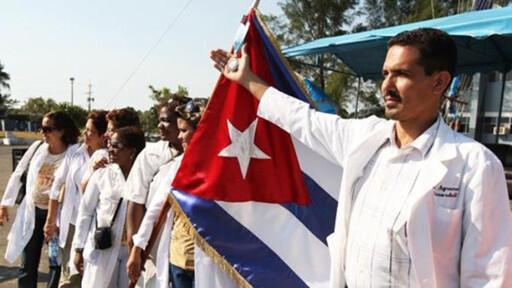
Based on this initiative, the Barrio Adentro (“Inside the Neighborhood”) program was launched. In the first phase, around 10,000 Cuban doctors came to Venezuela; later, this number increased to about 14,000. Along with them, 15,000–20,000 other health workers – such as dentists, nurses, and technicians – were recruited. As a result, nearly 7,000 new primary healthcare centers and about 5,000 diagnostic centers were established across the country.
In the next phase, Venezuelan students traveled to Cuba for medical training. After completing their training as doctors, they returned to their own country and began working in various healthcare facilities throughout Venezuela. At the same time, many of them also became involved in teaching medicine at colleges and universities in Venezuela. Most of these new doctors were appointed to areas close to their own places of residence, so that healthcare services would be more easily accessible to local communities. The entire cost of this public health program was borne through the exchange of Venezuela’s oil resources.
Ordinarily, international oil trade and exchange are conducted on the basis of commercial profit traded against the US dollar. But Venezuela and Cuba demonstrated that social development and public health could also be important areas of exchange in return for oil. Instead of sending troops to weaker countries to seize oil and resources, Venezuela and Cuba set an international example of how social development can be achieved through mutual cooperation using oil as a medium of exchange, departing from the usual norm.
Read more: Venezuela and Iran: oil and survival
At the beginning of 2003, Misión Barrio Adentro began as a small program in the Libertador district of Caracas. Its aim was to provide free primary healthcare to poor communities who had previously been neglected or had no regular access to health services. At that time, many Venezuelan doctors were unable, for various reasons, to work in poor urban slums and rural areas. For this reason, the mayor of the Libertador district took the initiative to bring doctors from Cuba to staff newly established local clinics.
Later, in 2010, a devastating earthquake struck Haiti. The way Venezuelan doctors provided medical services there also set an important example. Brazil’s Ministry of Health recognized this medical work and innovative public health system and joined in cooperation with them in Haiti. This program gained considerable international recognition and was reported in The Lancet.
Cuba’s revolutionary medicine as inspiration for Venezuelan healthcare
Today, there is an ideological difference between how the United States views oil and how Venezuela views it. Venezuelan President Hugo Chávez signed an agreement with Cuba under which petroleum was supplied to Cuba at discounted rates in exchange for doctors and other health professionals. These doctors generally worked in Venezuela on rotating two-year terms. By 2004, Barrio Adentro had become a nationwide network of 13,000 doctors, along with nurses, dentists, and other healthcare workers.
However, in the long run, it was not feasible to rely solely on doctors from Cuba. Therefore, soon after the project began, initiatives were taken to integrate Venezuela’s own doctors into the system. Residency programs were introduced for newly graduated doctors, and many medical students were sent to Havana’s Latin American School of Medicine. At the same time, a six-year integrated community medicine program – Medicina Integral Comunitaria (MIC) – was established. Operating outside the traditional university framework, this program trained thousands of new doctors with a focus on primary healthcare.
A unique feature of the MIC program is that students do not have to leave their villages or slum areas. Even students from the poorest neighborhoods of Venezuelan cities can pursue medical education while remaining in their own communities. This is not a short-term course; rather, it is a comprehensive program designed to create a new kind of doctor who is a part of a community healthcare system. The experience of Cuba’s healthcare system has had a significant impact on the development of public health in Venezuela.
Watch: 60 years of Cuban medical solidarity
The roots of this Cuban medical philosophy lie in the post-revolutionary outlook of the island. In a speech in 1960, Che Guevara spoke about the role of medicine in the new Cuba, saying: “Our task today is to direct the creative capacity of all medical professionals toward social medicine.” Within a year and a half of the revolution, he began thinking about “revolutionary medicine” and the possibility of creating a new type of doctor. He linked the mission of medicine to the construction of a just society.
A cooperation that brings international solidarity and respect
In his book “Revolutionary doctors: how Venezuela and Cuba are changing the world’s conception of health care,” Dr. Steve Brouwer shows how Cuba’s healthcare and medical education systems evolved in a unique way after the revolution, and how medicine also played an important role in Cuba’s relations with the outside world. Brouwer himself lived for a year in rural Venezuela and observed that in areas where healthcare services had not existed just a few years earlier, new doctors, students, and health workers were now actively working.
Clearly, the actions and mutual cooperation of Cuba and Venezuela were producing striking results. Yet the United States remained determined to disrupt both Cuba and Venezuela, imposing strict economic and travel sanctions. Not only that, it began devising and funding various plans to weaken the two revolutionary governments. In 2006, the US created the Cuban Medical Professional Parole Program, aiming directly to undermine Cuba’s humanitarian medical missions. Special plans were designed to draw Cuban doctors, nurses, and technicians away from their overseas assignments.
Read more: How Venezuela poses an “unusual and extraordinary threat” to the US agenda
However, the US did not succeed in diminishing the international solidarity and respect that Cuba and Venezuela were earning worldwide through their exchange-based cooperation. Nor was it able to halt the expansion of humanitarian medical assistance and international medical education programs.
In 2007, at the graduation ceremony of the Latin American School of Medicine in Havana, a young graduate said: “Today we are an army in white coats, who will bring health and dignity to our people.” In the words of Dr. Steve Brouwer, when emergency services and humanitarian cooperation take precedence over diplomatic or military coercion by powerful countries, true moral victory is achieved.
Venezuela and Cuba have presented a concrete example of those alternative values in opposition to capitalist and imperialist powers.
People’s Health Dispatch is a fortnightly bulletin published by the People’s Health Movement and Peoples Dispatch*. For more articles and subscription to People’s Health Dispatch, click* here.
The post Venezuela and Cuba: a socialist alliance for Health for All appeared first on Peoples Dispatch.
From Peoples Dispatch via This RSS Feed.