

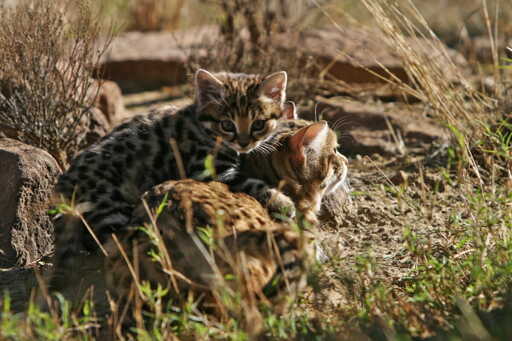
Under cover of night, a black-footed cat moves almost invisibly through the grasses of southern Namibia, hunting small rodents, birds and insects. Barely a third the size of a domestic cat, its tawny coat speckled with dark spots helps it disappear into the darkened landscape. By day, the cat disappears underground, folding its small body into abandoned burrows and tunnels — a rare behavior among felines. Female Felis nigripes patrol territories covering anywhere from 10 to more than 80 square kilometers (4-31 square miles), depending on prey availability, while males roam areas between 15 and 90 km² (6 and 35 mi2). Their energy and activity, despite their small size, continue to surprise researchers. Alexander Sliwa, project leader for the Black-footed Cat Working Group, an international network monitoring wild populations, notes, “It’s really small, but very active and unique in its nocturnal behavior.” Newly published research, focused on the cats’ daytime activity, has uncovered their heavy reliance on burrows dug by springhares (Pedetes capensis), a large rodent, to raise their young. Female black-footed cats rotate among multiple dens, and once the kittens start moving, the mothers change shelters almost daily, likely to reduce predation risk and avoid leaving traces that predators could follow. Survival in this harsh, semiarid landscape depends not just on stealth and hunting skill, but also on these hidden interdependencies. Black-footed cats range extends across semi-arid landscapes in Namibia, Botswana and South Africa. Image courtesy of Hal Brindley. Surviving in borrowed burrows Famously more efficient hunters than lions…This article was originally published on Mongabay
From Conservation news via This RSS Feed.