

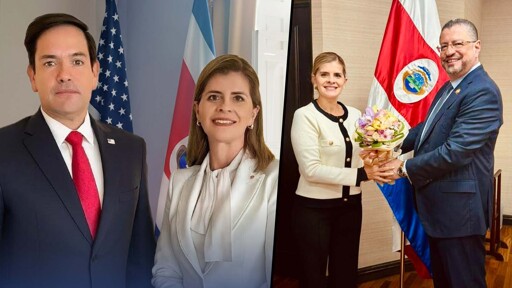
Costa Rica held elections on February 1, 2026, and right-wing presidential candidate Laura Fernández Delgado won decisively, exceeding the 40% threshold required to avoid a runoff.
Fernández’s campaign was run almost entirely on one promise: continuing what incumbent President Rodrigo Chaves started back in 2022.
Just a few days after the electoral authorities declared her the winner, Chaves appointed Fernández as his new minister of the presidency, reinforcing the idea that the newly elected government will be a continuation of the previous one.
Fernández’s incoming administration will have an unprecedented majority in the Legislative Assembly, and is preparing to shape Costa Rica’s domestic and foreign policy for years to come.
She has vowed to crack down hard on crime, and wants to construct a large militarized prison, based on the so-called “Terrorism Confinement Center” (CECOT) built by El Salvador’s US-backed leader Nayib Bukele.
Immediately after her victory, US Secretary of State Marco Rubio publicly congratulated Fernández, vowing to deepen cooperation on issues such as narco-trafficking, immigration, and cybersecurity.
The Donald Trump administration openly supported Fernández. When Rubio visited Costa Rica in February 2025, he met with her.
In a press conference during his trip to Costa Rica, Rubio praised Fernández as a “very strong ally of the United States”, and happily noted that she will oppose China, because she understands the supposed “threats that Chinese companies represent”.
Costa Rica’s corrupt, pro-Trump, pro-Israel President Rodrigo Chaves
Washington has heavily collaborated with Rodrigo Chaves throughout his presidency, and Fernández’s victory ensures a seamless transition with policy continuity rather than change.
This bodes well for the US, which has always seen Chaves as an ally and has sought to defend him, even amid corruption scandals.
In 2025, the US Embassy in Costa Rica held meetings with lawmakers from different political groups to pressure them to vote against lifting President Chaves’ immunity. The Supreme Court of Costa Rica had requested that Chaves lose his immunity, so he could face criminal proceedings for the crime of extortion.
Upon her victory, Laura Fernández held a friendly phone call with outgoing President Chaves, who is poised to assume a cabinet position in the new government, to maintain his immunity in order to avoid prosecution for corruption. Fernández’s decision to appoint him to her cabinet effectively grants Chaves immunity for an additional four years.
Chaves’ government was marked by a handful of geopolitical decisions that faced international scrutiny, such as the promotion of a free trade agreement with Israel, which was publicly denounced by Francesca Albanese, the UN special rapporteur on the occupied Palestinian territories.
Costa Rica’s free-trade deal with Israel amid apartheid, illegal occupation,genocide, ignoring ICJ rulings & UN decisions is just wrong. I urge Costa Rica to pause ratification & conduct a human rights review, avoiding to contribute to/being complicit with an economy of genocide. https://t.co/DpLxvEULIS
— Francesca Albanese, UN Special Rapporteur oPt (@FranceskAlbs) December 12, 2025
Chaves was asked at press conference in July 2025 why he was signing a free trade agreement with Israel while it was committing genocide and facing international condemnation from a litany of human rights organizations.
The Costa Rican president laughed and dismissively retorted: “You know what? I’ll sign it with this pen right here if it’s up to me. Thank you very much”.
In 2025, lawmakers and other public figures had their US visas revoked following a visit to Costa Rica by Secretary of State Rubio, who warned that political officials would face “consequences” if US authorities deemed them a “risk to cybersecurity”.
This pressure has, in turn, made Costa Rica into the only Latin American country to exclude Chinese companies from its 5G networks, effectively halting further development under US demands.
President-elect Laura Fernández celebrated the US military’s illegal kidnapping of Venezuela’s President Nicolás Maduro in January 2026, perpetuating the false and debunked narrative that Maduro is a “narco-dictator”.
Chaves’ political project and its continuation through Laura Fernández shows a subordinated alignment to the far-right and to US interests. This rupture from Costa Rica’s traditional political system was made explicit in Fernández’s victory speech where she calls for the “end of the Second Republic”, and calls for a constituent assembly to enact the profound and irreversible constitutional changes to her discretion.
Continuity of the Rodrigo Chaves project
Fernández’s political profile cannot be separated from that of Rodrigo Chaves. She served in Chaves’ cabinet as minister of planning and minister of the presidency.
The electoral landscape was marked by polls consistently showing Fernández leading the field by overwhelmingly significant margins well before election day and a campaign focused on promises about “the continuity of change”.
The newly formed Chaves-aligned Sovereign People’s Party (PPSO) secured an unprecedented and historic legislative majority, winning 31 out of 57 seats in the Legislative Assembly; a huge contrast from 2022, when Chaves got just 10 seats. No political party in Costa Rica has achieved a majority this significant in the Legislative Assembly in more than four decades.
This grants the right-wing party a unified executive and legislative base that now has an unprecedented capacity to push through the Chaves-Fernández agenda, allowing institutional reforms, budget control, and even constitutional changes to be done more aggressively than before.
What this means for the region
The implications of Fernández’s presidency extend beyond domestic politics. Her victory represents yet another success for right-wing populist movements in Latin America, following developments in Honduras with Nasry Asfura, Chile with José Antonio Kast, Bolivia with Rodrigo Paz, and elsewhere.
These US-backed governments reinforce a regional pattern of divisive rhetoric and unbridled obedience to Donald Trump’s agenda.
Costa Rica’s conservative shift and Laura Fernández’s majority in the legislative body contribute overall to a broader alignment with and cohesion of far-right and US-friendly regimes.
Costa Rica’s 2026 election cannot be understood in isolation. In cases like these, where a successor candidate inherits not only policy priorities but also institutional momentum and power, domestic political continuity often deepens broader geopolitical alignment.
This election may ultimately be remembered as the opportunity where the right-wing project initially engendered by Rodrigo Chaves entered a new chapter, now backed by far greater institutional consolidation and leverage.
The post Costa Rica deepens alignment with US-backed right-wing forces, with victory of Laura Fernández appeared first on Geopolitical Economy Report.
From Geopolitical Economy Report via This RSS Feed.