

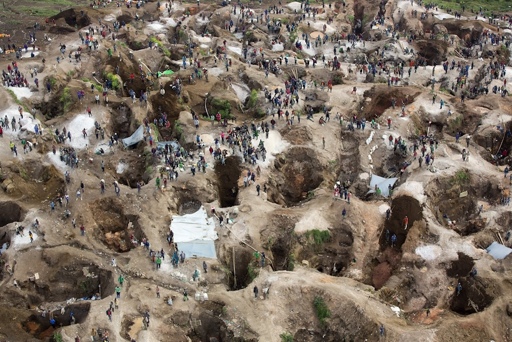
More than 220 people were killed in two successive landslides on Jan. 28 and 29 in eastern Democratic Republic of Congo. The victims were artisanal miners known as “diggers.” The accident occurred at the Luwowo mining site in Gasasa, within the Rubaya mining perimeter in Masisi territory, North Kivu. Mines in this area produce around 15% of the global supply of coltan. Since April 2024, this area has been controlled by the M23, the largest armed group in Congolese territory, supported by Rwanda, according to the United Nations. The accident occurred as a result of successive risky activities on the rugged and unstable terrain, which was prone to landslides. Prior to the accident, heavy rains had fallen on the region until Jan. 27, the day before. On Jan. 28, the first landslide occurred, according to Ignace Tusali, a journalist with Rubaya’s Amani community radio station, who was contacted by Mongabay on Feb. 1. This landslide was followed by another on Jan. 29. An ecological tragedy The diggers work with pickaxes. They delve into long tunnels that they dig in search of coltan, a mineral essential in the manufacture of various gadgets, including cell phones. These tunnels often do not comply with safety measures such as the distance between diggers to ensure soil stability. Inside, where copper and cobalt are mined by hand, the tunnel walls are supported only by pieces of wood, as is also the case in Katanga in southeastern DRC, where previous accidents have occurred. Around the Luwowo…This article was originally published on Mongabay
From Conservation news via This RSS Feed.