

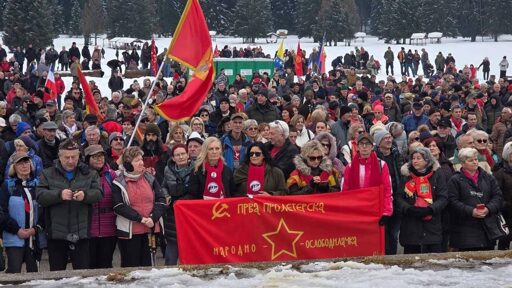
On January 27 and 28, 1942, hundreds of Yugoslav partisans marched over Mount Igman in Bosnia to evade Nazi encirclement and reach liberated territory in Foča. This feat of the First Proletarian Brigade – carried out at temperatures around −30 degrees Celsius, with dozens of fighters dying or suffering injuries due to frostbite – became a defining moment of the antifascist resistance. It remains commemorated to this day, testifying to the determination and endurance of the partisans.
Every year, thousands travel to Igman from across the former republics of socialist Yugoslavia to pay tribute, while also drawing inspiration and strength for contemporary struggles. This year’s anniversary of the Igman March was marked on January 31. Many participants reached the monumental area of Veliko Polje on foot, carrying red flags and banners of local antifascist organizations and breaking into revolutionary songs along the way.
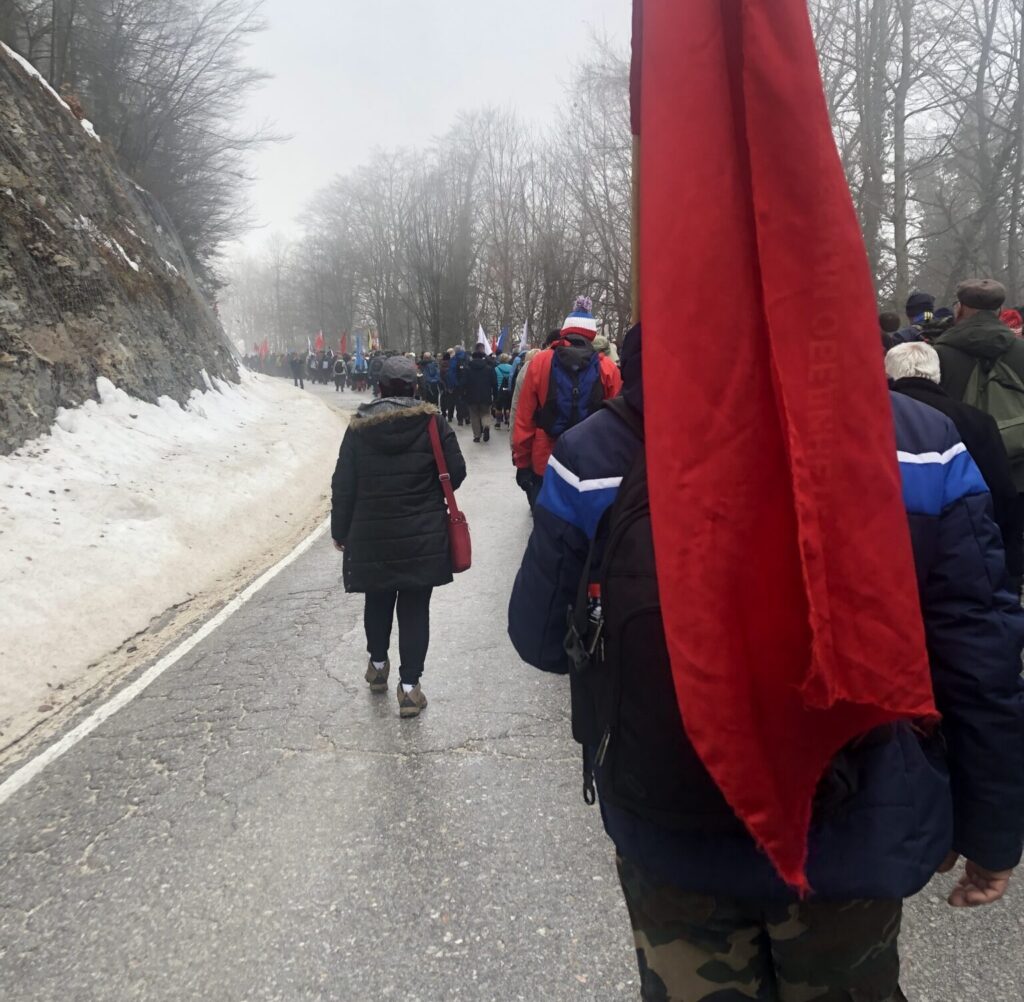
Photo: Peoples Dispatch
As they arrived at the central site, representatives of the Association of Anti-Fascists and Veterans of the People’s Liberation War of Bosnia and Herzegovina (SABNOR BiH) cautioned against limiting the meaning of antifascist resistance to remembrance alone.
“Today, we take away the lesson of how to recognize fascism, how to identify the threat it poses – so that we can act against it,” said Mirsad Ćatić, president of SABNOR Sarajevo. “As we honor those who fought with weapons in hand against fascism, we also seek inspiration from their spirit of freedom. The Proletarians, the Partisans of that time, understood that the word ‘freedom’ remains just a word unless it is made real – unless it is liberated.”
Read more: “No room for fear”: broad antifascist front confronts far-right violence in Croatia
As in much of Europe, countries of the Western Balkans have experienced a resurgence of the far right, including through the rehabilitation of local World War II collaborators and efforts to erase the role of antifascist and socialist movements in liberating Yugoslavia – and Europe – from occupation. While the scope of this historical revisionism differs across the region, the diminishing presence of antifascist history in school programs, swiftly replaced by nationalist narratives, is a shared concern.
In response, SABNOR Sarajevo recently launched a booklet for high school students, “The Partisan Reader”, aimed at countering these trends within educational institutions. Yet speakers at the 2026 Igman March stressed that resistance to the far right must be unified and universal, conducted on all fronts and confronting the repressive agendas pursued by many governments in the region.
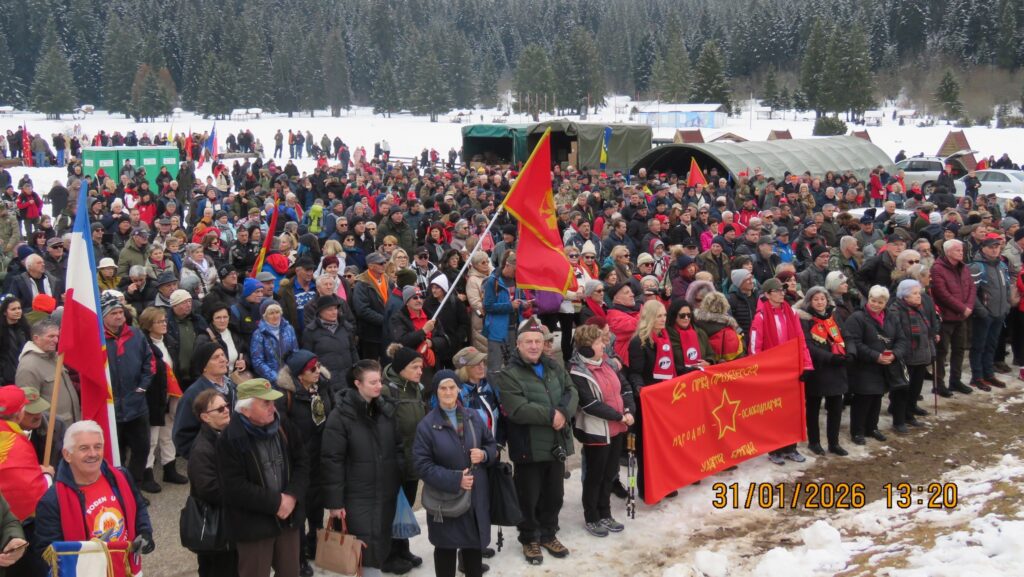
Central event during Igman March anniversary. Source: Arijana Hadžić/Facebook
“Aren’t fascist movements being rehabilitated in our countries in the former Yugoslav republics?” asked Sead Đulić, president of SABNOR BiH. “Aren’t the Ustaše, Chetniks, and other collaborators being rehabilitated? They are traitors to this day, yet we have allowed them to come to power. They have infiltrated every level of government, and we remain silent.”
“What is the point of gathering on Igman, on Sutjeska, on the Neretva, and at all the other sites across the former Yugoslavia,” Đulić continued, “if we stay silent while those in power are the ideological heirs of the very forces our comrades fought in the 1940s?”
Read more: Is fascism back in Europe? A conversation with the Zetkin Forum
“Today, we are surrounded by a new fascism,” Ćatić warned. “A fascism that has learned its lessons from the war. It was defeated once, but now it returns, polished, smiling […] It slips into institutions that shape laws echoing those from 84 years ago.”
“We are here not only to learn from the evils of the past, but also to draw inspiration from the freedom-loving spirit of our wise ancestors, and to confront this growing fascism with our own wisdom today,” he added.
“We must give up our silence,” Đulić echoed. “We are far too silent, while there is too much neo-fascism and neo-Nazism around us. We must speak up. We have no right to remain silent if we call ourselves antifascists. But we must speak up together.”
“Let us awaken and unite in a broad, popular antifascist front against all those who are taking away what is rightfully ours,” he concluded. “Let us restore the human face to our countries – and that cannot happen without antifascism.”
The post Thousands mark Igman March anniversary as “new fascism” spreads around former Yugoslav republics appeared first on Peoples Dispatch.
From Peoples Dispatch via This RSS Feed.