

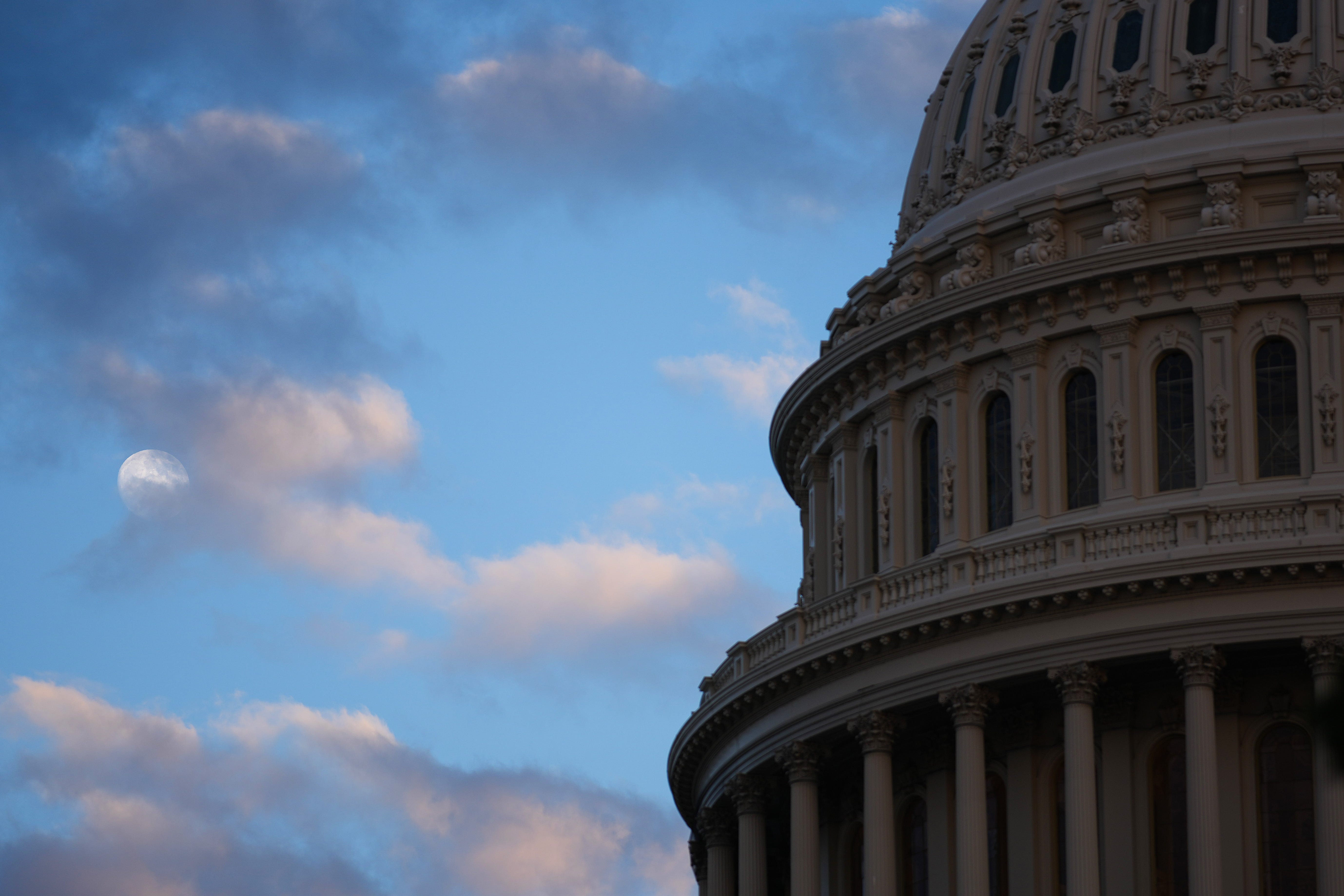
The U.S. Capitol on December 2, 2025 in Washington, DC. Photo by Andrew Harnik/Getty Images.
The breakaway territory of Somaliland, fresh off establishing formal ties with Israel late last year, is aiming for a much higher diplomatic prize. The government has hired a major firm with ties to the Trump administration to lobby in Washington for U.S. recognition, according to a recent Foreign Agents Registration Act (FARA) filing. Somalia hired its own lobbying firm to counter the offensive, marking a rival influence campaign that could potentially reshape U.S. policy in the Horn of Africa.
Nestpoint, a Dallas-based private equity and government affairs firm, was retained by Somaliland to “develop and execute a comprehensive strategy to secure international recognition…by engaging U.S. government stakeholders,” the filing states. The firm will receive $7,500 a month under the one-year contract that was signed in October and registered under FARA in December, and which also calls for pitching investment in Somaliland. In a December news release published on its website, Nestpoint said it had two goals for its new client: diplomatic recognition and economic self-reliance.
“Their [Nestpoint’s] ability to bridge the gap between diplomatic advocacy and economic development makes them the ideal partner to help Somaliland take its rightful place on the world stage,” read part of a statement attributed to Somaliland President Abdirahman Mohamed Abdullahi.
Readers like you make Drop Site’s journalism possible.
Nestpoint is run by a coterie of prominent GOP strategists, including cable TV pundit John Thomas. The firm counts former 2016 Trump campaign field director Stuart Jolly as its chief lobbyist. Jolly, who Trump personally congratulated on stage for his first primary win in New Hampshire, also previously ran the pro-Trump Super PAC, Great America PAC. He is listed as one of the lobbyists in the FARA disclosure.
Somaliland’s move to enter the lobbying arena comes amid a full-court press by influential GOP think tanks to recognize the territory, which has emerged as a strategic battleground in a growing struggle to exert influence over the Horn of Africa region. A Washington Post op-ed by Joshua Meservey, a fellow at the neoconservative Hudson Institute, said recognition was “recognizing reality.” Michael Rubin, a senior fellow at the American Enterprise Institute, went as far as to say U.S. recognition would prevent a war between Somaliland and Somalia—despite Israeli recognition already triggering threats of armed confrontation and separatist violence.
Despite calls to embrace Somaliland, Nestpoint faces an uphill battle in Washington. A bill to recognize Somaliland was introduced in the House last June but never got out of committee. Despite some high-profile supporters, like Sen. Ted Cruz, most members of Congress have eschewed calls for recognition. Throughout his second term, President Trump has disparaged Somalia, and the Somali people, often referring to Somalia as “not even a country,” while indicating in numerous public comments that he is not ready to recognize the breakaway state.
Somalia, already contracted with a major K-Street lobbying firm, BGR Group, hired another lobbying shop in September, according to a recent disclosure. The $44,000 per-month contract with Virginia-based Arsenal Government and Public Affairs Group lays out that Arsenal will “engage with U.S. Executive Branch officials and staff to inform them of client’s public policy views, and to create media opportunities for client to increase public awareness of those views and policies.”
Among those policies, it notes, is security cooperation—likely a reference to the fight against al-Shabaab, an al-Qaeda-affiliated militant group that controls large swaths of the country. The firm boasts that it secured Somalia’s President Hassan Sheikh Mohamud an interview on a Newsmax program in October. Mohamud repeatedly praised President Trump in that interview for his administration’s counterterrorism policy in Somalia, highlighting U.S. airstrikes that targeted al-Shabaab militants the previous month.
The Arsenal Group is run by Christopher Neiweem, an Iraq-war veteran who has been a registered lobbyist since 2013, records show. The filing lists Trump associate Roger Stone as a co-leader of the lobbying campaign, though Stone has denied any ties to The Arsenal Group. In a post last month on his X account, Stone acknowledged that he had previously met the Somali ambassador to the United States, Dahir Hassan Abdi, but declined to represent them. He wrote that seeing his name on the filing “took me by surprise” and said his lawyers had demanded it be removed. Stone had briefly lobbied for an American company with commodity interests in Somalia during the first Trump administration.
Neiweem declined to comment.
“I know the president”
This lobbying push comes as Somalia’s government faces significant political headwinds in the United States. Somali Americans in Minnesota have been targets of rightwing movements after a video published in late December alleged extensive fraud at Somali-run child care centers in the state. The viral video allegations garnered more than 150 million views across social media platforms and were promoted by Vice President J.D. Vance and X owner Elon Musk.
The Department of Homeland Security launched an investigation into the centers and the Department of Health and Human Services froze all childcare payments to the state. The administration cited the alleged fraud as one of the reasons for the federal immigration enforcement crackdown in Minneapolis. President Trump has frequently referenced the alleged fraud, including in his high-profile speech at the World Economic Forum in Davos. “I always say these are low IQ people,” Trump told the crowd. “How do they go into Minnesota and steal all that money?”
The blowback in Minnesota has been of significant concern for the Somali embassy in Washington, according to a person who has discussed the matter with embassy officials. “In terms of strategy, they don’t have one,” said the person, who requested anonymity to discuss private conversations.
The Somali embassy did not respond to requests for comment.
It is unclear whether these domestic issues will adversely affect U.S. relations with Somalia and the issue of Somaliland’s recognition, said Omar Mahmood, a senior analyst for Somalia and the Horn of Africa at the International Crisis Group. Prior to Israeli recognition, Mahmood said, the territory was largely not on the White House’s radar.
“In this administration, basically what you have to do is convince the guy at the top,” Mahmood told Drop Site. “If you can get in Trump’s ear, maybe you have a shot.”
In a recent interview with D Magazine, a Dallas publication, Nestpoint managing director John Thomas touted the young firm’s hybrid private equity-lobbying business model as its secret sauce. He also was not shy about another key factor: President Trump.
“I know the president[,] and [I] am close to many senior officials,” Thomas told the magazine. “So our access and reach expanded dramatically.”
That access to the Trump administration, Thomas said, has brought opportunities for Nestpoint to serve as a conduit to business and diplomatic deals. He offered the example of representing “African nations that want to sell rare earth minerals to the U.S. instead of China.”
Nestpoint did not respond to a request for comment.
The type of dealmaking Thomas spoke about falls into a long bipartisan tradition in Washington. For decades, foreign nations have hired lobbying firms close to the party in power and those firms have benefited handsomely. An estimated $540 million was spent on foreign lobbying in 2024, the last available year for data, according to Daniel Auble, who directs the Foreign Lobby Watch Program at the nonpartisan campaign finance group OpenSecrets.
“In a lot of ways, it’s about connections,” Auble told Drop Site. “Firms that have a direct line, with foreign lobbying especially, to the executive branch are able to market that and have been successful in gaining clients that way.”
Last October, those White House connections were on display at a black-tie gala that Nestpoint’s nonprofit held at Washington’s Kennedy Center. Some of the biggest media figures on the right including country music star Anne Wilson and commentator Megyn Kelly attended. On stage, Nestpoint’s Stuart Jolly honored the night’s most important guest, Secretary of War Pete Hegseth, with the “Great American Exceptionalism” award.
“I’m grateful for folks like you,” Hegseth told the audience.
“This issue now is bigger than Somalia”
Israel’s shock recognition of Somaliland, an autonomous region of roughly six million people in northwest Somalia that declared independence in 1991 as Somalia descended into civil war, has set off a power struggle in the strategically important Horn of Africa.
Somalia’s major Middle East allies—Egypt, Qatar, Turkey, and Saudi Arabia—have quickly moved to quell any momentum for recognition by other nations. Riyadh reportedly initiated talks with Egypt and Somalia to form a military coalition to secure control of the African side of a key shipping route, the Bab Al-Mandab Strait, that links the Red Sea to the Gulf of Aden, where nearly 15 percent of international trade passes through annually. Turkey, which has major investments in Somalia, has sent F-16 jets to the country.
A major objective of this regional scramble has been to curb the influence of the United Arab Emirates, which the Somali government views as the key architect behind Israel’s recognition, said a Mogadishu-based independent analyst who requested anonymity to discuss the sensitive issue.
“This issue now is bigger than Somalia,” the analyst told Dropsite News. “The custom has been, until now, that African borders are left the way they are because, if you tamper with them, you open a Pandora’s box.”
Last month, Somalia canceled all commercial and security agreements with the UAE, though it stopped short of cutting diplomatic ties. The country’s information minister told Al Jazeera it was in response to “a lot of activities that UAE was involved in trying to undermine the sovereignty of Somalia.” The decision came just days after the leader of the UAE-backed Yemeni separatist group, the Southern Transitional Council, secretly traveled by boat to the Somaliland port city of Berbera, where he boarded a plane to the UAE.
The UAE has made significant investments in Somaliland, at least $539 million according to one estimate. DP World, the Dubai-based logistics giant, has 30-year rights to operate Berbera’s strategic deepwater port, and it is building a free trade zone there. DP World CEO Sultan Ahmed bin Sulayem has publicly urged his government to recognize Somaliland.
Beyond the motivations of the UAE, Somalia’s president has repeatedly questioned what Somaliland may have offered Israel in exchange for recognition. Last year, Somaliland was one of three governments reportedly approached by U.S. and Israeli officials to take in Palestinians displaced from Gaza. Somalia’s Defense Minister has said he has “confirmed information” that Palestinian displacement is part of the deal but has not provided evidence. Somaliland has strongly denied the charge.
The Somaliland mission in the United States declined requests for comment.
Mass displacement would invite substantial internal resistance within Somaliland, said Mahmood. It is unlikely, he noted, that Israel would seek to destabilize a territory that it hopes to use as an outpost for its own security interests.
“Somaliland’s position gives them a foothold to monitor Houthi activities [in Yemen], if not be more operational against them,” said Mahmood. “So, I think that’s primarily what’s in it for Israel.”
Last month, Somaliland’s President Abdullahi was in Davos in search of foreign direct investment, notably pitching the port of Berbera at a private dinner that included Trump Organization CEO Eric Trump, according to a Reuters report. A Trump spokesperson later distanced the president’s son from the meeting after Abdullahi posted a photo on social media. At the dinner, Abdullahi was bullish about his nation’s prospects.
“We expect that everyone (around) this table will support the recognition of Somaliland,” Abdullahi reportedly told the attendees.
From Drop Site News via This RSS Feed.