

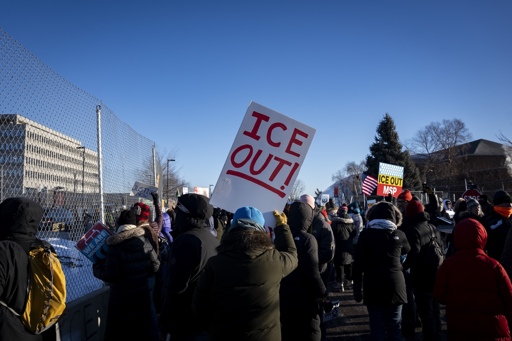
Don’t believe anyone who tells you that the fight against Trump and the Far Right is impossible. A little over a month after the start of Operation Metro Surge, and mere weeks after the murders of Renee Nicole Good and Alex Pretti, Trump’s “border czar,” Tom Homan, announced that 700 federal immigration forces were going to leave the state.
The battle isn’t over yet. There are still over 2,000 agents who will continue to terrorize the streets of Minnesota, not to mention the hundreds of local law enforcement agents who work with them. Yet, even this partial retreat was made possible not because of any sort of goodwill or bipartisanship, but forced by a community in revolt.
For over a month, federal agents have rained terror on immigrants in Minnesota, especially in the Twin Cities, in what they describe as the “largest immigration operation ever.” They’ve snatched people, including children as young as five, off the streets, from outside their homes, store parking lots, and schools. And it’s not just immigrants — agents have terrorized and even shot people who’ve tried to document their actions or get in their way.
But Minnesotans have refused to sit idly by while their neighbors and friends are kidnapped. While the whole country watched as tens of thousands took to the streets in the middle of some of the coldest days this winter, ready to shut it all down in the face of these attacks, the community is still showing up every day. Neighborhood patrols are everywhere, specially near schools. Whistle networks are activated at a moment’s notice to alert the community of ICE’s presence. Whether its raising money for rental assistance for immigrant neighbors sheltering in place or dropping food off at their homes, communities have come closer together to weather this challenge.
While sanctuary committees have formed in schools nationwide, Minneapolis has become their ultimate proving ground. Here, city schools have emerged as fortresses against ICE, anchored by a vast solidarity network of teachers, students, and parents. Forged through years of shared struggle, this network now serves as the first line of defense for immigrant families.
Eager to hear their stories, we spoke with three elementary school educators on a Tuesday afternoon.
Protecting the Community in the Classroom
The degree to which teachers and their community have been transformed by Trump’s ICE offensive has become impossible to ignore. The threat of removal, harassment, and deportation are constant. Empty desks are common as almost half their students are staying at home in the face of ICE’s terror, and teachers are adapting to a new reality of hybrid learning. For one teacher, only about a third of her class size of 26 is attending classes in person.
But what is learning in these conditions, even? One of the teachers, R, wonders out loud if she’s being a “good” teacher when she moves away from teaching the curriculum in these times. But she’s okay with it. It’s more important to her, she stresses, to hold space for her students who are living in constant fear of their families and friends being taken away and help them navigate these big feelings.
They all concur that every teacher in the school has a student who has personally experienced or witnessed someone detained or harassed by ICE. As they teach every day, ICE’s presence looms large, whether in the sound of shouts and whistles from the streets pouring in through the video call during class, or a student having to step away because ICE was on their street, in their building, or even at their door.
The impact of ICE’s repression extends far beyond immigrant families, too. It’s not just immigrants who are being targeted now — many of their Indigenous and Black students are also staying home. Long targeted by police violence, these communities understand that repression does not stop at immigration status; and that when the state escalates, it moves against all those it has historically oppressed.
But none of these teachers have stood idly by. Spurred by the initiative of some parents that the teachers have dubbed “supermoms,” teachers were quick to mobilize alongside the community as Operation Metro Surge began in December, just as winter break was setting in.
A Network Emerges
Recognizing that many of their kids’ friends and classmates were the very targets of this offensive, teachers and parents were quick to mobilize around the needs of the families who were “sheltering in place.”
What began as largely weekly deliveries of groceries and other necessities for these families, quickly grew into much more. They drive students and parents not just to and from school, but also to appointments and events. When parents have been unable to work, teachers and parents have fundraised for rental assistance so they don’t face further precariousness and eviction.
And then there’s the creativity. Whether cooking or crafts, to help generate extra income, parents have organized remote workshops with those who have skills to share. It is a complex operation, moving between spreadsheets and forms and different chats at a moment’s notice as ICE changes their tactics and forces them to change theirs. But the care never stops.
Amidst it all, teachers are in the classroom, managing their students’ the fears and confusion against their own place in the world, as educators, parents, immigrants, and neighbors. They talk about this looming presence constantly closing in. One teacher reflected, “I feel relieved that we can support families staying home. Can you imagine kids being here, constantly worried that their parents are being kidnapped by ICE? The damage happening now will last for years. This doesn’t end when ICE leaves.”
It hits closest to home for M, a Latina teacher who’s long been a citizen and raised a family here, now confronting her new reality in this place she calls home. She tells us of her son who lives out of state who implored her to carry her documents. This isn’t about legal status anymore, he reminds her; his childhood friend got picked up by ICE.
But that fear and loss picks at everyone. One of them spoke of their family members self-deporting, as well as the trials of having to teach through that pain and show up for her students. Others describe waking up at 3 a.m., scared about ICE being outside the door when she’s helping immigrant families. With the battle lines drawn, ICE hasn’t shied away from going after those who stand with immigrants either. S, a woman in her 60s, describes the fear she felt when attempting her first grocery dropoff back in December. She called R, decades her junior, to accompany her. In the time since, they’ve also found these roles reversed. It is as they say, they’re really all in it together.
It’s not possible to face this and find hope and confidence without community, they all stress. For them, it’s a community they’ve built through shared struggle. First, there was the Covid-19 pandemic, before being faced with new struggles mere months later in the face of the murder of George Floyd and a city in revolt against racist and police violence. It’s a community that was reinforced and strengthened by dancing together in the cold at the picket lines during the 18-day-long teachers’ strike in March 2022 — the first in Minneapolis in 50 years. At the time, fighting against racism and for more resources for their students, they emphasized that their teaching conditions were their students’ learning conditions. Far before Operation Metro Surge, they were already mobilizing to defend immigrant students.
Unions Must Actively Join the Fight
In Minneapolis schools, teachers are not only educating under fire, but are also helping build the infrastructure of resistance that the working class needs to survive and fight back. To defeat ICE, the labor movement has to actively join the struggle.
When unions, faith leaders, and community organizations called for a day of “no work, no school, no shopping,” teachers unions in the Twin Cities joined the call. But our unions need to do more than offer strong statements with only symbolic solidarity — they need to actively mobilize and put all of their resources toward the defense of the community, using everything in our power to defeat ICE terror.
Teachers are already doing enormous work. If the unions joined this struggle actively, schools could become bastions that centralize the resistance. Teachers acutely understand the needs of the community, interacting with them every day. Assemblies and meetings in every school could be an immense step forward in coordinating the struggle, where teachers, students, and parents can come together to not only discuss how to keep each other safe, but also what they need.
These bodies could further coordinate and centralize their response at neighborhood and citywide levels. Unions have this infrastructure in place already and could lead the charge to coordinate resources across the district. Teachers unions could work with service workers unions, and bus drivers could provide safe passage for families. Union halls and resources could go towards supporting workers and families sheltering in place, including mutual aid efforts. These committees could become the structures that coordinate not just the everyday needs and defense against ICE, but also where workers can plan and execute large days of action to actually strike and shut it all down.
We can’t put it off anymore. Trump’s first steps of retreat show the immense potential of what is possible when we stand and fight together. ICE and Trump came for immigrants — but the wall they found was the resistance in Minneapolis, which is moving a nation to action. Teachers, alongside students, parents and the community are determined to defeat ICE. As one teacher put it: “We don’t want them to go to other places; we want to defeat them here so they don’t do it elsewhere.”
The time for that resounding defeat is now.
The post Teachers Organizing Against ICE in Minneapolis Schools Are the Heart of the Resistance appeared first on Left Voice.
From Left Voice via This RSS Feed.