

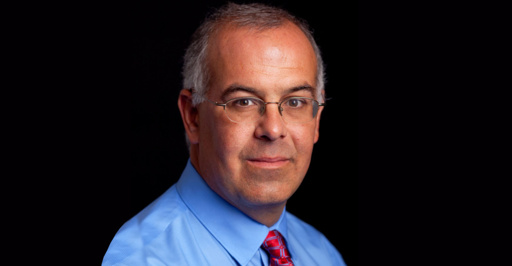

David Brooks says he’s leaving the New York Times (1/30/26) to focus on the “fundamental questions of life,” like “How do you become a better person?” Is becoming a better person something Brooks has any experience with, though?
New York Times columnist David Brooks recently announced that he was leaving the paper after 22 years to join the staff of the Atlantic. He’ll also be a presidential senior fellow at Yale University, where he will deliver lectures and host a podcast for the magazine.
His final column for the Times, “Time to Say Goodbye” (1/30/26), was a fitting end to a career defined by vapidity, self-regard and a blithe lack of introspection. Throughout his decades at the Times, Brooks has defended the powerful, denigrated the vulnerable, and decried America’s toxic political culture, the causes of which he has analyzed via tossed-off listicles.
His farewell column opened with a striking admission: “When I came to the Times, I set out to promote a moderate conservative political philosophy informed by thinkers like Edmund Burke and Alexander Hamilton,” he wrote. He added:
I have been so fantastically successful in bringing people to my point of view that moderate Republicans are now the dominant force in American politics, holding power everywhere from the White House to Gracie Mansion. I figure my work here is done.
In case you didn’t get the joke, this assertion is followed by a paragraph break and the phrase, “I’m kidding.”
Yet even the blunt acknowledgment that the defining political project of his life has failed does not prompt much introspection. In recent years, Brooks has walked back some of what he spent decades asserting—without ever quite saying, “I was wrong.”
In 2016 (2/12/16), he expressed bafflement at millennial affection for Bernie Sanders, while accidentally stumbling on its source:
In supporting Bernie Sanders they are not just supporting a guy who is mad at Wall Street. They are supporting a guy who fundamentally wants to reshape the American economic system, and thus reshape American culture and values.
He warned the misguided youth that Sanders wanted to raise their taxes, which could alienate billionaires: “When you raise taxes that high, the Elon Musks of the world find other places to build their companies.”
In 2020 (2/27/20), he equated Sanders with Trump—they respectively represent “corrosive populisms of right and left”—in a column headlined, “No, Not Sanders, Not Ever.”
Yet shortly after the 2024 presidential election, Brooks (11/13/24) pivoted to broadcasting podcast episodes entitled, “Maybe Bernie Sanders Is Right,” in which he sought to unpack “Donald Trump’s overwhelming support from working-class Americans and what Democrats can do to win them back.” That Sanders’ prescience and Trump’s appeal to working-class Americans came as a shock to Brooks, who covers US politics for a living, suggests that he has not spent much time with supporters of either.
Vanity is worse than child rape
David Brooks (New York Times, 11/14/11) noted that “Over the course of history—during the Holocaust, the Rwandan genocide or the street beatings that happen in American neighborhoods—the same pattern has emerged. Many people do not intervene.” Brooks illustrates his own point: During the current genocide in Gaza, rather than intervening, he wrote (3/24/24), “Israel’s over-the-top responses have sometimes served as effective deterrents and prevented further bloodshed.”
At the New York Times, Brooks has served as an apologist for the ruling class, whose crimes and errors of judgement he is always ready to trivialize and forgive.
In 2011 (11/14/11), Brooks wrote that it was unseemly for commentators to express outrage at legendary Penn State football coach Joe Paterno, whose reputation was tarnished once evidence began piling up that he had turned a blind eye to his assistant coach Jerry Sandusky’s serial sexual abuse of children. Brooks dismissed as “vanity” the
outraged reaction of a zillion commentators…whose indignation is based on the assumption that if they had been in Joe Paterno’s shoes, or assistant coach Mike McQueary’s shoes, they would have behaved better.
While insisting that “many people do nothing while witnessing ongoing crimes,” Brooks derided those who seek to prevent future atrocities from taking place: “When something atrocious happens, people look for some artificial, outside force that must have caused it—like the culture of college football, or some other favorite bogey,” he wrote. He added, “People look for laws that can be changed so it never happens again.”
In Brooks’ view, trying to ensure that something awful never happens again is a mug’s game. The real sin of the Penn State coverup wasn’t that college administrators chose money and athletic glory over the health and safety of children; it was that “commentators ruthlessly vilify all involved from the island of their own innocence” rather than asking, “How can we ourselves overcome our natural tendency to evade and self-deceive”? Don’t blame college football; tell ’em that it’s human nature.
Brooks has been similarly dismissive of efforts to uncover the extent of sex trafficker Jeffrey Epstein’s ties to elite figures across the globe, including the US president. Apparently nostalgic for what the Times (11/16/25) dubbed “a clubby world that is all but gone,” he used his column (11/21/25) to downplay the Epstein story, which he suggested was the province of conspiracy nuts and social media mobs.
“Say what you will about our financial, educational, nonprofit and political elites,” he wrote, “but they are not mass rapists.” He cautioned against leaping to the conclusion that Epstein was “a typical member of the American establishment,” rather than an “outlier.”
To Brooks, it’s not the girls and women who survived assaults and threats, but elite men, and even Epstein himself, who are the real victims: After all, far-right commentator Candace Owens sees Epstein not just as a “rancid man,” but “a scheming Jew working on behalf of Israel to control assets via blackmail.”
A few weeks after that column appeared, the House committee on oversight and government reform released multiple photos featuring Brooks from the Epstein estate. In writing about Epstein, Brooks failed to disclose his own ties to the convicted sex offender.
‘A plague of nonjudgmentalism’

The same New York Times columnist who thought people were too hard on football coach Joe Paterno for ignoring evidence of child rape (11/14/11), and too interested in people (like himself, he failed to note) who hung out with sex trafficker Jeffrey Epstein (11/21/25), also asserted that working-class communities had been “destroyed by a plague of nonjudgmentalism, which refused to assert that one way of behaving was better than another.” (Photo: Josh Haner/New York Times.)
If Brooks finds it nutty to scrutinize the Epstein files, and unfair to vilify Paterno, he has few qualms about blaming people with far less power for what he sees as the defects of character and culture that doom them to inferior lives.
He asserted in 2015 (3/10/15) that people struggle in high school–educated communities—as opposed to those populated by college graduates—because their communities’ “norms” have been “destroyed by a plague of nonjudgmentalism.” After all, “the health of society is primarily determined by the habits and virtues of its citizens”—and in many parts of America, “People got out of the habit of setting standards.” Fortunately, we can fix this by “holding everybody responsible.”
Lest you think he’s holding the poorer and less educated to a higher standard than he does his own elite colleagues and peers, Brooks hastened to add that “America is obviously not a country in which the less educated are behaving irresponsibly and the more educated are beacons of virtue.” In fact, “social norms need repair up and down the scale, universally, together and all at once.” This seems difficult to accomplish without, say, holding child sex predators and their enablers accountable for their crimes.
In a Brooks column headlined “The Nature of Poverty” (5/1/15), Brooks wrote that “the real barriers to mobility are matters of social psychology, the quality of relationships in a home and a neighborhood that either encourage or discourage responsibility, future-oriented thinking, and practical ambition”—not a lack of money, housing, or decent jobs. “Until the invisible bonds of relationships are repaired, life for too many will be nasty, brutish, solitary and short,” he concluded. (Thomas Hobbes’ memorable phrase appears throughout Brooks’ work.)
For Brooks, there are clear limits to what government can do, and it’s hardly worth spending more time and money to figure out how best to help people. Unless or until they get better norms and relationships, poor people will simply have to suffer and die.
‘Mean world vibe’

“Rage,” wrote David Brooks (New York Times, 11/2/23), “blinds you and turns you into a hate-filled monster”—like those on the “hard left…who are so consumed by their self-righteous fury that they become cruel—desensitized to the suffering of Israelis, because Israelis are the bad guys in their simple ideological fables.”
Brooks may find coverage of rape rings that cater to elite men excessive and overblown, but what really bugs him are anger and meanness (1/25/24), whether in response to increasing injustice and inequality, or “because so many people have not been taught or don’t bother practicing to enter sympathetically into the minds of their fellow human beings.”
“Americans have become vicious toward one another amid our disagreements,” he asserted in 2023 (11/2/23), and “people are coping with…shock, pain, contempt, anger, anxiety, fear.” As usual, Brooks sees this not as a natural reaction to deteriorating conditions, but a mysterious character flaw.
He wishes “the hard left” weren’t so angry that they risked becoming “hate-filled” monsters but, sadly, the left consists of “people who are so consumed by their self-righteous fury that they become cruel—desensitized to the suffering of Israelis, because Israelis are the bad guys in their simple ideological fables.” Most journalists would feel the need to furnish at least one example of this alleged phenomenon, but for Brooks, it’s easier to assert without evidence.
A couple of months later, he wrote a column (1/25/24) headlined “How to Save a Sad, Lonely, Angry and Mean Society,” in which he lamented that Americans have chosen politics over morals, spirituality and culture: “We’re overpoliticized while growing increasingly undermoralized, underspiritualized, undercultured.”
In May 2024 (5/9/24), he wrote that “American society, at every economic level, is still plagued by enmity, distrust, isolation, willful misunderstanding, ungraciousness and just plain meanness.” Our “mean world vibe” continued to trouble him in 2025 (4/3/25), when he declared, “My main concern is over the spirit and values of the country.”
Despite asserting that he has “come to appreciate people who are ardent about life” (1/2/26), Brooks has repeatedly criticized passionate women. In 2007 (7/10/07), he complained that female characters in pop songs performed by women are “a product of the cold-eyed age of divorce and hookups,” and of “the free-floating anger that’s part of the climate this decade.”
Six years later, Brooks fell victim to the cold-eyed age and divorced his wife of 27 years. He then married his former research assistant, who is 23 years his junior, and aroused in him a late-blooming interest in Christianity.
‘I s****uspect’
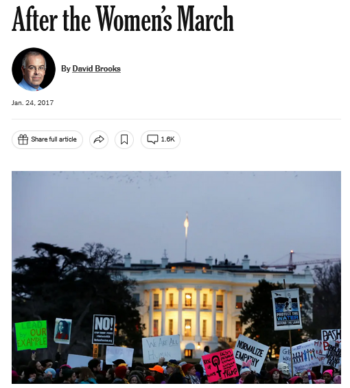
David Brooks’ first criticism (New York Times, 1/24/17) of the 2017 women’s march is that it failed to address how things like “capitalism” and “the American-led global order” are “now under assault”: “If you’re not engaging these issues first, you’re not going to be in the main arena of national life.”
Brooks imagines the people he writes about have feelings and opinions, but he doesn’t often bother to ask what they are. Of the 2017 Women’s March, he wrote (1/24/17), “The Times’ Julie Bosman was in Niles, Michigan, where many women had never heard of the marches, and if they had, I suspect, they would not have felt at home at one.” Besides not having interviewed a single woman from Niles before making this claim, Brooks appears not to have read his colleague’s story (1/21/17), which included actual quotes from actual women, many of whom “shared…disgust at Mr. Trump’s attitude toward women.”
“Over the last few decades, we in the college-educated media and cultural circles have increasingly shut out working-class voices,” he declared in 2023 (11/2/23). This mea culpa was unaccompanied by any effort to converse with, or even quote, a working-class person.
Brooks once wrote of “a friend with only a high school degree” (10/11/17) that he took to a “gourmet sandwich shop”:
Suddenly I saw her face freeze up as she was confronted with sandwiches named “Padrino” and “Pomodoro” and ingredients like soppressata, capicollo and a striata baguette. I quickly asked her if she wanted to go somewhere else and she anxiously nodded yes and we ate Mexican.
Did he ask her about this? Evidently not; the look on her face was enough for Brooks to divine that a lack of college education made his friend anxious around Italian (but not Mexican) food.
This lack of curiosity is not just a journalistic failure; it’s a larger failure to understand the world (Extra!, 9–10/08). If you do not interact with different kinds of people, you cannot understand, much less represent, their experiences. Although he frequently speculates about the causes—loss of religion, lack of humanities education, polarization, the internet—of the “meanness” that so saddens him, Brooks rarely asks Americans what they think and feel. At least Times columnist Thomas Friedman (used to) ask his cab drivers.
Innocents abroad
Brooks has spent his career denying that policy choices can meaningfully alleviate or exacerbate human suffering. He describes even decisions like the invasion of Iraq as if no human leaders were involved with, let alone responsible for, the resulting devastation and loss of life. Reflecting on his New Y****ork Times career, he wrote (1/30/26), “When I think about how the world has changed since I joined the Times, the master trend has been Americans’ collective loss of faith—not only religious faith but many other kinds.”
This is precisely the kind of hollow, bromidic, unchallenging statement for which he is renowned: comfortingly vague, superficially wise-sounding, and impossible to prove or disprove.
“The post-Cold War world has been a disappointment,” Brooks continued glibly in his Times swan song, before ticking off an apples-to-oranges list of assorted policy failures, global crises, new technologies and complex social problems:
The Iraq War shattered America’s confidence in its own power. The financial crisis shattered Americans’ faith that capitalism when left alone would produce broad and stable prosperity. The internet did not usher in an era of deep connection but rather an era of growing depression, enmity and loneliness. Collapsing levels of social trust revealed a comprehensive loss of faith in our neighbors. The rise of China and everything about Donald Trump shattered our serene assumptions about America’s role in the world.
“We have become a sadder, meaner and more pessimistic country,” he regretfully concluded. The problem isn’t rapacious capitalism, staggering inequality, reckless warmongering, or the rational fear that a person’s neighbor might harm or fail to protect them—it’s our nation’s shattered confidence and our own broken faith and assumptions.
Americans are innocent babies, in Brooks’ worldview, and he believes that the feelings “we” had in 2003—“more faith that democracy was sweeping the globe, more faith in America’s goodness, more faith in technology and more in one another”—ought to be allowed to flourish unchallenged, regardless of how differently the people who live here, and those around the world, experience America and Americanness. Other perspectives borne of other experiences are simply “meaner and more pessimistic.”
**‘**Offends potential allies’
David Brooks (New York Times, 8/13/20) looked into his crystal ball in 2020: “I’m hopeful that if given power, Biden, Kamala Harris, Nancy Pelosi and Chuck Schumer will forge a new conservative radicalism…. I’m convinced that if Donald Trump is defeated, revolutionary zealotry will fade as debates over practical change and legislation dominate.”
In his last-ever New Yo****rk Times column (1/30/26), Brooks defined “humanism” as “anything that upholds the dignity of each person.” Employing his favored technique of listing disparate people and items to illustrate a purported phenomenon, he cited as exemplars of humanism Antigone (a mythical figure), Lincoln (a US president), Tracy Chapman and Luke Combs (Grammy-winning singers), and “Martin Luther King Jr. writing that letter from the Birmingham jail.” That he then broadened his definition of humanism to include “any gesture that makes other people feel seen, heard and respected” makes this list even more absurd: Did Antigone make Creon feel seen, heard and respected?
Dr. King might have been surprised to learn that a white moderate columnist for a newspaper that once harshly criticized him for linking his “personal opposition to the war in Vietnam with the cause of Negro equality in the United States” (4/7/67) would one day approvingly cite his “Letter From a Birmingham Jail.”
One of the most famous passages in King’s letter concerns white moderates. King wrote that he had “almost reached the regrettable conclusion that the Negro’s great stumbling block in his stride toward freedom is not the White Citizen’s Counciler or the Ku Klux Klanner, but the white moderate”:
who is more devoted to “order” than to justice; who prefers a negative peace which is the absence of tension to a positive peace which is the presence of justice; who constantly says: “I agree with you in the goal you seek, but I cannot agree with your methods of direct action”; who paternalistically believes he can set the timetable for another man’s freedom; who lives by a mythical concept of time and who constantly advises the Negro to wait for a “more convenient season.”
It is difficult to imagine a more apt description of an inveterate armchair critic of social movements like Brooks. In a 2017 column (11/2/17) on sexual predators, he faulted the #metoo movement for failing to offer fun alternatives: “It is necessary but not enough to have a negative vision of what men should not do. It would also be nice if there were some positive vision of how sexuality fits into a rich life.”
Echoing the Times of 1967, Brooks (8/13/20) wrote in 2020 of Black Lives Matter:
Radicals are not good at producing change…. They also tend to divide the world into good people and bad people. They think they can bring change if they can destroy enough bad people, and so they devolve into a purist, destructive force that offends potential allies.
That it seems not to have occurred to Brooks that King considered men like him enemies of progress suggests that he has not read King’s letter in its entirety, or at all.
Power is for elites

After writing that China is “way ahead of us” on cutting edge technologies, David Brooks (New York Times, 2/14/19) explained how it got there: “It’s stealing.” Stealing from the country that is way behind it?
Brooks finds Donald Trump repellent. The president, he wrote (1/30/26), is “nihilism personified, with his assumption that morality is for suckers, that life is about power, force, bullying and cruelty.” Thanks to Trump, America—previously so moral and good!—“is becoming the rabid wolf of nations.”
Aside from conveniently eliding much of US history and global affairs, this view is at odds with other views Brooks holds, namely, that American power is good, and it’s fine and even noble to seek power, so long as you intend to exercise it wisely and justly.
Brooks (5/19/14) favors processes that are “unapologetically elitist”; “small groups of the great and the good” should make decisions for the rest of us. He sees China (2/14/19) as “a grave economic, technological and intellectual threat to the United States and the world order”; he warned that that country may soon “be able to write the rules and penetrate the fibers of our society and our lives in ways that we cannot match,” thus compromising “American identity.”
It’s hard to imagine the US responding to such a threat without resorting to the kind of power and force Brooks objects to when his opponents wield it. Power, in Brooks’ view (1/30/26), is properly the province of Americans and elites, and should be kept out of the hands of activists, who have “decided persuasion is a myth and that life is a ruthless power competition between oppressors and oppressed groups.”
Because Black Lives Matter organizers are “extremists” and “leftist illiberals” (8/13/20), only elite figures like Joe Biden, Kamala Harris, Nancy Pelosi and Chuck Schumer—who have “spent their lives within the liberal system, understand politics, understand radicalism’s advantages and dangers,” and are “drawing support from an astonishingly wide swath of the ideological spectrum”—should be entrusted with power.
Just as some countries and leaders deserve power because they are, as Brooks sees it, wise, just, rational and experienced, some people deserve compassion while others require brute force. In a column (11/2/23) calling on Americans to stop dehumanizing one another, and to be “curious about strangers” and “a little vulnerable with them,” Brooks cautioned readers not to get too carried away: “This is not a call to naïveté…. Genocidal fanatics like the leaders of Hamas just need to be defeated by force of arms.”
Undoubtedly some will miss seeing Brooks’ byline in the New York Times. Those who value clear thinking and writing will not.
From FAIR via This RSS Feed.