

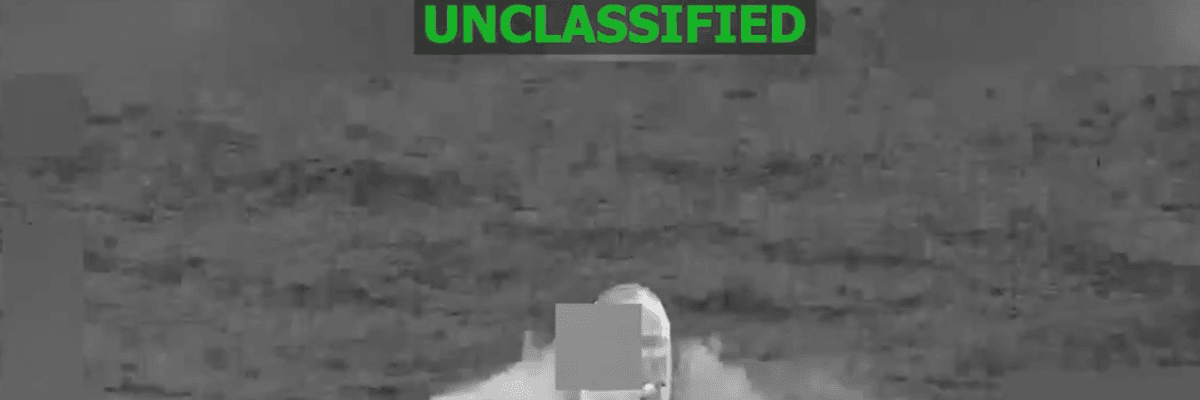
Just over a week after the families of two Trinidadian men sued the Trump administration over the boat bombings that killed their relatives, the US Department of Defense killed two more people in the eastern Pacific Ocean, bringing the total death toll to at least 128 in the White House’s operation that it claims is targeting drug traffickers.
The US Southern Command said in a social media post that at the direction of Cmdr. Gen. Francis L. Donovan, “Joint Task Force Southern Spear conducted a lethal kinetic strike on a vessel operated by designated terrorist organizations.”
As with the other dozens of strikes the Pentagon has carried out in the Pacific and the Caribbean Sea since September, Southern Command did not provide evidence for its claim that “narco-terrorists” were killed in the attack or that the vessel was traveling “along known narco-trafficking routes in the Eastern Pacific and was engaged in narco-trafficking operations.”
The White House has persistently claimed that the boat strikes are aimed at stopping drug cartels based in Venezuela from sending drugs to the US, but international and domestic intelligence agencies have not identified Venezuela as a major player in the trafficking of illicit substances—particularly not of fentanyl, the leading cause of overdoses in the US.
President Donald Trump has claimed the US is in an “armed conflict” with drug cartels. Members of Congress from both sides of the aisle have unsuccessfully sought to pass war powers resolutions to stop the administration from attacking vessels and targets in Venezuela.
Dozens of strikes preceded the Trump administration’s invasion of Venezuela and abduction of President Nicolás Maduro, whom the White House has accused of being directly involved with drug trafficking. Since attacking Venezuela, though, administration officials have all but admitted their goal in the South American country is to take control of its oil supply.
The killings of nearly 130 people in the Caribbean and eastern Pacific have been denounced as extrajudicial “murders” by numerous legal experts, and a top military lawyer at the Pentagon warned officials in August, weeks before the operations began, that carrying out the strikes could expose military top brass as well as rank-and-file service members to legal liability.
In the case of at least one bombing in September, the official who oversaw the strike told Congress that the boat was found to have been headed to Suriname, not the United States. One vessel had turned back toward Venezuela, away from the US, when it was struck.
The strike on Thursday was announced soon after Defense Secretary Pete Hegseth claimed that "some top cartel drug-traffickers… have decided to cease all narcotics operations INDEFINITELY due to recent (highly effective) kinetic strikes in the Caribbean.” Hegseth did not provide evidence for the claim.
Adam Isacson of the Washington Office on Latin America emphasized on Thursday that after killing more than 127 people in the Caribbean and eastern Pacific, the administration has nothing to show for the operation but “a collection of gruesome videos” of the bombings.
“The amount of cocaine found at the US land border keeps increasing,” he said, citing Customs and Border Protection statistics.
From Common Dreams via This RSS Feed.