

Bullets:
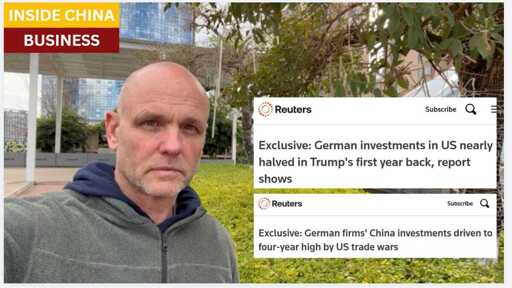
Despite the weak dollar and high tariffs, industrial companies are dramatically reducing new investments in the United States.
Surveys of German companies reveal that the policies from Washington are simply too erratic their executives to make even short-term forecasts, let alone multi-year budgeting decisions.
But their approach to China is radically different, and German firms’ investments are the highest in years.
Access to China’s deep supply chains and low energy costs are key drivers in attracting new CAPEX. But the demand side is just as compelling: The fastest-growing consumer markets in world history are in Asia, and consumers in Global Majority countries are far more valuable to goods-producing firms than the slow-growing economies of Europe and North America.
Inside China / Business is a reader-supported publication. To receive new posts and support my work, consider becoming a free or paid subscriber.
Report:
Good morning.
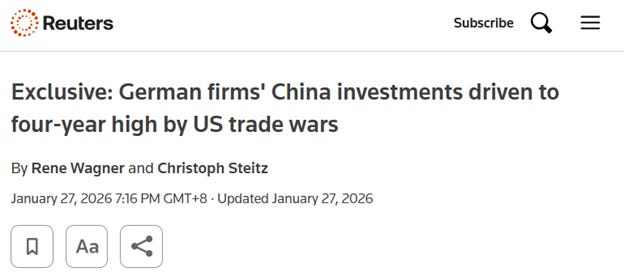
There are some deep problems with the thesis, that high tariffs will drive industries to move from China back to the United States, or to Europe. The data are coming in, and they confirm that it’s just no easy thing to decouple from China’s supply chains, or from China’s consumer demand. Two headlines about manufacturers in Germany, who are slashing investment in the United States, while dramatically increasing their Capex in China:
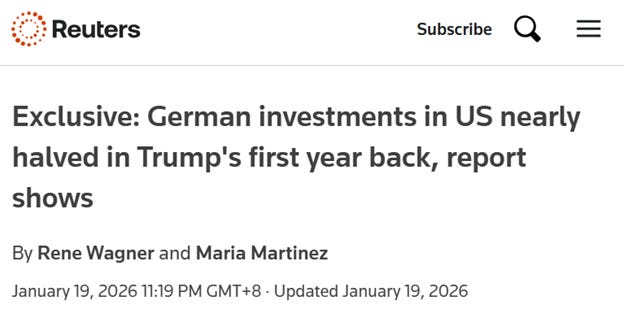
In 2025, German investment in the US was about $11 billion over 10 months, which was down about 45% from the year prior. Compared to the average over the past 10 years, German investment in the US last year was down a fourth.
The dollar is weakening, and that itself should encourage foreign investments in the United States, because assets priced in dollars cost less to foreign buyers seeking to acquire them. And the high tariffs should also encourage foreign investments in the United States, as manufacturers work to get around them. But that’s not happening, even though the tariffs are high, and the Trump Administration is threatening to raise them even more.
So while on the surface the weak dollar and high tariffs should attract new investment, the uncertainty of it all just drives long-term planners and capital budgeters crazy. Why spend a billion dollars over five years to build a factory to get around the high tariffs, if the next president lowers them in three years? Or if Trump himself does in three days? Most foreign companies aren’t going to take long-term risks when the uncertainty even in the short term is so high, and no CFO is going to risk his job if new policies render the US investments worthless. So they’re waiting.
German exports to the United States are also falling, the steepest drop in 15 years, and falling even more sharply in automotive, machinery, and chemicals.
But German firms’ approach to China is completely different. Investment in China was the highest in four years, up 55% compared to 2024. German companies are expanding here, and doing so faster. They need to strengthen supply chains, which are in China. Affordable electricity is also in China, compared to the United States, and especially compared to Europe.
But there is another problem, which is that this is where the customers are, today, and this is where tomorrow’s consumers are going to be. The fastest-growing markets in world history are here, and not in Europe, and not in North America. China today is the biggest market in the world, and will grow by another 15% by 2030. India will grow by almost half.
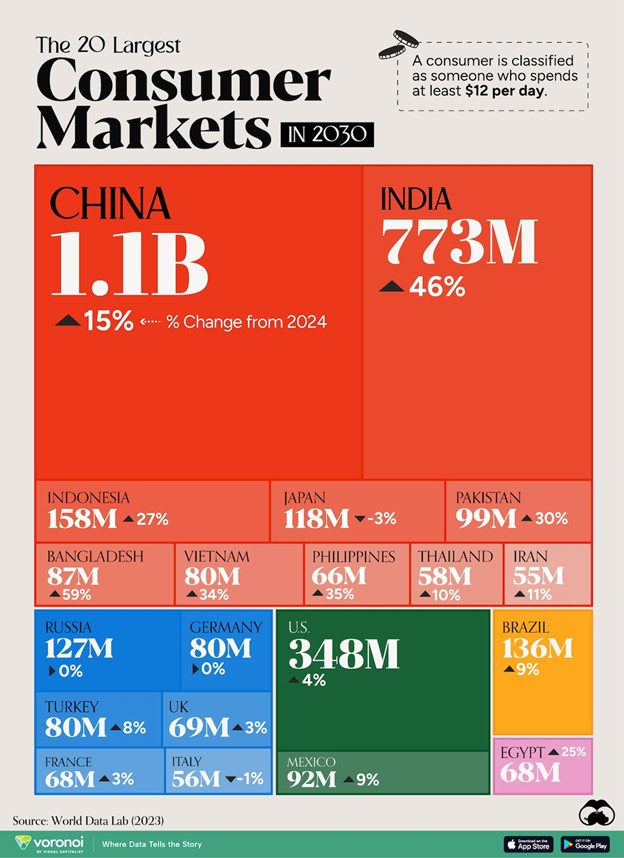
Asian countries on this graphic are in red, and the only down number is Japan—which will fall by 3%. Indonesia is on track to be the world’s fourth-largest consumer economy, and will be more valuable than Japan to goods-producing firms. Pakistan will have 100 million consumers. Bangladesh, Vietnam, Philippines, Thailand, Iran—all up by double-digit percentages.
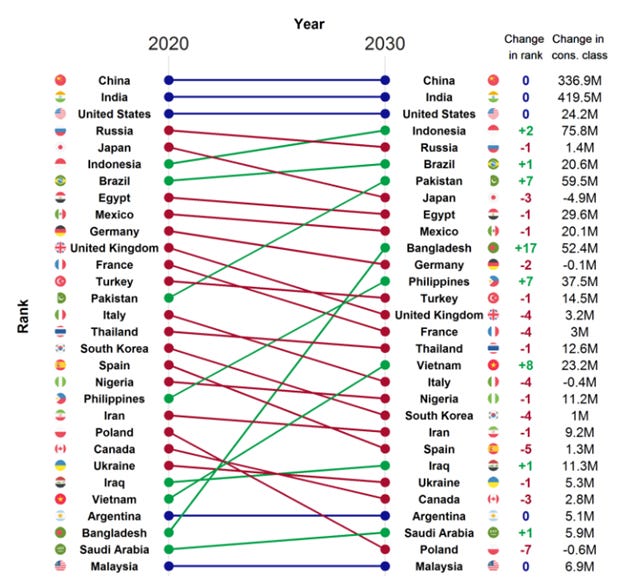
This table shows the change in rank, and the change in consumer class population over the decade. The United States’ consumer market will grow by 24 million. The growth in China will be 336 million, or 14 times as much. Indonesia will grow 3 times faster than the US. Germany’s is falling, slightly. Europe overall is holding steady, barely. But Germany is Europe’s top manufacturing economy, and all the growth is happening outside Germany. So their manufacturers have to go somewhere to find new markets.
China is the world’s top manufacturing economy, but also happens to be where the world’s customers are. So we see lots of anecdotes like this one: Ebm-pabst is a manufacturer of fans and ventilation products, and produces over 20,000 models. In 2025 the company invested 30 million euro to expand in China, because they need new capacity where their customers are, and where their new customers will be coming from. The company goes on to say that they also have plans to invest in the United States.
So we’ll see about that. Or maybe they’re waiting too.
Be good.
Inside China / Business is a reader-supported publication. To receive new posts and support my work, consider becoming a free or paid subscriber.
From Inside China / Business via This RSS Feed.