

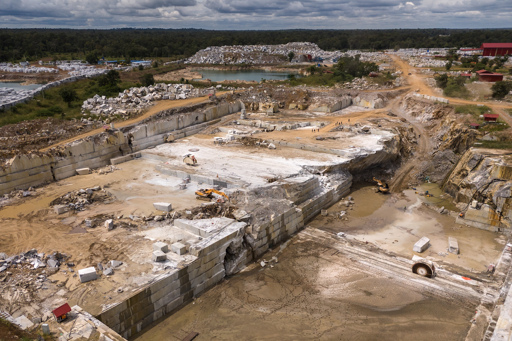
In Sre Chhuk village, a quiet patch in northeast Cambodia where the Mekong’s smaller veins trace the edge of a fading wildlife sanctuary, Vorn Pang and Sao Thorn once believed their land was safe. By 2018, officials and conservation groups had formalized their farmland as part of the Veal Kambor Community Protected Area (CPA), under a conservation model that aims to balance local livelihoods and forest protection. In return for patrolling and managing the adjoining forests of the Lumphat Wildlife Sanctuary, villagers retained rights to manage resources in a nearly 3,000-hectare (7,413-acre) “community zone” for 15 years. Their fields, they were told, were secure for years to come. That’s why it came as a shock, they said, when parts of the community zone were handed over to extractive companies starting in 2020. Vorn and Sao said they were given no compensation as marble quarries and open pits tore through their fallow rice paddies and cut into the forests where they gathered non-timber products, all in the heart of one of Cambodia’s most threatened sanctuaries. A homemade alcohol used as a remedy for intestinal ailments, brewed from three types of wood collected deep into in the wildlife sanctuary. Community Protected Areas typically allow sustainable harvesting of forest products. “A meeting was held with the Ministry of Environment and company representatives for compensation but, years later, there is still nothing,” said Pang, who recalled that the meeting took place in 2021 but was unsure which firm was responsible or who initiated the…This article was originally published on Mongabay
From Conservation news via This RSS Feed.