

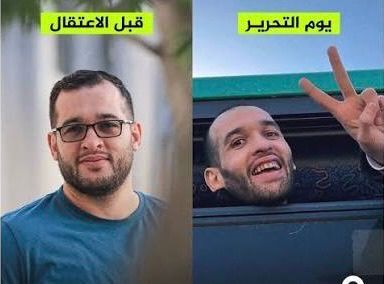

It wasn’t fear of illness that kept Palestinian prisoners away from prison clinics. It was fear of the “treatment” itself.
This is how released prisoner Ahmed Shaqoura describes the year and a half he spent in Israeli occupation prisons. According to his testimony, the medical clinic became another site of torture and humiliation, not healing.
In a testimony published on his personal account, Shaqoura recounts a journey that began with his arrest and transfer to the Jalameh military interrogation centre. There, he says, torture was immediate. He describes severe beatings, insults, and deliberate humiliation. His hands were bound with plastic zip ties tightened so harshly that his skin tore and his palms swelled.
The resulting medical neglect, he says, nearly led to the amputation of his hand. The injury still affects him today, both physically and psychologically.
Palestinian prisoners’ road to the clinic: torture in itself
Shaqoura describes his first transfer to the clinic as an act of humiliation in itself. Handcuffed and shackled, he was forced to walk on his knees.
Every minute on that journey, he says, felt longer than a lifetime. The pain was not only physical, but a deliberate crushing of dignity.
When he arrived, there was no doctor in the usual sense. He recalls:
It was a torturer in a white coat
The man pressed violently on the wound, hurled insults, wrapped it hastily, and coldly told him to leave. This was not treatment, but a message: the pain was intentional.
Even when an interrogator noticed the swelling and ordered medical attention, nothing changed. Complaints were pointless. Shaqoura says:
They are eloquent in their words, but ineffective in their actions
Ofer Prison: medicine as oppression
After his transfer to Ofer Prison, conditions worsened.
During his first visit to the doctor there, one of his teeth broke. At the doctor’s request, a guard climbed onto Shaqoura’s back. The weight pinned him to the ground. The doctor then attempted to strike his eyes with an iron ruler, hitting his forehead instead.
According to Shaqoura, this was not an isolated incident.
He recounts the case of another prisoner suffering from haemorrhoids who repeatedly begged for care. When finally taken to the clinic, the man was beaten and dragged back bleeding.
Guards mocked him as they pulled him along the ground, saying: “This is how we treated you.”
Paracetamol — and silence
In another incident, many prisoners developed painful boils. Shaqoura was among them.
His hand swelled to seven times its normal size. The pain was unbearable. Nights passed with cries for help unanswered.
There was no doctor, no response, and no concern. He says:
The only treatment was paracetamol — and a lot of silence.
He also describes other doctors who openly beat prisoners, treating them not as patients, but as targets for violence.
An unforgettable scene
One of the most harrowing moments in Shaqoura’s testimony occurred after a prisoner was killed by guards in a nearby section.
At dawn, the body was brought in and placed in a black bag in front of the cells. The corridor echoed with laughter and mockery. Shaqoura said:
The guards joked “Tie him up tight, so he doesn’t run away.” At that moment, I felt even the night was ashamed of us.
Why Palestinian prisoners fear the clinic
Shaqoura ends his testimony with a clear answer. Prisoners do not refuse treatment. They fear the clinic because it is not a place of healing.
In the reality of occupation prisons, the clinic is an extension of the system of oppression. A space meant to protect life becomes another station of suffering, where pain is policy and humiliation is routine.
This is not an isolated account. It reflects the lived reality of thousands of prisoners, where human values are stripped of meaning and even medical care becomes a weapon.
Featured image via author
By Alaa Shamali
From Canary via This RSS Feed.