

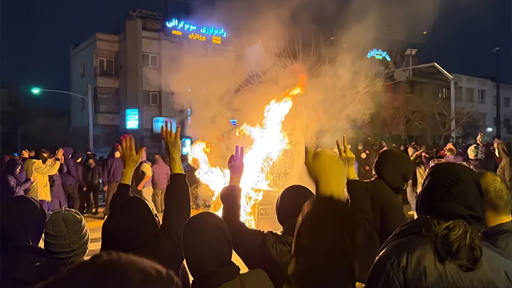
In the first weeks of January, forty-seven years after a general strike initiated the Iranian revolution, working people across Iran forced their way back into international headlines. Precarious youth with no future, women emboldened by years of feminist struggle, small business owners crushed by inflation, Kurds, mothers of murdered activists, and retirees rose up as soaring prices and falling wages made survival harder by the week. The economic crisis worsened through the fall, especially with the United States reimposing snackpack sanctions in late September. While regime-linked firms and banks were insulated from the crisis, most households faced higher food prices, shrinking incomes, and savings that were being eaten away by inflation.
This anger from below broke into the open and the regime moved quickly to contain it. Security forces answered demonstrations with mass arrests and live fire. According to the Human Rights Activists News Agency (HRANA), by the thirty-sixth day of protests 6,842 people had been killed — including 146 children — more than 26,000 arrested, and over 11,000 injured across 207 cities nationwide.
Alongside this repression, officials deployed a narrative weapon. Alarmed by a movement that grew out of economic grievances and began to question the regime itself, Iranian officials rushed to brand the protesters “foreign agents.” In fact, on X, Khamenei insisted that “this sedition was designed abroad and run from abroad,” rejecting any account of the unrest as a response to declining living standards and political repression imposed by the regime itself.
Despite their sharp rivalries and very different positions of power, both the Iranian regime and U.S. imperialism responded to the uprising in ways that ultimately converged. In Tehran, officials answered demands for bread and freedom with bullets, mass arrests, and a media campaign that branded demonstrators as “seditionists” and agents of the CIA and Mossad, smearing truck drivers and students into supposed shock troops of foreign powers. In Washington, Trump looked at the same crowds and did not see workers and youth risking their lives against a dictatorship, but an opening to weaken a rival state.
His administration tightened sanctions that had already slashed wages and emptied shelves, betting that harsher misery might crack the regime. When this pressure-cooker strategy failed to bring the clerics to their knees, the White House shifted to aircraft carriers, missile threats, and talk of ‘all options on the table,’moving the center of gravity from the streets of Ahvaz and Mashhad to the corridors of the Pentagon. In both cases, the concrete experience of people fighting over prices, jobs, and repression was pushed into the background, replaced by a script in which only governments, generals, and negotiating teams appeared as the real actors.
A Social Crisis in the Making
The latest protests are part of a cycle of revolts that began with the “Bread, Work, and Freedom” demonstrations in late 2017, when the working class reemerged as a political force in response to rising food prices, unpaid wages, and the collapse of the reformist promises of the Rouhani government, whose pact with the devil in the nuclear deal only meant “sanctions relief” for the ruling elite by stabilizing the profits of state-linked capital and commercial sectors, without improving the daily living conditions of the majority.
Then, in 2018, Trump’s “maximum pressure” sanctions became the context in which the regime made the working class pay for imperialist pressure through increases in fuel prices, subsidy cuts, and wages crushed by inflation, a course that exploded into the November 2019 national fuel protests. Three years later, the crisis of livelihoods and the crisis of legitimacy converged openly in the “Woman, Life, Freedom” uprising of 2022.
Between these explosions, the working class has continued to organize—in the strikes of Haft Tappeh workers, the national mobilizations of teachers and retirees, the struggles of Tehran bus drivers, and the repeated strikes of contract workers in the oil and petrochemical sectors—often through informal coordinating bodies and nascent forms of self-organization that revive, in embryonic form, the idea of workers’ councils (shoras).
From these accumulated experiences of revolt and workers’ action, a broader social movement has emerged that confronts the regime. It still lacks coordination, organization, and a unified set of demands, but it is rooted in an intolerable social situation and shows no signs of disappearing.
In the context of a society that has gradually gained confidence in its own capacity for resistance, the crisis in Iran has not abated but has intensified, as the 12-day war with Israel in June 2025 disrupted trade and finance, and the reimposition of UN sanctions in September triggered a new round of economic shock therapy overseen by the so-called reformist wing of the regime, represented by Pezeshkian, which shifted the costs of the crisis to the population through subsidy cuts, rising energy prices, currency collapse, and wages crushed by inflation.
The social divide is reflected in everyday life,as reported by international media on families forced to sleep on rooftops after renting out their homes and households buying cooking oil on credit, while the regime’s elites ensure a comfortable life for their children in the very “Western” countries they claim to despise.
The Art of Bourgeois Containment in Iran
This contrast between misery and privilege has its roots in the counterrevolutionary outcome of the 1979 revolution. From its inception, the Islamic Republic took shape as a project to stabilize capitalist rule by thwarting the development of workers’ power and independent organization that had begun to emerge through the shoras.
These council-like bodies, initiated by oil workers, came to coordinate the general strike that overthrew the deeply unpopular, U.S.-backed dictatorship of the Shah. They were then systematically dismantled as clerical rule consolidated amid a political vacuum.
The consolidation of clerical rule was not just an internal process. Despite the Islamic Republic’s “anti-imperialist” rhetoric, many popular accounts of the revolution obscure how the imperialist powers, after losing their client regime, acted to contain the danger of a workers’ revolution and ultimately accommodated the new clerical state as a bourgeois lesser evil.
Episodes such as the Iran-Contra scandal—in which Washington covertly supplied weapons to Tehran while publicly presenting it as an enemy—revealed how quickly “anti-imperialism” gave way to quiet cooperation once the priority shifted to blocking revolutionary instability in the region.
That counterrevolutionary logic did not end with the consolidation of the clerical regime. It continues to determine how power is exercised today. The Trump and Khamenei regimes occupy opposite positions in the world system: one as the head of an imperialist power and the other as the ruler of a subordinate and sanctioned capitalist state. However, this difference does not prevent them from sharing a common concern today: the fear of a popular uprising that could escape their control in Iran and threaten the social order from which they both benefit.
Perhaps it is this fear that drives the regime to resort to brutal repression to protect itself at all costs, and which also explains Trump’s hesitation to commit to open confrontation in a country marked by vivid memories of U.S. intervention and a long tradition of popular uprisings.
This is also reflected in the nervous diplomacy of the Gulf monarchies, which are quick to warn against “destabilization,” and in Netanyahu’s oscillation between belligerence and moderation, aware that a regional war could trigger unrest not only in Iran but throughout the region.
Beyond the current regional crisis in the Middle East, Trump faces a deep social crisis of his own making at home. The historic mobilizations against ICE that erupted in Minneapolis and spread to other cities following the killing of two activists by federal immigration agents have revealed how fragile the social order within the United States itself has become.
The situation appears to have cornered Trump and has already forced him to fire one of his key political allies, Greg Bovino, general commander of the U.S. Border Patrol. This internal instability helps explain Trump’s caution toward any course of action in Iran that could further destabilize an already explosive social situation in his country.
Although Trump’s internal crisis has reduced his room for maneuver, it has not stopped Washington’s efforts to exploit the current confrontation with Iran to its own advantage, especially at a time when U.S. authority is eroding globally. However, Trump has so far oscillated between rhetorical threats, military demonstrations, and signs of possible negotiation, rather than a coherent campaign. As in the recent escalation against Venezuela, coercion and spectacle are being used to mask the absence of a long-term solution to the contradictions currently facing U.S. imperialism, contradictions that have their origins both in the long-term crisis of capitalist profitability and in the rise of rival powers such as China.
Alongside Trump’s shifting arsenal of maneuvers, a parallel ideological offensive is brewing, as the media and political elites peddle prefabricated answers about what should happen in Iran. For some, the solution is the restoration of the monarchy or some kind of regime under Reza Pahlavi: not the empowerment of the masses, but the replacement of the clerical elite with a royal one, anchored in networks of exiles and foreign patronage.
Monarchical restoration is sold as “freedom.” But every time “freedom” has been imposed from above in the region, it has meant foreign-backed rule and repression. In Iraq, the overthrow of Saddam Hussein led to occupation and civil war. In Libya, NATO’s removal of Muammar Gaddafi brought militias and lasting instability.
Iranian monarchists are asking Iranians to forget their own history. In the 1920s, Reza Shah came to power with British backing to crush strikes and peasant revolts that spread in the wake of the Russian Revolution. In 1953, a coup backed by the CIA and MI6 restored his son Mohammad Reza Shah to power to block a mass movement fighting to nationalize Iranian oil. What followed was not democracy, but twenty-five years of dictatorship enforced by prisons and the CIA-trained SAVAK. Today, the same solution is being recycled. Reza Pahlavi has no popular mandate within Iran; his support comes mainly from sectors of the diaspora and foreign political circles.
Behind the resurgence of the sun and sword flag, therefore, lies a family project: not self-government for those who are now fighting, but a transition from above designed to contain the independent organization of workers, women, and youth. The monarchist project is not the only false solution being promoted. A second version of the same logic appears in proposals put forward by leading human rights NGOs and European officials.
While monarchism offers a king in exile, this current offers a transition managed by diplomats and courts. Both reduce a social uprising to a problem of governance and legality—calling for the terrorist designation of the IRGC, tougher sanctions, and a negotiated settlement through international law—while shifting the struggle from the hands of those on the streets to institutions whose priority is to preserve the existing economic order and their own geopolitical influence.
Others defend the current government in the name of opposition to the United States, treating repression as something that must be accepted. This logic also appears in debates within the pro-Palestine movement, where some currents present Iran as a progressive regional force simply because it appears to “confront” the United States and Israel. Yet, condemning this massacre does not require supporting foreign intervention. It requires supporting those within Iran who are risking their lives to change society themselves.
There is no doubt that imperialist and Israeli intelligence agencies seek to intervene in the crisis in Iran. But the protests cannot be reduced to the Mossad or the CIA. The effect of doing so is political: a social uprising rooted in inflation, unemployment, and state violence is reconfigured as an external conspiracy, and the independent action of workers, women, and youth disappears from view.
The Only Way Forward
If the protests in Iran arise from inflation, repression, and the problems of everyday life, then their outcome cannot be determined without those who are already risking their lives in the streets. This is precisely what the dominant proposals seek to prevent: whether through monarchical restoration, diplomatic transition, or repression justified in the name of “anti-imperialism,” each functionally blocks the transformation of a revolt into an independent class force.
These attempts to manage the crisis in Iran from above are part of a broader context: an era of wars, sanctions, and authoritarian turns in which class struggle—which is becoming a more active feature of the political situation—has begun to reappear on the scene. Even in the imperialist centers, where the ruling classes seek to discipline populations through repression and racism, revolt has begun to seek collective forms. In Minneapolis, outrage over state violence and deportations was organized across neighborhoods and workplaces, turning fear into mass mobilization and provoking a political crisis from below. In Italy, port and transport workers used strikes and blockades to oppose the genocide in Palestine, disrupting “normality” and demonstrating that solidarity can become a material force.
These experiences do not offer a model to be imitated, but they point to a common logic: when repression closes the streets, the struggle seeks other levers: withdrawal from work, collective coordination, mutual protection networks. It is not unreasonable to think that, under much harsher conditions, something similar could emerge in Iran. In the face of scattered protests and brutal repression, the need to unite struggles, defend each other, and continue the revolt could revive, out of necessity, the spirit of the shoras.
In a region marked by genocide in Palestine and violent repression of the Kurds in Syria, this is the only internationalism that makes sense: not alliances between states, but unity among the exploited and oppressed across borders. Against imperial domination and against regimes that repress in the name of “resistance,” the rebirth of self-organization—widespread and extending beyond any particular sector—is the only force capable of confronting dictatorship, war, and exploitation at the same time.
The real question, then, is not which ruler or diplomatic formula will replace the current one, but who will decide. Will the next chapter be written by Trump’s generals, European diplomats, and the IRGC, or by the masses themselves? Iran’s freedom will not be brought about by foreign capital or new strongmen. It can only be won by Iranian workers and youth organized from below.
The post Between Social Revolt and Geopolitical Crisis: Who Will Decide Iran’s Future? appeared first on Left Voice.
From Left Voice via This RSS Feed.