

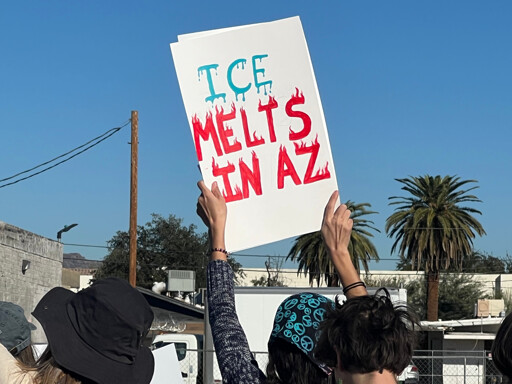
On Saturday January 31, thousands of students, teachers, workers, elderly people, families, organizations, and community members went on strike and took the streets of Tucson. This was an act of solidarity with the workers and immigrant communities in Minneapolis who are resisting ICE.
Under the slogan “no work, no school, no shopping,” high school students and students from the University of Arizona, along with community organizations, called for the strike to demand “ICE out of Tucson.” Local businesses like La Michoacana, Café Tres Leches, and other Latino-owned establishments also participated by suspending sales of their products and actively urging their customers to join the strike.
They were joined by teachers from the Tucson Education Association (TEA) who, despite not being called upon by their leader Jim Byrne, staged a work stoppage at 21 schools in the city. The teachers marched alongside students, workers, families, and the community through the streets of downtown Tucson, from Catalina Park to the capitol. “If we use our influence as workers, today we demonstrate that we can shut everything down,” declared math teacher Finlay Parsons from Tucson High School.
Following the community’s strong participation in the event, it was announced that mobilizations, informational workshops and activities against ICE will continue. In the city and the Arizona-Sonora border area, there is a strong presence of Mexican-American families, as well as a syncretism between Latin and Anglo-Saxon cultures. Daily, thousands of goods and people cross the border — legally and illegally — in both directions for school, work, and/or commercial reasons. Tucson is a city that shares territory with Nogales (Sonora), where immigrants make up more than 16 percent of the population.
Minneapolis, an Example to Follow
Following the brutal murders of activists Renee Nicole Good and Alex Pretti at the hands of ICE agents, Minneapolis and St. Paul have become the forefront in the fight to defend immigrants against Donald Trump’s terror policies. On January 23, a mass wildcat strike paralyzed both cities, with over 50,000 people taking the streets despite temperatures below 20 degrees. Despite many unions refusing to take up the second week of action, the January 31 protests showed that there are no signs of the immigrant rights movement losing momentum.
On the contrary, this historic struggle has already achieved a partial but very important victory with the dismissal of Greg Bovino and his withdrawal from Minneapolis.
The city that in 2020 saw the birth of the powerful Black Lives Matter movement after the brutal police murder of George Floyd, today applies active defense of its neighbors and worker solidarity as a strategy against ICE and Trump. As Daniel Kóvacs and Lilia Walters explain it:
BLOCKQUOTE/Communities have taken up the defense of their neighbors against ICE. Teachers, social workers, parents, and educators are making sure students continue to get the education they deserve. In doing so, they draw on worker and community solidarity from a reservoir that only deepens when used, defying a logic that counterposes the interests of the working class and the oppressed. Recently formed community groups, including education workers, organize grocery runs and food preparation so their students’ families can eat and stay safe in their homes. […] More significantly, in the last month several stores have helped protesters recover from clashes with ICE or shelter those targeted by immigration officials. One restaurant even opened its doors to the community, converting to a free kitchen where anyone (except federal agents) can come in and get a meal./BLOCKQUOTE
The idea of a general strike is in the air and permeates the consciousness of millions of people across the United States, as the most effective method to fight against the violence of the capitalist, racist, and imperialist state. However, leaders of national unions such as Shawn Fain of the United Auto Workers, as well as Communications Workers of America and American Federation of Government Employees — the latter of which Alex Pretti was a member — have limited themselves to moderate statements aligned with the typical diversionary politics of the Democratic Party.
Democrats and their main figures seek to channel discontent against ICE through legal and electoral means, as their greatest fear—along with republicans and capitalists—is that the situation escalates into an “uncontrollable” scenario where the multiethnic and multiracial US working class takes a hegemonic role and overcomes the control of union bureaucracies.
Growing Discontent and Organization in the Southwest
In addition to Tucson, mobilizations are being organized in other cities in front of ICE offices, and community organization is advancing against the increasing raids and operations in the region.
Recently in Phoenix, organizations including Puente Human Rights Movement, Phoenix Legal Action Network, and Borderlands Resource Initiative held a training workshop with over 600 volunteers against raids, supported by lawyers, interpreters, and migration specialists.
In Texas, after the defeat of Republican Leigh Wambsganss, a Trumpist candidate in the elections of the ultra-conservative Tarrant County, hundreds of high school students from Manor took to the streets to express their rejection of ICE and solidarity with immigrant communities and Minneapolis.
In California youth, workers, and communities are also continuing to raise their voices and engaging in strong clashes against the police. In the city of Escondido in San Diego, high school students took to the streets to reject ICE’s presence in their communities after federal agents and vehicles were confirmed in the area.
They were accompanied by teachers from the Association of Raza Educators and members of Unión del Barrio, who recently also supported the young man Anthony Paredes, an 18-year-old deaf youth who was detained and beaten by Department of Homeland Security (DHS) agents during a protest in Los Angeles.
The deep ties that exist between teachers, students, families, and the community in general are some of the most encouraging elements of the labor movement and the current situation. The experiences of community organization and trends toward worker solidarity in Minneapolis, Chicago, California, New York, Arizona, and other states are not isolated events but new chapters in the history of class struggle in the heart of imperialism.
From Left Voice and La Izquierda Diario at Sonora and Mexico, we express our full support to the students, teachers, workers, activists, and organizations in Tucson and the US Southwest who are raising their voices and organizing against Trump, ICE, and the capitalists. We open the pages of our media outlet and put our humble forces at their disposal to strengthen their struggle, for on the Mexican side of the border there are also teachers, students, unions, workers and communities fighting and resisting U.S. imperialist oppression on Mexican soil.
Your struggle is our struggle. The working class is one and without borders!
This article was first published in Spanish on February 3 in La Izquierda Diario México. It was translated and lightly adapted for a U.S. audience.
The post Tucson Mobilizes against ICE in Solidarity with Minneapolis appeared first on Left Voice.
From Left Voice via This RSS Feed.