

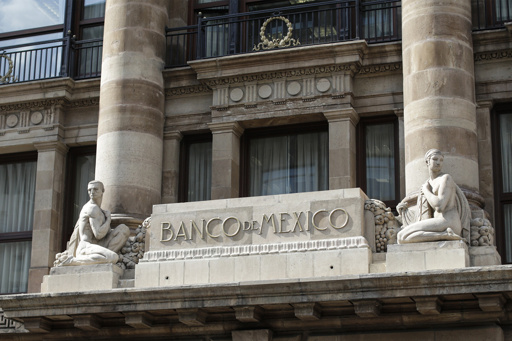
This article by Arturo Huerta González originally appeared in the February 3, 2026 issue of La Jornada de Oriente, the Puebla edition of Mexico’s premier left wing daily newspaper.
On January 27, 2026, the President of Mexico met with bankers and stated that “access to credit has been one of the historical limitations to economic growth,” and that “efforts are underway to facilitate access to credit , especially for small and medium-sized enterprises, without jeopardizing the financial system, enabling them to grow.” It should be noted that the risk to the financial system stems from the high interest rates set by the Bank of Mexico (Banxico) and the banks, as well as the budget cuts implemented by the Ministry of Finance, which are hindering economic activity. This has led to national income growth falling below the interest rate, increasing the difficulty of servicing the debt and jeopardizing banking stability.
Credit depends on the performance of the economy. The contraction of the domestic market, which generates underemployment, poverty, and growing income inequality as a result of prevailing policies, means there is no demand for loans from the private sector for investment. Banks are not expanding credit because they lack guaranteed repayment. Therefore, unless the government addresses the contraction of economic activity, credit will not increase despite the President’s appeals to bankers.
If the government truly wants to increase credit availability, it must change its fiscal policy of budget cuts, since these are the cause of market contraction, leading to a lack of demand for and supply of credit.
The President should look back to a time before neoliberalism, when the government controlled the central bank, regulated the banking sector in favor of the industrial and agricultural sectors, and protectionist policies prevailed in favor of productive development and employment.
At that meeting, the monetary authorities themselves indicated that “uncertainty surrounding trade relations with the United States and the review of the USMCA could affect the economy, and therefore they continue to warn of downside risks to growth.” This should compel them to change their monetary policy, since high interest rates discourage productive investment and further weaken the economy’s ability to cope with the adversities that will be exacerbated by the USMCA review.
Economic policy must create conditions for growth and profit in the productive sector so that investment and credit increase, thus overcoming the stagnation in which the national economy finds itself.
The government should send a bill to Congress to modify the Bank of Mexico’s objectives, introducing, in addition to low inflation, the goals of economic growth and high employment , as is the case in the United States. This would require lowering the interest rate to move towards achieving these objectives. The lower interest rate would reduce financial pressures on the public sector, businesses, and heavily indebted families , allowing them to increase their spending and investment capacity and thus resume the economic activity desired by the president and the entire country. This bill should also include provisions for the central bank to purchase government debt directly, enabling the government to spend what is necessary to boost employment, promote import substitution to reduce the trade deficit, and decrease dependence on capital inflows.
The expansion of public spending and the reduction of the interest rate would create conditions for economic growth, where national income grows above the interest rate, thus increasing the demand for and supply of credit to boost productive investment and also avoiding insolvency problems.
The banking sector needs to be regulated, as it was in the 1940s, 50s, and 60s, when cheap credit was granted to industry and agriculture, boosting economic growth. As long as banking remains deregulated, it will continue to be detrimental to growth and generate high profits at the expense of debtors, both in the public and non-financial private sectors.
Rather than meetings with bankers to increase credit and with economists who do not question monetary policy, fiscal austerity, and the USMCA, the government should implement the policies that prevailed from the late 1930s until 1981, when the economy grew at an average annual rate of 6.4%, when the government controlled the central bank, regulated the banking sector in favor of the industrial and agricultural sectors, and protectionist policies prevailed in favor of productive development and employment.
-

Credit Crunch
February 5, 2026February 5, 2026
As long as Mexican banking remains deregulated, it will continue to be detrimental to growth, generating high profits at the expense of debtors, both in the public and non-financial private sectors.
-

In 2025, 297 Businesses Polluted Mexico’s Atoyac River & Were Only Fined An Average $1,800 USD Per Offender
February 5, 2026
While Puebla’s Water Agency uses fines to settle debts, the Atoyac River continues to receive discharges from factories that pay a minimal cost for failing to comply with wastewater regulations.
-

Aceves del Olmo Leaves CTM, PRI’s Labour Wing, After a Decade
February 5, 2026February 5, 2026
The leadership of Mexico’s largest trade union federation has traditionally, and controversially, been a lifetime position.
The post Credit Crunch appeared first on Mexico Solidarity Media.
From Mexico Solidarity Media via This RSS Feed.