

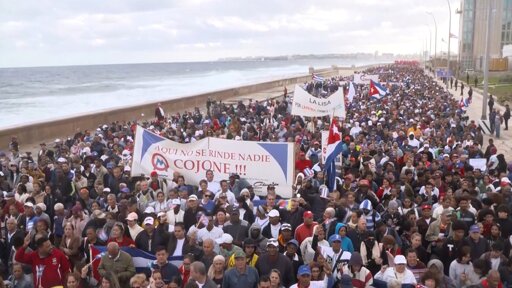
On January 29, the White House issued an official statement declaring a national emergency in the United States because, it claims, “the policies, practices, and actions of the Government of Cuba constitute an unusual and extraordinary threat, which has its source in whole or substantial part outside the United States, to the national security and foreign policy of the United States.”
According to the statement, the Cuban government “aligns” itself with hostile countries, terrorist groups, and “malign actors adverse to the United States,” which the White House considers to include Russia, China, Iran, Hamas, and Hezbollah. Several analysts believe that these justifications do not imply that Cuba is a threat to US national security.
However, beyond the reality behind this or that suspicion, the Trump administration, based on these justifications, has decided to economically suffocate the Cuban government, which, since 1959, the year the Revolution triumphed, has been considered by Washington a fundamental target to be eliminated.
Cuba is currently subject to the longest economic and commercial blockade in contemporary history, imposed unilaterally by the United States. It has been condemned and rejected dozens of times by the almost absolute majority of the world’s countries in the United Nations.
Now Washington seeks to further suffocate Cuba’s small economy, which, in its own way, has managed to withstand punishment from the most powerful country on the planet for more than 60 years. According to the statement, the alleged threat from the small Caribbean country authorizes US authorities to impose new tariffs (the amount is not specified) on products from countries that sell or offer oil to Cuba.
Trump’s goal is clear: to overthrow the government in Havana. Following the White House announcement, Trump told the press: “It looks like it won’t be able to survive. Cuba won’t be able to survive.”
Rejection and condemnation by Cuban authorities
The measure has been strongly rejected by the Cuban authorities. The country’s president, Miguel Díaz-Canel, said: “Under a false and empty pretext, sold by those who make politics and enrich themselves at the expense of our people’s suffering, President Trump intends to suffocate the Cuban economy by imposing tariffs on countries that sovereignly trade oil with Cuba. Didn’t the Secretary of State and his harlequins say that the blockade did not exist? Where are those who bore us with their false stories that it is simply an ‘embargo on bilateral trade’?”
He added: “This new measure highlights the fascist, criminal, and genocidal nature of a clique that has hijacked the interests of the American people for purely personal gain.”
For his part, Cuban Foreign Minister Bruno Rodríguez posted on X that Cuba does not pose a threat to the United States: “To justify [the new measures, the United States] relies on a long list of lies that seek to portray Cuba as a threat that it is not. Every day, there is new evidence that the only threat to peace, security, and stability in the region, and the only malign influence, is that exerted by the US government against the nations and peoples of Our America, which it seeks to subjugate to its dictates, strip of their resources, mutilate their sovereignty, and deprive them of their independence.”
Rodríguez also pointed out: “The US also resorts to blackmail and coercion to try to get other countries to join its universally condemned policy of blockade against Cuba, threatening those that refuse with the imposition of arbitrary and abusive tariffs, in violation of all free trade rules. We denounce before the world this brutal act of aggression against Cuba and its people, who for more than 65 years have been subjected to the longest and cruelest economic blockade ever imposed on an entire nation and who are now promised to be subjected to extreme living conditions.”
A new economic threat to Cuba’s partners
The measure seeks to encourage countries that still offer aid to the blockaded island to reconsider their position regarding the revolutionary government. Even prior to the invasion of Venezuela on January 3, Cuba had lost its main energy partner when Washington imposed a naval blockade on Venezuela. Cuba is now experiencing an energy crisis as a result of the US economic blockade, which has intensified after Washington forced the Venezuelan authorities to cut off the supply of hydrocarbons to Cuba.
Read more: Trump’s ultimatum to Cuba: no fuel until surrender!
Among the countries that collaborate with Cuba on energy matters is Mexico, which many analysts believe is the main target of Washington’s “warning”. Russia and China could also be affected if they decide to continue their collaboration with Cuba.
For now, Claudia Sheinbaum, president of Mexico, has said that aid to Cuba will continue in such a way that it does not “put Mexico at risk”. She said she will request more information from the US State Department on the scope of this measure, but that she will not abandon the “tradition of solidarity and respect” that Mexico has maintained with all Latin American countries. “The application of tariffs could trigger a far-reaching crisis, affecting hospitals and food supplies, a situation that must be avoided in accordance with international law,” said the president.
Indeed, within the framework of this new form of US foreign policy, Cubans will undoubtedly be the most affected. The civilian population could find itself in dire straits without transportation and electricity, which compromise the most fundamental aspects of people’s lives.
This was stated by Jorge Legañoa, president of Prensa Latina: “What is the goal? The goal is genocide of the Cuban people, and if the tariffs are implemented, the effect would be to paralyze electricity generation, transportation, industrial production, agricultural production, the availability of health services, water supply … in short, all spheres of life.”
The post The US is using “blackmail and coercion” to intensify the blockade, says Cuba appeared first on Peoples Dispatch.
From Peoples Dispatch via This RSS Feed.