

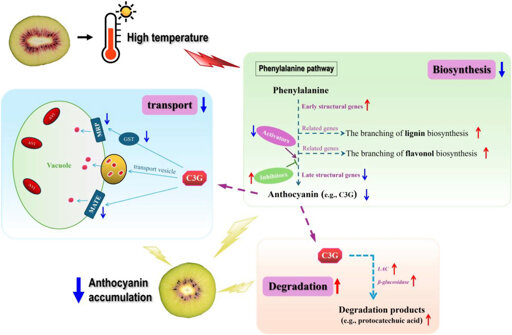
Red-fleshed kiwifruit, valued for its high anthocyanin content and associated health benefits, is increasingly threatened by rising temperatures. Global warming severely inhibits anthocyanin accumulation, leading to flesh discoloration and nutrient loss, directly compromising fruit quality and the sustainable development of the industry. To address this challenge, researchers from the Wuhan Botanical Garden of the Chinese Academy of Sciences used “Hongyang” kiwifruit to simulate high-temperature stress (30°C, 35°C, 40°C, compared with a 25°C control).
From Biology News - Evolution, Cell theory, Gene theory, Microbiology, Biotechnology via This RSS Feed.
You must log in or # to comment.