

On January 23, tens of thousands of people participated in a massive day of action that went beyond a traditional mobilization. The call was not only to take to the streets, but to disrupt the economy through a day of “no work, no school, and no shopping.” While many unions endorsed the action and expressed solidarity, they made clear that they would not call on their large memberships to strike. In the best cases, union leadership encouraged workers to participate by taking the day off or using individual tactics, without guaranteeing union protection. As a result, thousands of workers were left to take action on their own initiative, calling out of work and joining strike actions independently.
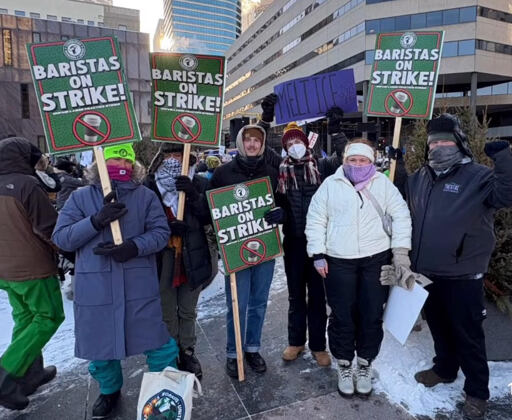
Even so, the call to participate on January 23 as workers — using our strongest weapon, the shutdown of workplaces — sparked conversations across the Twin Cities and beyond. Starbucks workers were among those who answered that call. Starbucks Workers United (SBWU) called for an Unfair Labor Practice strike that Friday as part of its broader contract campaign. This allowed workers to participate in the larger day of action while standing in solidarity with their immigrant neighbors and the growing movement to kick ICE out of Minnesota. That day, workers at eight Starbucks stores across the Twin Cities metro area went on a strike – six unionized stores and two non-union stores.
Anger at ICE’s terrorizing actions — particularly in immigrant neighborhoods and workplaces — intensified following the murder of Renee Nicole Good, a legal observer and community member who dedicated herself to monitoring ICE activity and standing in solidarity with immigrant communities. Her killing was devastating and made brutally clear that no one is safe as long as ICE continues to operate in Minnesota.
One week after Renee Good was murdered by ICE agents, Starbucks workers organized a march on the boss, demanding that Starbucks stop allowing ICE into its stores, as many other Minnesota businesses have already done. A video of a barista reading the demands at a Starbucks management meeting went viral, reaching over two million viewers. Picking from this example, union baristas read a letter with the same demand at a store in Chicago, another city impacted by ICE.
These kinds of actions are not foreign to Starbucks workers, including at the international level. Back in 2018, Antonio Paez, who is a barista and leader of Starbucks Union Chile, refused to serve coffee to the Carabineros (Chile’s national police), as the company was trying to help rebuild the image of a force that has violently repressed protests in the country.
Organizing at Starbucks is far from easy. The company is notorious for union-busting, retaliation, and the systematic burnout of its workforce. Nevertheless, organizing to take action on January 23 developed organically, with little hesitation from workers themselves. Many were prepared to strike as soon as they heard the call, including first-generation Latino and Somali workers who have been part of organizing these efforts.
That day, Minnesota Starbucks workers — unionized and non-union alike — joined the mass mobilization as a visible contingent, wearing their union gear and carrying signs. Their participation demonstrated that sectors of the working class are not only organizing around so-called “bread and butter” demands, but are also taking up political struggles: fighting to kick ICE out of our communities and confronting the authoritarian and xenophobic Trump administration.
This action also underscores a key lesson: workers do not strike only according to union leadership timelines, but when conditions demand bold action. It is no accident that Starbucks Workers United were among the first unions to issue a statement opposing the genocide in Gaza, clearly aligning themselves with the Palestinian people. In this case, Starbucks workers — like many workers across food chains and small businesses — are once again taking a stand against ICE and in solidarity with immigrant communities across the United States.
Even after the killings of Renee Good and Alex Pretti, ICE continues to endanger lives. Just this past Wednesday morning, ICE agents arrested legal observers at gunpoint. The fight against ICE is far from over. Unions must not only continue actions like January 23, but move from statements of solidarity to real strikes. Had the AFL-CIO and other major union federations called on workers to strike — directly challenging anti-union and anti-strike laws — the balance of forces would look radically different, posing a real challenge to ICE and the Trump administration.
Unions should already be organizing anti-ICE committees in every workplace, strengthening existing response networks, and building assemblies where workers, students, and communities can come together to debate strategy and organize what comes next. This means bringing together a multiracial workers’ movement, including both union and non-union workers.
Examples like the Starbucks workers, workers at Target who called out sick, teachers who are deeply connected with their communities, and others show that there is real potential to scale up the fight against ICE and defend our communities.
The post Union and Non-Unionized Starbucks Workers in Minnesota Went on Strike Against ICE appeared first on Left Voice.
From Left Voice via This RSS Feed.