

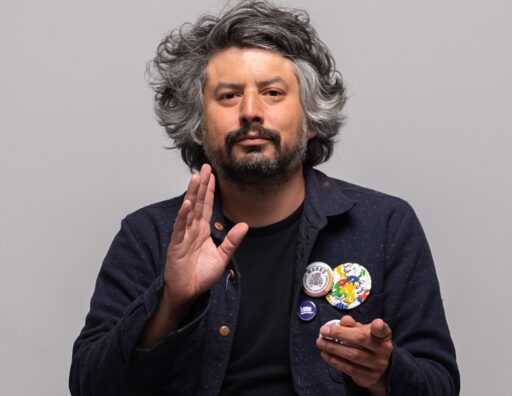

syilx musician Francis Baptiste, a member of Osoyoos Indian Band, says his latest album Lived Experience in East Vancouver hopes to ‘help people who struggled.’ Photo courtesy of Y Hanson Photography
“How long is the winter of our discontent?” Francis Baptiste sings out on his latest album. “Feels like it never ends.”
The syilx alt-rocker says he set out to “humanize addiction” on his country-infused third release, Lived Experience in East Vancouver.
In an interview with IndigiNews, the “Vancouver”-based songwriter says his goal with the project is “to help people who struggled with things that I’ve struggled with in the past.”
And as the record’s title suggests, the 41-year-old Osoyoos Indian Band (OIB) member delved into his own “lived experience” as he wrote the album’s 10 songs.
Released last October, the project echoes similar themes in his previous two albums — 2024’s Sənk̓lip, the Trickster, and it predecessor, Sneqsilx (Family), two years earlier.
All three musical projects touch upon his own experiences with loneliness, loss, substance abuse, healing, parenthood — rooted in a constant longing for family and home.
On his website, Baptiste describes himself as “a washed-up, divorced, recovering alcoholic and drug addict” — someone trying “to balance being a single father and being a middle-aged musician, living under the poverty line in East Vancouver.”
The music video for Francis Baptiste’s song Locked in for Lock, off his 2025 album Lived Experience in East Vancouver.Courtesy of Francis Baptiste/Youtube
His first two albums featured a mix of songs in both English and nsyilxcən, the language of the syilx people.
He tells IndigiNews he often incorporates nsyilxcən into his songs to both preserve and promote his nation’s language.
But, he explains, he didn’t grow up fluent in nsyilxcən; he views singing in the language as a learning tool for both himself and his 10-year-old son.
“I made a resolution to myself,” he explains, “to start trying to learn it, and for me to teach it to my son.”
Last year, he contributed music to the immersive Whispers of the Trickster short-film, which remains on display at the Nk’Mip Desert Cultural Centre in sw̓iw̓s (Osoyoos).
When he’s not making music, Baptiste works at the DUDES Club Society, a wellness organization in “Vancouver’s” Downtown Eastside. It offers Indigenous men community healing support and programming.
As he shares his story with IndigiNews, he explains how reconnecting with music also brought him closer to his heritage and homelands.
That reconnection, he says, contributed to his journey towards healing and hope, through personal struggle.
“In the immortal words of Francis Baptiste,” the songwriter quips self-referentially near the start of his new album, “‘I’m barely f—ing surviving here … I’m hoping for a little more.”
Lived Experience in East Vancouver by Francis Baptiste
The following Q&A has been edited for length and clarity.
Aaron Hemens: How did your life experiences — and working at the DUDES Club Society — inform the themes of your latest album, Lived Experiences in East Vancouver**?**
Francis Baptiste: I’ve struggled with addiction a lot in my life. Most of my life, I’ve been an alcoholic or a drug addict.
And I think a lot of my drug addiction was at its peak after my divorce about five, six years ago — just a bit before I started working here — where I was using every day and really struggling to maintain stability.
I was a single father at the time, so it was just me and my young son. I’ve had full custody of him for like five or six years. And during that time, I was still struggling, and being a single parent was something that was new to me. A lot of that is what’s in the album.
Now that I’ve battled through the addiction problems — I feel like it’s important to give back to the community. At the DUDES Club, I see people with addiction issues every day. Not everybody here is an addict or recovering addict, but a lot of them are.
And I have a lot of sympathy — a lot of empathy — for anyone who’s struggling with addiction or struggling with poverty.
Now that I work here, I’m on kind of the other side of things, where I’m trying to help people who struggled with things that I’ve struggled with in the past. It really kind of informs a lot of things I write about.
Part of the purpose of this album was trying to humanize addiction through my own experiences and my own stories — and help people understand that every addict has their own individual circumstances. We’re all human beings that deserve help and deserve sympathy.
A: Your past albums feature tracks of you singing in nsyilxcən. How has that contributed to your healing?
F: It’s been a big part of my healing and my healing journey.
When I was writing my first solo album, Snəqsilxʷ, that was directly after my divorce, and I was so depressed.
I had all this time to reflect: “I need to do something to get me out of this; I need to do something for myself that’s going to feed my soul and reconnect me to who I am, and help me build who I’m going to be from this point going forward.”
The two things that stuck out to me were going back [to] playing music — and the other answer was reconnecting with my family.
I’d been living out here in Vancouver at that time for like 15 years. So I started spending more time back home with my brothers and sisters — I have eight brothers and sisters, and a lot of uncles and aunties — spending time back on the OIB rez, connecting, realizing that I need to connect with the history of our people a little more.
Around the same time, my grandmother Leona Stelkia had just died. She was the last fully fluent language speaker in our Baptiste family — in our immediate family. The big theme at her funeral was about the language, and about losing another fluent language speaker.
It really made me realize I’ve spent so much time away from home, just not really thinking about home very much, and being in my own life, being very me-focused.
I didn’t realize that we were, as a community, so close to losing our language — so close to losing this super-important part of our identity.
So I made a resolution to myself: to start trying to learn it, and for me to teach it to my son.
Personally, the easiest way to do that was to incorporate it into songs. It’s almost like learning your ABCs: you put a couple words into a melody, and then before I knew it, my son was singing along to these songs, and then he’s learning the words.
It was like a learning tool for me, and it still is.
I’m not a fluent speaker, not even close; I’m like a child speaker.
I have friends at OIB that are fluent speakers, and I send them little bits — little poems — and they’ll send me back translations and audio files from their phone, little voice memos, so I can get the pronunciation right.
That process is really exciting for me, because it makes me feel connected to home, and it makes me feel like I’m doing my part to preserve our heritage.
A: When you use nsyilxcən in your songs, do you view it as promoting it, in addition to preserving it?
F: Definitely. It really feels like more of a spiritual journey reconnecting with the old ways. One of my goals with including language in the music is to show the younger generations that it’s a cool thing to take interest in your culture.
There wasn’t anybody doing that when I was younger, leading by example, I guess.
I’m actually going to perform at Senpaq’cin School in April. Senpaq’cin is the school we have on the reserve in Oliver.
I’ll perform for the kids and give a little talk about the language and the importance of preserving culture and all that — basically the same talk we’re having right now — then perform at a dinner for the parents.
That’ll be really a good way to give back, and get the kids interested in learning and seeing the value in learning the language.
A: I see that you’re also on TikTok promoting the language there?
F: Yeah, I’m trying to get back into that this year. I fell out of it a bit with releasing this album. I was kind of focused on a lot of PR and press stuff.
I used to do these “word of the day” or “word of the week” videos.
My goal for 2026 is to get back to doing that more regularly.
Because I think it’s just a fun thing to do, and fun to include my son in it — building it back into my routine, and making it public to encourage other people in the community to learn words here and there and work on their vocabulary.
A: I think it’s beautiful that you are sharing nsyilxcən with others, as you are on this journey of learning the language yourself.
F: Hopefully it has a group mentality effect [so] when people see it they’re like, “I should do that too.”
Because I think a lot of people want to, they just don’t have time or whatever. But then every time you see somebody else doing it, you’re like, “You know what? Maybe I will do it.”
The post syilx rocker Francis Baptiste ‘hoping for a little more’ with release of newest album appeared first on Indiginews.
From Indiginews via This RSS Feed.