

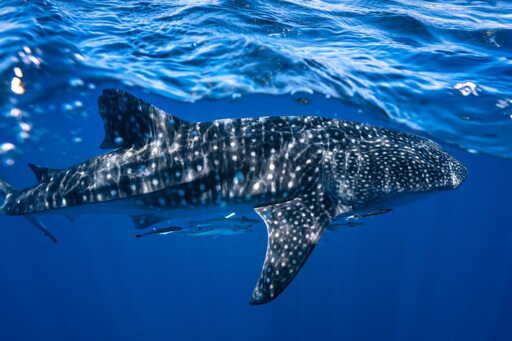
On a March morning in the suburbs of Thiruvananthapuram, Kerala state’s capital in southern India, a group of fishers were hauling their kambavala — a traditional net fixed between bamboo poles driven into the seabed. The net caught something immense. The fishers saw a dark, speckled shadow thrashing within the mesh. As they drew closer, they saw the white-dotted back and cavernous mouth of a whale shark, the world’s largest fish, trapped in the bamboo frame and nylon webbing. They hesitated for a moment: A torn net could mean the loss of a month’s income for small-scale fishers. However, saving the net would mean killing the animal. On the shore stood Ajit Shanghumukhom, a fisher community representative and a volunteer trained by the nonprofit Wildlife Trust of India (WTI). He made the call: “We can’t let it die,” he said. For half an hour, the fishers worked with knives and ropes, cutting the net section by section. The water frothed as the whale shark struggled. When it finally slipped free, the beach fell silent. The fishing net floated like a wound on the water, but the men smiled. They had lost their income but gained something greater — the feeling that the sea itself had been restored. The whale shark (Rhincodon typus) is the world’s largest fish, once caught and slaughtered rampantly along India’s coast for its liver oil and meat. Image courtesy of the Wildlife Trust of India. Fishers turn rescuers Two decades ago, India’s west coast told a…This article was originally published on Mongabay
From Conservation news via This RSS Feed.