

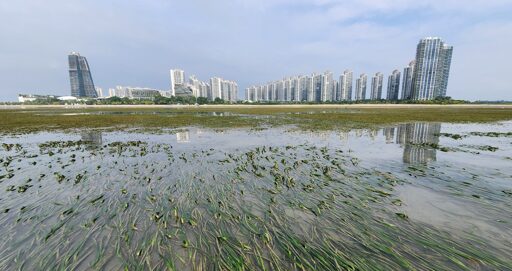
In the shallow waters off Johor Bahru’s rapidly urbanizing shoreline in Peninsular Malaysia, a busy assemblage of crabs, marine worms and mollusks are a sign of recovery. Just over a decade ago, the wafting seagrass meadow they now inhabit had been laid waste by development. In 2014, dredgers working on a massive land reclamation project to build a “Forest City” at the tip of the peninsula had dispersed plumes of sediment across the Merambong Shoal, one of Malaysia’s most extensive seagrass beds. Seagrasses, distinct from seaweeds, are flowering plants that form vibrant underwater meadows. Filtering pollutants, cycling nutrients, sequestering carbon and providing habitat for a rich diversity of marine life, they help maintain the health of coastal seas. While the Department of Environment recognized the harm and issued a stop-work order later that year, the damage was done: Roughly 10 hectares (25 acres) of seagrass meadow had been destroyed. To try to rectify the situation, the developer, Country Garden Pacificview Sdn. Bhd., ramped up mitigation measures and enlisted the help of marine scientists at the University of Putra Malaysia (UPM) to attempt recovering the seagrass. In a new study, the UPM researchers document the results of their decade-long (2015-25) seagrass restoration and monitoring program at the Merambong Shoal. Their approach, which focused on transplanting seedlings of a combination of fast-growing seagrass species, achieved relatively high survival rates — 66% in some recovery plots. What’s more, as the meadow stabilized, they recorded the natural return of many other types of seagrasses…This article was originally published on Mongabay
From Conservation news via This RSS Feed.