

By Dulce Amor Rodriguez
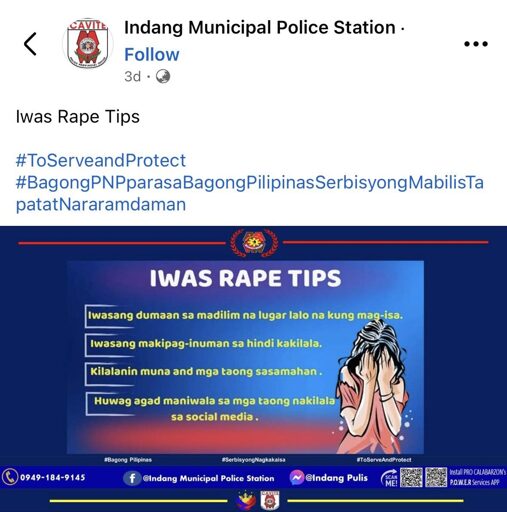
MANILA — When police units tasked to protect communities circulate advice that places the burden of preventing rape on women, advocates warn that the problem goes beyond a single social media post. The Indang Municipal Police Station’s “Iwas Rape Tips,” which drew public backlash this week, has reopened long-standing concerns over victim-blaming, police accountability, and how state institutions address sexual violence.
The controversy, condemned by progressive women’s group Gabriela, exposed how rape prevention campaigns can reinforce harmful narratives instead of confronting perpetrators and institutional failures.
Police unit shifting the blame
The Indang Municipal Police Station shared a set of “rape prevention” reminders online, advising women to avoid dark places, refrain from trusting people met on social media, and limit interactions with strangers. The post framed these reminders as protective measures, but critics said the advice implicitly placed responsibility for preventing rape on women’s behavior rather than on those who commit sexual violence.
Women’s alliance Gabriela said the messaging echoed outdated and harmful narratives that suggest rape can be avoided through personal caution alone.
Gabriela Secretary General Clarice Palce said the post promotes a mindset that restricts women’s freedom instead of addressing the actions of perpetrators.
“Instead of running after rapists, the Philippine National Police (PNP) is promoting a backward and harmful mindset that tells women to restrict their freedom and movements,” said Palce in a statement. “This logic implies that rape is caused by a woman’s choice of route, company, or clothing, rather than by the decision of a perpetrator, who are mostly men, to commit sexual violence. It is an insult to all survivors and a gross neglect of the PNP’s duty.”
Invalidation disguised as advice
Advocates pointed out that the police advice ignores well-documented realities of sexual violence. Researchers have long maintained that most rape cases are committed by someone known to the victim and often occur in private spaces such as homes—not necessarily in public, poorly lit areas or through encounters with strangers.
By focusing on women’s movements rather than offender behavior, critics said the post obscures the root causes of sexual violence and reinforces fear as a default survival strategy for women.
Women’s groups emphasized that such messaging risks discouraging survivors from reporting abuse, as it subtly implies they could have prevented the assault.
‘Safety tips’ as systemic failure
The backlash intensified as advocates linked the police post to unresolved cases of sexual violence involving law enforcement personnel. Gabriela cited previous incidents where police officers faced allegations of rape and sexual abuse, arguing that the institution must first address accountability within its own ranks.
“Perhaps the Marcos Jr. administration and its PNP should first educate themselves on the roots of violence against women. They should focus on cleansing their own ranks of rapists and abusers, instead of telling women how to live in fear,” Palce stated.
Critics said the credibility of public safety campaigns weakens when institutions implicated in violence against women issue advice that appears to absolve perpetrators, especially those in uniform.
For women’s groups, the issue goes beyond one social media post. They described it as part of a broader pattern where state institutions fail to confront patriarchal norms embedded in policing and governance.
Gender advocates stressed that effective rape prevention does not rely on restricting women’s lives but on dismantling systems that enable violence. They said public education should focus on consent, survivor-centered reporting mechanisms, and swift prosecution of offenders.
The controversy also exposed the absence of consultation with women’s organizations and gender experts in crafting police communications on sexual violence. Advocates said this gap leads to messaging that contradicts both lived experience and evidence-based prevention strategies.
Calls for accountability and reform
Gabriela demanded the immediate retraction of the “Iwas Rape Tips” and urged the PNP to overhaul its approach to addressing violence against women. The group called for training programs that center survivor rights, accountability, and institutional reform.
Women’s rights advocates stressed that public safety campaigns must condemn sexual violence without conditions and affirm that responsibility always lies with perpetrators—not with women navigating daily life.
The Indang police post may have been local, but the response revealed a national issue: how institutions tasked with protection continue to frame violence in ways that burden those most at risk.
For advocates, the outrage is not simply about one post, but about demanding a shift—from policing women’s behavior to dismantling the culture of impunity that allows sexual violence to persist. (AMU, RVO)
The post ‘Iwas Rape Tips’ spark outrage, expose gaps in police approach to sexual violence appeared first on Bulatlat.
From Bulatlat via This RSS Feed.