

Snow falls on George Floyd Square. Five and a half years ago, at the intersection of Chicago Avenue and 38th Street in Minneapolis, George Floyd was murdered by a white police officer during an arrest. The city rose in revolt. Thousands took to the streets, burning down Minneapolis’s 3rd Precinct and inspiring a nation to rise up against the racist police killings of Black people. Floyd’s last words, “I can’t breathe,” became a rallying cry for millions.
This history hangs heavy at the intersection. A shrine for Floyd stands outside Unity Foods (formerly Cup Foods), where the $20 bill he used was reported to police as counterfeit, setting off the events that led to his murder. Across the street, graffiti on an abandoned gas station reads, “Where there’s people, there’s power.” The sentiment feels particularly true now. Collaged with posters of Audre Lorde and “Black Lives Matter” signs are new ones proclaiming “ICE out of Minnesota.” These signs are scattered throughout the city — on street corners, off highways, at the windows and doors of homes and businesses.
Not far from the square, ICE agents gunned down two people last month — first Renée Nicole Good, a mother and legal observer, then Alex Pretti, an ICU nurse. Good and Pretti were among the thousands of Minnesotans defending an immigrant community under siege. Trump deployed over 3,000 officers to the state under Operation Metro Surge, militarizing the streets, sowing terror, and abducting people — including children — off the streets and from schools, workplaces, and parking lots. These agents everywhere, in uniform or plain clothes, in unmarked cars, armed with guns and pepper spray.
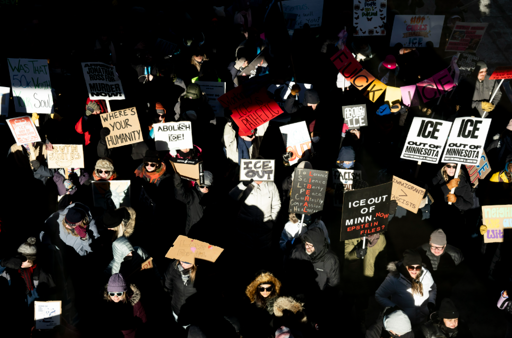
Yet, while they lurk in the shadows, the people of the Twin Cities are out in the streets, determined to protect their community. Fifty thousand took to the streets on January 23, one of the coldest days this winter, for “no work, no school, no shopping.” Major unions joined the call for a shutdown. Workers walked off the job in one of the largest wildcat actions in decades. Eighty-five percent of one CWA local’s members did not go to work. Starbucks stores closed. At one Target location, 16 of 21 workers walked off their jobs. The idea of a “strike,” or the necessity of shutting down business as usual, was everywhere, and many recognized the immense power represented by withholding their labor. Such was the power that the next day, after Pretti was murdered, thousands took to the streets almost immediately, chanting “strike!”
Students answered the call this time, with student groups from University of Minnesota calling for another “strike” and day of action on January 30. Tens of thousands took to the streets again, for a second Friday in a row, not just in Minneapolis, but across the nation, even as unions and other organizations withheld their endorsements. While fewer businesses closed than the week before, in downtown Minneapolis, it was hard to find a café open.
In the face of uncertainty over the scale of the afternoon march, various other actions dotted the day too, showing that, even without official support, people did not want to sit idly by and were looking for ways to participate. Hundreds gathered in the morning at the Whipple Federal Building, where ICE deploys from every morning; housing activists held a press conference to demand eviction moratoriums; workers and community members picketed outside Target, calling for an end to the corporation’s ongoing cooperation with ICE. Teachers in the Twin Cities, eager to act on the day of action even though their union didn’t echo the call of the week before, organized a teach-in outside Governor Tim Walz’s residence to protest ICE, leaving letters from their students at his gates.
Throughout the weekend, there were others. Another demonstration outside Target on Saturday forced the store to close. As we drove around south Minneapolis, we encountered many more gatherings, such as some dozens of people at a roundabout holding signs, or the hundreds who joined a bike ride in honor of Alex, or those who gathered outside the VA hospital where Alex worked. And these are just the ones we witnessed firsthand.
We Keep Us Safe
It feels like this entire city is having a shared political experience and is moved to act every which way you see it. You can see the city’s fight against ICE not only in these major days of action but also in the many ways the community has taken up this responsibility of defending their own.
Schools have become bastions of struggle, where teachers have joined forces with students and parents to protect their immigrant students and families. They have established corridors to ensure safe passage, offered remote learning for those unable to come to school, and collected funds to buy groceries and supplies for families sheltering in place. School bus drivers have refused to allow ICE on their buses to apprehend students.
And then, there’s all that people are doing in their neighborhoods. The city is teeming with people out and about all the time to patrol the streets for ICE activity and make sure that their neighbors are safe. Neighborhood patrols have become a fixture of daily life. They’re at every street corner, especially in immigrant and residential areas, whether in groups of two or three on foot, or circling the area in cars or on bikes. Whistles are a part of the uniform of the city, ready to be blown at a moment’s notice to activate the network and alert the community to ICE’s presence. There are streets where they’ve set up barricades, checking cars to make sure they’re not ICE.
Driving to a food distribution run on Saturday with K, who has been participating in the patrols since Operation Metro Surge began, she explains how widespread it is. People aren’t just doing this when they are free, she explains. Everyone is actively trying to make time. They patrol during their lunch breaks at work, on their way home, or whenever they find a window of opportunity. The urgency feels especially heightened after Renée and Alex’s murders, she says. There’s something about how K and others refer to them by their first names that creates a sense of closeness. Did they know them personally? I don’t know. Not that it matters, I think, because they know them in a deeper, more universal way. They were friends, comrades — truly one of them in this with them.
K confirms what others have reported on before: they drive their routes while tuned in to large group calls that, in real time, help them identify suspected ICE vehicles — largely unmarked vehicles with out-of-state license plates. They’ve built an impressive database over the past few months. Even as ICE changes its tactics, it appears that they’re still able to identify their vehicles. K emphasizes that their goal is to document rather than to intervene, especially given the risks of being shot. But they still do their best to follow ICE vehicles, alerting the neighborhood through their whistle network and coordination chats, and documenting interactions in case of abductions. They are not only trying to gather information about the ICE agents and filming their brutality, but are also collecting the names and details of those being abducted so that families can be notified.
For everything they know about ICE agents, however, it seems that ICE agents know just as much about them. They maintain their own databases, not only of the cars involved in patrols — so they know which ones are following them — but also the very people who are patrolling. It is another front of their operations, this battle with the people and the work to thwart their tails to continue terrorizing immigrants. They’ve tear gassed and pepper sprayed with impunity, boxed in patrols, and threatened arrests if the patrols continued to follow and record their actions. Yet, despite these challenges, people have persevered.
K shares stories emerging from these patrols, which only reveal the depth of community solidarity. Once, she recounts, someone on patrol saw ICE abduct a man from a store parking lot. The man tossed her his car keys, gave his address, and asked if she could drive his car back home. Acts of solidarity like this, I assume, become the first — and sometimes only — way families learn that their loved ones have been taken.
Food for the People
We arrive at this suburban church that is one of many places organizing grocery deliveries for families too afraid to leave their homes for something as basic as going to the store. The parking lot is full, so we park on the side of the road before walking in. K and I both remark that it’s a good problem to have — clearly, hundreds are moved by a profound sense of solidarity to volunteer here on their days off. It is a diverse cross-section of the community, with both young and old helping out. Some work in a large warehouse-like space in the back, assembling the boxes we’ll take for delivery, while others coordinate logistics for the volunteers or work outside in the cold, helping load food into cars.
The operation is massive and runs with remarkable professionalism. Those volunteering for drop-offs register for the day, receive their assignments from dispatch coordinators, and then pick up their assigned boxes before leaving for the day. There are people here ready to make deliveries on their own, while others are here with their families, knee-high kids in tow, or, like us, made it an affair among friends.
We say we’re happy to help wherever is most needed and they reaffirm how much help they need with drop-offs, so that’s what we volunteer to do. Over small talk about cars, sports, and family, our dispatcher — an older man in his 60s, perhaps — hands us our assignments and sends us on our way. It is busy. He tells us that this site alone will complete 2,000 deliveries that day. At two in the afternoon, when we arrived, they had 600 deliveries left. They do this four days a week.
Despite receiving our assignments in under 20 minutes, we wait for almost an hour to pick up the grocery boxes, given the sheer volume of volunteers. When we get through the sea of cars ahead of us, everything moves quickly. The boxes themselves are comprehensive, covering a week’s worth of essentials: protein, rice, fruits, vegetables, and toilet paper, as well as diapers if needed.
The deliveries themselves are a whole other story. Our four locations are all within the same block in south Minneapolis. Two of them are neighbors. We text them when we are on our way and, again, when we are outside their homes. We’re so conscious of our own presence as we wait, hoping we don’t have to linger too long so we don’t get mistaken for ICE agents.
It is eerie to witness the trepidation with which families open their doors, just barely, with such a separation between these worlds. At our first drop-off location, the woman brings K into a teary embrace after we drop off the box. At another stop, a mother struggles to rein in her toddler, who’s clearly excited by the arrival of strangers. The sorrow, solidarity, and gratitude run deep on both sides of the door.
Which Way Forward
What’s happening in Minneapolis reveals both the persevering spirit of a people ready to fight and the necessity of building on that spirit with organization and strategy. Despite the bipartisan attempts to de-escalate the situation in Minnesota, ICE and DHS is still here, constantly adapting their tactics. But the community is here too, ready to fight, and are showing that they won’t back down.
From the protests and walkouts to neighborhood patrols and food distributions, it’s an immense demonstration of what is possible when people act together. But to sustain and deepen this resistance to force ICE and federal immigration agents off the streets and the communities, people need spaces to meet, discuss, decide, and coordinate a collective path forward.
Popular assemblies could transform this landscape. Imagine regular mass meetings, organized by neighborhood and city-wide, where all those involved in coordinating this resistance can come together to discuss the political situation at hand, debate over strategy, share their know-how, and make decisions democratically. Not meetings run by any one organization or tendency that serve their own reproduction, but open forums where everyone engaged in this struggle has a voice and a vote on the path forward, whether it is on how to best organize and mobilize for a day of action or coordinating everyday community self-defense against ICE terror.
In this task of community defense, especially, labor must join the fight actively — not just with militant words of solidarity. Everywhere in Minneapolis, people stress the critical role that schools, and particularly teachers and school bus drivers, have been playing in protecting immigrant families. This serves as an important example: workers across sectors possess strategic power not only to shut things down, but also to organize this self-defense of the community, transforming workplaces into bastions that can centralize resistance.
But this requires more than symbolic gestures from our unions. Workers are already on the move, with rank-and-file teachers organizing protection alongside students and parents from the schools. Or Target and Starbucks workers walking off their jobs in solidarity with the immigrant community. Or working people using their own time to coordinate patrols and mutual aid. We need our unions to step up and actively join the fight, leveraging the vast resources at their disposal towards the defense of their communities that workers are already actively taking up. The products of labor, the infrastructure of workplaces, and the organizational capacity of our unions must be deployed to protect the community.
The resources our unions control are vast. Teachers’ unions could use their databases to identify families in need of support. Transit unions could refuse to transport detainees. Healthcare unions could organize free clinics. The infrastructure of union halls could serve as coordination centers. Union funds could go towards supporting workers striking or sheltering in place as well as these extensive mutual aid operations. The organizational capacity built over decades, of phone banks, steward networks, meeting spaces, and communication systems, could all be deployed to this fight against ICE and Trump’s attacks.
The conditions for this exist in Minneapolis right now, especially as federal immigration agents continue to terrorize our streets and face off against a community eager to fight back. In the face of this militarized force, it is easy to slip into despair, but throughout the city, the resilience of its people serves as a constant reminder that a better world is possible. And it is urgent that we fight for it.
From George Floyd Square, we trudged over to Renée’s memorial a few blocks away. A dusting of snow blanketed her photos, as well as all the candles, and art left in tribute, while posters and pages of poetry fluttered in the light wind, stuck to the trees. One handwritten page stands out: a passage from J. R. R. Tolkien’s The Two Towers, in which Sam says to Frodo,
It’s like in the great stories, Mr. Frodo. The ones that really mattered. Full of darkness and danger they were. And sometimes you didn’t want to know the end. Because how could the end be happy? How could the world go back to the way it was when so much bad had happened? But in the end, it’s only a passing thing, this shadow. Even darkness must pass. A new day will come. And when the sun shines it will shine out the clearer. Those were the stories that stayed with you. That meant something. Even if you were too small to understand why. But I think, Mr. Frodo, I do understand. I know now. Folk in those stories had lots of chances of turning back only they didn’t. They kept going because they were holding on to something.
In Minnesota, people are holding on to something: to each other and the idea that their solidarity can be stronger than the terror unleashed by the Trump administration. And they’re not turning back.
The post Minneapolis vs. ICE: A City in Revolt from Below appeared first on Left Voice.
From Left Voice via This RSS Feed.
You must log in or # to comment.