

Article Summary
• Conflict has long threatened the survival of traditional Palestinian crops, and Israeli attacks since 2023 have destroyed nearly all the farmland in Gaza.
• The West Bank-based Palestine Heritage Seed Library collects and distributes Palestinian seeds for cultivation.
• In 2024, the Library created a U.S. network of growers called the Seed Protectors Project, based in the Hudson Valley of New York.
At City Green Farm Eco-Center, in Clifton, New Jersey, giant 9-foot-tall stalks of okra produce bushels of succulent, fuzzy green pods, ideal for soups and stews. This variety of okra, Bamyeh Falastinia, is native to what is now the West Bank, and for centuries, it has been a staple in Palestinian kitchens.
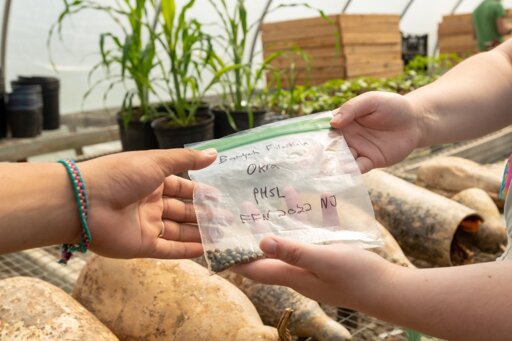
The plants’ true treasure, though, is its seeds—and in 2024, the City Green plants produced more than 9,000. At a time when conflict in the Middle East has destroyed Palestinian farmland and foodways, these seeds have become a beacon of hope for many.
Seeds are vessels of memory that carry the traditions of the people who grow, cook, and share the food.
City Green is part of a grassroots network of growers in the U.S. who are cultivating ancient Palestinian crops as part of the Palestinian Heirloom Seed Library (PHSL) Seed Protectors Project. Currently, approximately 40 growers and organizations in the U.S. work as seed protectors, including the Experimental Farm Network (EFN) in Pennsylvania, the Hudson Valley Farm Hub in New York, the Organic Seed Alliance in Washington State, the Ujamaa Cooperative Farming Alliance, and Truelove Seeds.
While growing varieties of okra, tomatoes, squash, cucumbers, herbs, and collard greens that have been grown in Palestine for centuries, these groups are also preserving Palestinian culture.
In her book Heirloom Seeds and Their Keepers, anthropologist Virginia Nazarea describes seeds as not only of critical importance to the preservation of crop diversity but also to the safeguarding of cultural knowledge. In this way, seeds are vessels of memory that carry the traditions of the people who grow, cook, and share the food, embodying both communal identity as well as agricultural value.
This is something the leaders at City Green understand. “We try to grow a lot of culturally relevant food at City Green,” says farm director Henry Anderson. “There’s a lot of Palestinian people here in Paterson and Clifton, and so we just want to keep preserving those cultures as much as we can.”
The Founding of the Seed Protectors

Seed protector Lana Mustafa (left) and PHSL Program Director Melina Roise (right) with towering Bamyeh Falastinia okra plants. (Photo credit: Nicole Vascimini)
The warm, dry climate of the West Bank and Gaza has for centuries supported unique varieties of wheat, barley, chickpeas, olives, lentils, and a diverse range of vegetables. Both regions belong to the Fertile Crescent, the area in the Middle East that was the birthplace of agriculture.
Protecting both cultural identity and crop varieties is what inspired Vivien Sansour, an advocate for seed conservation, to establish the PHSL in the West Bank town of Battir in 2014. Unlike a seed bank or vault, which sequesters seeds for safekeeping, the goal of a seed library is to keep crops active and growing. Growers borrow seeds from the library and then propagate, harvest, and resow them—as well as return a portion back to the library to be shared with more growers. For almost a decade, the PHSL worked in the West Bank, lending seeds and preserving culture.
But, as conflict in the region caused conditions to deteriorate, the work of the PHSL was also jeopardized. Since 2023, bombing and ground assaults into Gaza by Israeli forces have left only 1.5 percent of the farmland in Gaza undamaged and accessible to cultivation, according to a United Nations report released in August 2025.
To be able to continue the work of preserving seeds and culture, the PHSL launched the Seed Protectors Project in 2024. Its goal is to get Palestinian heirloom seeds into the hands of “trusted friends, both Palestinian and non-Palestinian, who live in safety and security elsewhere in the world”—though primarily the United States.
“It really started from conversations that our team was having around our responsibilities as seed keepers right now,” says Melina Roise, program director for the PHSL.

At Saboon Maazeh farm at the Chester Agricultural Center in New York, seed protectors for the PHSL harvest crops for seeds. (Photo credit: Melina Roise)
How the Network Works
Regulations from the U.S. Department of Agriculture (USDA) limit the import of seeds to protect American agriculture from disease and insect infestation. This has meant that the PHSL has had to rely on the Palestinian diaspora in the U.S. for seeds.
“We have re-formed the seed library in the U.S.,” Roise says, “by people gifting us seeds, mostly passed down from their grandmothers and mothers.”
Seeds are shared with growers who have the experience and the available land to scale seed production. Once harvested, growers share seeds with other growers within their networks to resow and keep safe.
“The seed library does not currently have a permanent home in the U.S.,” Roise says. “Seeds are kept in various places, with farmers, at our homes, and at a small office we have in the Hudson Valley. Our dream is to have a farm in the future with a public seed library, but we are still in the process.”
Some of the seeds grown by the Seed Protectors Project are also available to the general public through seed sales. TrueLove Seeds, for example, sells Palestinian seeds grown by U.S. seed protectors, including the okra grown at City Green.
Lana Mustafa, an American Palestinian living in Clifton, New Jersey, has been stewarding the okra seeds for the last 10 years and is now part of the Seed Protectors Project. Needing more land to scale up okra production for the PHSL, she reached out to City Green, and it’s her seeds that now tower above the landscape at the Eco-Center. For her, saving the okra seeds is much more than a hobby. “It’s our duty and responsibility as humans and as individuals to protect what needs protection,” she says.
It’s a belief shared by others involved with the PHSL. “As an American and as a Jew,” says Nate Kleinman, founder of the Experimental Farm Network, “I believe that we have a really important role to play in working to solve the ongoing, really terrible situation of Palestine and the Palestinian people. Working to preserve seeds is just one piece of the puzzle, as they are such an important conveyor of culture and memory.”

As part of their efforts to preserve crops vital to the agriculture and culture of war-torn regions, the Experimental Farm Network (EFN) grows and saves seeds from Ukrainian cucumbers. (Photo credit: Nate Kleinman)
The Benefits—and Challenges—of Growing Non-Native Crops in U.S. Soil
The PHSL and its seed protectors are not the only organization working to preserve seeds from areas ripped apart by conflict. The Iraqi Seed Collective, a U.S.-based network, distributes heirloom Iraqi vegetable seeds to members of the Iraqi diaspora in the U.S., and the Ukrainian Heritage Seed Network has distributed heritage seeds to more than 2,000 farmers, both in Ukraine and around the world.
The EFN has played a role in some of these efforts. It has grown soybeans and sunflowers from Ukrainian seeds it has requested from the USDA, as well as from other regions facing extreme challenges, such as South Sudan and Afghanistan.
“We have made it a focus on growing seed from threatened communities where the traditional agricultural systems and foodways are under threat, whether by war or climate change, sea level rise, or outmigration due to poverty and other factors,” says Kleinman.
He believes that, along with culture preservation, Palestinian seeds may hold clues to future crop production and even global food security. Traditional Palestinian agriculture has long relied on ba’al crops, sometimes referred to as rainfed crops, which grow using only the moisture retained in the soil during the winter months. This has produced crops that are able to adapt to hot and dry conditions, something increasingly common in North America due to climate change.
“We have to do a much better job of preserving seeds from around the world and especially preserving varieties that can stand up to the extreme climatic forces that are coming our way,” Kleinman says.
There are, of course, challenges when growing seeds attuned to a Middle Eastern climate in unfamiliar soils. Jennifer Williams of Wild Dream Farms on Vashon Island in Washington State’s Puget Sound grows vegetables for the Seed Protectors Project. She was recruited by Kleinman to work on brassicas like cauliflower and cabbage.
“These brassica crops are very difficult to grow for seed on the East Coast because of pest pressure primarily,” Kleinman says. Cabbage worms and aphids can devastate them, and the Pacific Northwest offers more favorable conditions. Williams often receives advice during monthly calls with other seed protectors, advising her not to water the plant once established. This helps mimic the arid conditions of the Middle East.
Even so, Williams admits, a plant grown in the wet climate of the Pacific Northwest, no matter how carefully curated, does not taste the same as one grown in the dry soils of Palestine. “The cauliflower wasn’t the same flavor,” she says. “At least I can harvest the seed, with the idea being that they will go back to Palestine when the opportunity arises.”
It’s this hope and the connection these crops give to Palestinians around the world that makes the work at City Green take on a deeper meaning. The fall of 2025 was wetter than the previous year in Clifton, and some of the okra pods didn’t dry as well, resulting in fewer seeds. This, though, has not dampened spirits, especially for Mustafa, who sees the okra as more than just a plant.
“It’s an opportunity for me to stay connected to my identity as a Palestinian,” she says.
The post The US Farmers Saving Palestinian Seeds appeared first on Civil Eats.
From Civil Eats via This RSS Feed.