

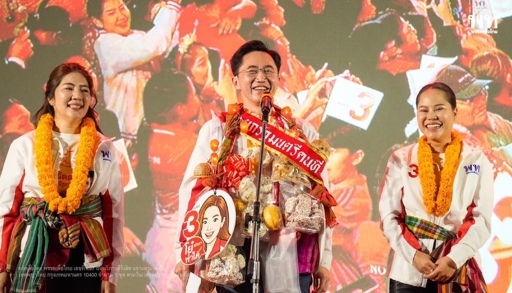
As Thailand goes to the polls, three visions compete: one which experiments in strange new populist economics, one which critiques from the seminar room, and one paying to keep the countryside quiet. In the Thai election, scheduled for February 8, we can see the Global South’s political laboratory in microcosm.
Today’s landscape is a three-way struggle between Pheu Thai’s disruptive populism, the liberal Peoples Party’s Westernized idealism, and the Bhumjaithai Party’s reactionary clientelism. The February election will decide which paradigm prevails.
The Red Deal: rainbow agrarian populism
Since the 1957 military coup, power in Thailand has been held by a narrow elite: the military, the monarchy, and old-money families. This bloated clientelist bureaucracy left the outer provinces perennially impoverished and stuck in semi-feudal, semi-capitalist economic relations. This “deep alliance” has always been the constant ambient, often lethal, background of Thai politics, with 11 successful coup d‘états since 57.
The 1997 Asian financial crash exposed this elite’s incompetence at crisis management. A new cohort of domestic capitalists, led by telecoms billionaire Thaksin Shinawatra, forged an unprecedented class collaboration. Uniting military officers, nationalists, former insurgents, and academics under the Thai Rak Thai (later Pheu Thai) banner, their imperative was to modernize the state and develop the periphery.
Their manifesto delivered policies like universal healthcare, a farmer debt moratorium, and direct village funds. For the first time, the poor were addressed in terms of class interest. Policies like the 30-Baht healthcare scheme bypassed the old bureaucracy, establishing a direct relationship between government and masses. Rural communities themselves decided how to use funds, redistributing not just wealth, but decision-making. This broke down semi-feudal rural relations.
Pheu Thai’s rural empowerment also benefitted urban workers. By making rural life viable, it reduced the economic coercion forcing migrants to Bangkok, giving urban workers leverage in the factories, indirectly improving conditions for the rural and urban poor.
In the early years, however, Pheu Thai relied on ugly alliances. It oversaw a brutal drug war and violent suppression in the Muslim-majority Deep South. In recent years, though, it has pivoted to extreme social progressivism, legalizing same-sex marriage, providing trans-affirming healthcare, and joining pride parades. In foreign policy, it moved from a strongly US-aligned stance to recognizing Palestine, joining BRICS, and cooperating with Iran and Hamas to secure the release of Thai prisoners accidentally taken in Gaza.
Thaksin was ousted by military coup in 2006, resulting in the famous Red Shirt (Pheu Thai) vs Yellow Shirt (Royalist) street battles and military massacres of Red Shirt protesters (2008-2014), but the Pheu Thai machine continued to hold on and regain parliament on and off ever since despite massive persecution from the reactionary elite classes.
For most, Pheu Thai’s governments were boom eras. It was a deal: the poor gained agency and material improvement; new elites gained a mandate without violent revolution. Socialist outcomes, without the capital S Socialism – a “Rainbow Agrarian Populism”.
Orange Western liberalism
In 2018, the Orange movement (Future Forward/Peoples Party) emerged. Founded by disaffected Pheu Thai elites (academics, NGO leaders, and younger capitalists like Thanathorn Juangroongruangkit) it positioned itself as the clean, progressive alternative to Pheu Thai. Its base was young, urban, middle-class, and anti-military/monarchy.
Yet its critique was ideological, not material. It championed abstract ideals like “Democracy” and a Western-style welfare state, often ignoring Pheu Thai’s foundational programs. This attracted voters historically aligned with Pheu Thai and, more recently, leadership flocking from ultra-conservative backgrounds, following the political winds.
Pheu Thai supporters often say, “Orange are the new Ultra-Right.” The leadership represents a different faction of the urban elite seeking to supplant old monopolists while leaving class hierarchies intact. Their angst is directed not at capitalism, but at its mismanagement.
This idealism has consequences. By splitting the anti-military vote, Orange victories helped hand Parliament to the military-backed ultra-right in 2019. In 2023, they won a slim majority of votes but failed to form a government, forcing Pheu Thai into a coalition with its former military persecutors. In 2025, after the judicial coup against Pheu Thai, Orange entered a temporary coalition with the ultra-nationalist Bhumjaithai, taking no ministerial posts out of “principle”. For many, this revealed a politics of aesthetics, not structural transformation.
Bhumjaithai machine: reactionary clientelism
If Pheu Thai mobilizes peasant agency, and Orange offers liberal idealism, then Bhumjaithai offers the old establishment’s perfected antidote: patronage disguised as politics. Its function is to protect agrarian inequality by neutralizing class consciousness.
Founded by trucking magnate Newin Chidchob, another Pheu Thai defector, it harnesses Pheu Thai-esque populist tactics to serve reactionary ends. It is the intermediary between the old Bangkok elite and the restive rural population. Under ultra-billionaire leader Anutin Charnvirakul, it rebranded patronage as “localist development”.
Its power flows through local elites, landowning dynasties, and provincial brokers (the aforementioned semi-feudal class). By controlling the Interior Ministry for the past decade, it turned budgets and infrastructure into tools of patronage to pre-empt mass mobilization. Bhumjaithai’s welfare schemes are deliberately fragmented, distributed through local elites to ensure dependence, not empowerment.
Beneath its folksy veneer lies hardcore reaction: anti-immigrant fervor, ultranationalism stoked by the border war with Cambodia, and disdain for LGBTQ+ rights. It frames rural poverty as cultural failing, not structural exploitation.
The stakes
The Pheu Thai Party has defined Thai politics for over two decades, yet defies easy definition. It is a peasant-backed populist movement and an alliance of urban capitalists; it has privatized state assets while investing massively in public welfare. By every rule of 21st-century politics, it should not exist. Yet it has delivered a paradigm shift that baffles elites while transforming society.
Pheu Thai’s successes have provoked relentless sabotage (coups, judicial dissolutions, and the 2017 Constitution designed to cripple it). Yet the symbiotic relationship between party and poor endured because the deal delivered material gains.
Despite a hostile coalition since 2023, Pheu Thai has pushed through universal dental care, mass social housing, same-sex marriage, and cash handouts to the poor. Rainbow Agrarian Populism persists.
The February elections present a stark choice. Pheu Thai’s ceiling is its bourgeois leadership; it seeks inclusive capitalism, not class abolition. Yet it differs fundamentally from Global North social democrats by depending on a mobilized base engaged in economic realignment.
This rare class collaboration is an experiment in leveraging cross-class alliances to achieve material victories for the poor. Pheu Thai offers a compromised but effective stepping stone for mass mobilization that puts food on workers’ plates.
As the Global South asserts new models, Thailand’s political triad reveals a broader struggle: between indigenous, material-based populism; Westernized liberal idealism; and adaptive reactionary control. The February vote will define which paradigm, or which combination of paradigms, prevails.
Kay Young is a writer and editor at DinDeng journal (Thailand). He has a forthcoming book on Thai revolutionary history with LeftWord Books (India).
This article was produced by Globetrotter.
The post Thailand general election 2026 appeared first on Peoples Dispatch.
From Peoples Dispatch via This RSS Feed.