

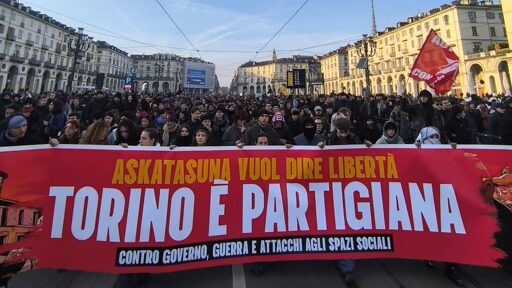
On January 31, around 50,000 people mobilized in Turin against the forced closure of the social center Askatasuna and the increasingly repressive policies of Prime Minister Giorgia Meloni’s far-right government. Authorities deployed hundreds of police officers, who used tear gas and physical force against demonstrators during the march.
The following day, mainstream media and official accounts attempted to shift attention away from the scale of the mobilization and the violence used by the authorities, instead focusing on injuries apparently sustained by a police officer. “Today’s news reports try to obscure all this [the effects of austerity and militarization] with the story of a policeman injured at the end of the march, forgetting the scenes earlier in the day where the roles were reversed,” Potere al Popolo Turin wrote in a reaction. “Above all, they pretend not to understand that this is what happens when repression is the response to those who rightly refuse to accept a future of misery and exploitation.”
Relying on a narrative already used before the protest – one in which activists mobilizing in solidarity with Palestine and Venezuela, and against war and rearmament, are portrayed as terrorists or internal enemies – authorities also tried to downplay the significance of the demonstration. The size of the crowd, however, marching behind a banner reading “Turin is partisan,” left little doubt that this strategy has so far failed. “From the United States to the United Kingdom and here, we state that we are not terrorists, but partisans,” wrote Potere al Popolo spokesperson Marta Collot after the protest.
Read more: Is fascism back in Europe? A conversation with the Zetkin Forum
Askatasuna was forcibly shut down in a large-scale police operation in late December, which residents described as full-blown militarization of the surrounding neighborhood. Schools and kindergartens were closed without prior notice, and the area was flooded with state agents. For years, the social center had provided space for community programs, as well as initiatives organizing against austerity and in support of social and environmental justice.
More recently, a plan had been advanced to institutionalize Askatasuna as a publicly owned, activist-run community space. But Turin’s centrist city government abandoned the plan following the eviction. “War, both internal and external, is draining resources from social spending while increasingly shrinking spaces for democracy and social life,” Collot wrote. “Both the Meloni government and the center-left, where it governs locally, are participating in this process.”
Left groups denounced the actions of both national and local authorities, warning that the eviction of Askatasuna reflects a broader political discourse defined by rearmament and attacks on dissent. “The timing of this operation is not accidental but part of an increasingly tense climate of war, both externally and internally,” Potere al Popolo Turin warned ahead of the mobilization.
Read more: Dockworkers in Mediterranean ports announce coordinated action against war
“The eviction of the social center is an expression of the government’s, and of the EU’s and NATO’s, policies of war and support for Netanyahu,” said Giorgio Cremaschi, a member of Potere al Popolo’s executive body, in December. “State fascism is nourished and reinforced by these violent and reactionary policies spreading across the West, hitting first and foremost the Palestine solidarity movement and the struggle against war and rearmament.”
“We have said it many times,” Potere al Popolo Turin reiterated in the call to Saturday’s mobilization. “In the face of the impoverishment of our neighborhoods and attacks on wages and the working class, the only security we need is social security: housing, wages, transport, healthcare, and rights for all.”
The post Partisan Turin rises against militarization and repression appeared first on Peoples Dispatch.
From Peoples Dispatch via This RSS Feed.