

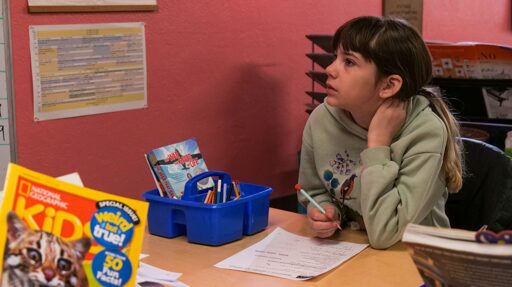

Kłaʔmásq̓t, whose English name is Irie Wiley-Camacho, Sinixt Lake Band from the Colville Confederated Tribes, works through a math problem in n̓səl̓xčin̓, Colville-Okanagan Salish, on November 6, 2025. (Photo by Nika Bartoo-Smith, Underscore Native News / ICT)
This story was originally printed in Underscore Native News and ICT, and appears here with permission and minor stylistic edits.
Sitting at a small desk in the basement of a single-family home converted into a school, paˤłxʷ (Graham Wiley-Camacho) patiently helps his youngest daughter work through a fractions math problem in n̓səl̓xčin̓ (Colville-Okanagan Salish).
As he supports Kłaʔmásq̓t — whose English name is Irie Wiley-Camacho — and six other elementary school kids work on division, the students asked and answered questions on a worksheet, all in Salish.
paˤłxʷ is Sinixt Lake Band from the Colville Confederated Tribes. He is the lead elementary school teacher at Salish School of Spokane, which was founded by his mother in 2009.
N̓ʔiy̓sítaʔtkʷ (LaRae Wiley), a Sinixt citizen of the Colville Confederated Tribes, is a founder and former executive director of the school. She is now serving as an Elder linguist. paˤłxʷ’s dad, ʔaˤn̓n̓ (Chris Parkin), is the school’s principal.
“That’s just how language revitalization works,” paˤłxʷ said. “Because if the goal is to restart intergenerational transmission and create Salish speaking households again, then that kind of implies families and extended families.”
Next door, paˤłxʷ’s wife Sx̌mn̓atkʷ (Dominique Wiley-Camacho), teaches middle school math in Salish. Their oldest daughter, X̌sčn̓itkʷ (Seneca Wiley-Camacho) quietly works on her math assignment as her mom answers questions.
“Our grandparents made the school, our parents are both teachers, we speak Salish a lot, like at home too,” X̌sčn̓itkʷ (Seneca) said. “And it’s a really small school so everyone here is like family.”

paˤłxʷ, whose English name is Graham Wiley-Camacho, is Sinixt Lake Band from the Colville Confederated Tribes. He is the lead elementary school teacher at the Salish School of Spokane. (Photo by Nika Bartoo-Smith, Underscore Native News / ICT)
For 94 years, no children in N̓ʔiy̓sítaʔtkʷ’s family were raised speaking Salish. She changed that with her language journey, now having three grandchildren who attended Salish School of Spokane and grew up immersed in their language.
For students like her grandaughters, growing up at an immersion school, hearing, speaking, reading and writing in Salish is normal. Even at home, they speak Salish with their parents and grandparents, often using it to communicate out in public to have more private conversations.
“I get emotional because I think about what my great grandmother would think if she saw these little kids speaking our language,” N̓ʔiy̓sítaʔtkʷ said. “My grandmother went through so much suffering and pain, and so to just have this joy and this revival of the language, it really touches my heart.”
Inspired by her uncle and grandmothers, N̓ʔiy̓sítaʔtkʷ has brought back Salish not only for her family, but for many others in “Spokane, Washington.” While Salish School of Spokane educates a whole new generation of Salish speakers, families and teachers alike, N̓ʔiy̓sítaʔtkʷ, ʔaˤn̓n̓ (Chris) and their family are also sharing language revitalization efforts with other communities.
The making of an immersion school

Students from the pre-K classroom at the Salish School of Spokane play outside together on November 5, 2025. (Photo by Nika Bartoo-Smith, Underscore Native News / ICT)
On a crisp fall day in early November, students and staff gathered outside of Salish School of Spokane to start their school day the same as any other — with songs in Salish. When the snows come in and the weather is too cold, staff and students squeeze together in the multi-purpose room within the school.
Students ranging from one to 13 years old, along with teachers and administrators, took turns calling out which Salish song they would sing.
“We have a morning circle every morning and everybody drums together, from our smallest baby,” said k̓ʷaʔk̓ʷíslaʔxʷ (Kim Richards), Apache and Santa Anna Pueblo, co-executive director of Salish School of Spokane. “We come together as a community every single morning.”
Throughout the classrooms, hallways and playground, hardly a word of English is spoken, as students and teachers alike talk to each other in Salish, even when not in active instruction time.
There are 29 Salish languages throughout the region of what has been known as “Washington,” “Oregon,” “Idaho,” and “British Columbia.” Of those, there are 22 Coast Salish languages and seven Interior Salish languages, according to the Salish School of Spokane website.
At Salish School of Spokane the goal is the revitalization of the four Southern Interior Salish languages, with a focus on n̓səl̓xčin̓. The curriculum enables staff to teach both n̓səl̓xčin̓ (Colville-Okanagan Salish) and n̓sélišcn̓ (Spokane-Kalispel-Bitterroot Salish), bringing learners to an advanced level of fluency.
The “fluency transfer system” created and used at Salish School of Spokane is made up of audio recordings of a first-language fluent Elder, Sʕamtíc̓aʔ (Sarah Peterson); transcriptions; Salish curriculum; and immersion teaching strategies.
Through this system, Salish School of Spokane staff are helping to create a whole community of Salish speakers. From students and staff to their parents, who are also required to take language classes.
“That’s the goal, is to create a community of new speakers,” N̓ʔiy̓sítaʔtkʷ said.
Growing up, she never heard her language spoken.
“I knew that my grandma and my great grandma spoke the language, but they didn’t pass it on to my dad, because they didn’t want him to have to deal with all the racism and everything,” she said.

N̓ʔiy̓sítaʔtkʷ, whose English name is LaRae Wiley, Sinixt citizen of the Colville Confederated Tribes, is a founder and former executive director of the Salish School of Spokane. She is now serving as an elder linguist. She smiles for a photo on November 6, 2025. (Photo by Nika Bartoo-Smith, Underscore Native News / ICT)
The need to learn her language struck N̓ʔiy̓sítaʔtkʷ in her late 30s, at her great uncle’s funeral in February 1997, when she found out he spoke Salish. Though she had grown up with her uncle, she never heard him speak Salish. He was the last Salish speaker in her family.
At the funeral, N̓ʔiy̓sítaʔtkʷ remembers someone speaking about the need for new language learners. “We need our young people to learn language and teach language. Every year we’re losing our fluent speakers,” she recalls them saying.
That struck N̓ʔiy̓sítaʔtkʷ, who taught in the Chewelah School District in “Washington” at the time. In her last position, she taught middle and high school choir along with high school social studies and language arts.
“I thought ‘well, maybe I can learn our language and I can teach it and pass it on to other people,’” she said. “I can bring it back to my family.”
From then on, she committed to learning Salish.
Initially N̓ʔiy̓sítaʔtkʷ enrolled in a Salish class in “Wellpinit, Washington.” There, she took classes learning n̓sélišcn̓ (Spokane-Kalispel-Bitterroot Salish) before she volunteered to teach for a few years.
“It wasn’t the language of my family, but it’s my sister language,” said N̓ʔiy̓sítaʔtkʷ, whose family spoke n̓səl̓xčin̓ (Colville-Okanagan Salish). “It really was powerful to learn any Salish language, and feel that connectedness to place and to ancestors.”
After volunteering, N̓ʔiy̓sítaʔtkʷ was hired on to teach for another year, working with kids from head start through Grade 4. As she worked to learn the language herself, she simultaneously created new materials to turn around and teach the language to her students.
At the time, N̓ʔiy̓sítaʔtkʷ’s ’s husband ʔaˤn̓n̓, who is non-Native, was a Spanish teacher at Gonzaga Prep. She realized how different their language jobs were. By the end of four years, learning Spanish one hour a day, students were able to hold full conversations in Spanish, with a plethora of materials to pull from. That was not the case with Salish.
Together, N̓ʔiy̓sítaʔtkʷ’ and her husband decided to begin by making audio recordings. They worked with fluent Spokane Elder Anne McCray, who also helped create the first book that N̓ʔiy̓sítaʔtkʷ’ taught during a n̓sélišcn̓ (Spokane-Kalispel-Bitterroot Salish) college class she led in “Wellpinit.”

ʔaˤn̓n̓, whose English name is Chris Parkin, is principal/business and grants manager for the Salish School of Spokane. He sits at his desk for a photo on November 6, 2025. (Photo by Nika Bartoo-Smith, Underscore Native News / ICT)
While teaching, N̓ʔiy̓sítaʔtkʷ applied to be an apprentice learner of n̓səl̓xčin̓ (Colville-Okanagan Salish) with her tribe. Once approved, she drove 138 miles and more than two-and-a-half hours back and forth between Wellpinit and Omak for the next year, immersed in both n̓sélišcn̓ (Spokane-Kalispel-Bitterroot Salish) and n̓səl̓xčin̓ (Colville-Okanagan Salish).
There, she met Sʕamtíc̓aʔ (Sarah) of Lower Similkameen Indian Band, one of 10 fluent n̓səl̓xčin̓ (Colville-Okanagan Salish) speakers at the time.
“I found out that our language was super endangered,” N̓ʔiy̓sítaʔtkʷ said. “I just felt this urgency. We need to figure out how to do this so that we can start creating new speakers.”
That urgency propelled N̓ʔiy̓sítaʔtkʷ to not only dive into learning her language, but expanding curriculum so she could teach future n̓səl̓xčin̓ (Colville-Okanagan Salish) speakers as well.
In the summer of 2004, N̓ʔiy̓sítaʔtkʷ and ʔaˤn̓n̓ rented a house in Omak and embarked on a language intensive with Sʕamtíc̓aʔ.
Together, the trio created 30 lessons that first summer. Each day, ʔaˤn̓n̓ would record Sʕamtíc̓aʔ, then give the recordings to N̓ʔiy̓sítaʔtkʷ, who would study them until late in the evening. The next day, N̓ʔiy̓sítaʔtkʷ would teach that lesson to ʔaˤn̓n̓ along with their son paˤłxʷ and his friend Jake La Mere, the four of them huddled together in the rented single-wide trailer.
“It was so successful that in six weeks, we caught up to apprentices who had been there for two years in terms of what we could say and what we could understand,” ʔaˤn̓n̓ said.
By the end of the summer, N̓ʔiy̓sítaʔtkʷ’ and ʔaˤn̓n̓ sold their house in Chewelah and moved to K̓ɬy̓aˤn̓q̓úʔ (Paul Creek) near Keremeos in “British Columbia” to live with Sʕam̓tíc̓aʔ and her family. They continued working with the language and creating curriculum.
They were able to lead eight weeks of intensive language training a year later.
The following year, the couple moved to Deer Park, a small town north of “Spokane,” to help take care of their first grandchild. They spoke to their granddaughter, Mireya Parkin-Pineda, in Salish. Mireya Parkin-Pineda is now in her first year in the honors college at Western Washington University in “Bellingham,” 40 minutes south of the “U.S.-Canada” border.
This inspired N̓ʔiy̓sítaʔtkʷ to reach out to three other Sinixt mothers, including her daughter and sister, and create a pilot Salish immersion nest in Spokane. The first class was made up of four kids, including N̓ʔiy̓sítaʔtkʷ and ʔaˤn̓n̓’s granddaughter. The pilot ran from January to June 2009 out of one of the mother’s basements.
In September 2010, that basement pilot program became Salish School of Spokane, starting with an immersion preschool program for six kids and evening language classes for their parents. The curriculum was all from what N̓ʔiy̓sítaʔtkʷ, ʔaˤn̓n̓ and Sʕamtíc̓aʔ created together.

Salish School of Spokane has continued to grow ever since. Prior to the COVID-19 pandemic, it briefly expanded to a Pre-K to Grade 12 program with 74 students aged one to 17 years in 2017 with a bilingual, Salish-English secondary program.
Unfortunately, the pandemic took a toll on the school. With a lack of teachers, the school went back to a Preschool to Grade 6, with 32 students enrolled for the 2021 academic year.
In 2024, the Salish immersion Language Nest classroom re-opened and Salish School of Spokane expanded back up to Grade 8.
Salish School of Spokane runs because of intentional collaboration and community-building between teachers, students and families, according to N̓ʔiy̓sítaʔtkʷ.
“They give their heart and soul to the school and the language, and this wouldn’t be here if it wasn’t for folks who really want the language back for their families,” she said.
In particular, Sʕamtíc̓aʔ (Sarah)’s legacy lives on through her contributions to the school. When first starting, there were a few dozen books in Salish to pull from, according to paˤłxʷ. Sʕamtíc̓aʔ translated around 600 books for the students.
Salish immersion curriculum
This September, 50 students enrolled in Salish School of Spokane. They also have 26 teachers in daily intensive language training classes and 48 adults, primarily students’ parents, in evening classes.
At the school, classes are broken up by age ranges, starting with the Salish Language Nest for one and two-year-olds. The early childhood education and assistance program is for preschool students, three and four-year-olds. Then a combined Kindergarten through Grade 2 class, followed by a combined Grade 3 through 5 grade class, and then finally a combined class for Grade 6 through 8.

Students from the pre-K classroom at the Salish School of Spokane gather with their teachers on November 5, 2025. (Photo by Nika Bartoo-Smith, Underscore Native News / ICT)
All subjects are taught in Salish. Subjects include math, reading, writing, science, art, piano lessons, powwow drumming and dancing. Middle schoolers also take a Spanish classes.
“Our kids are growing up as quasi first language speakers of this critically endangered language,” ʔaˤn̓n̓ said.
While students get instruction in Salish, they still take standardized tests in English. Most of the students score at or above grade level in all subjects, according to ʔaˤn̓n̓.
By the time students are in middle school, they spend about 30 per cent of their time outside the classroom learning. This includes harvesting traditional foods and medicines; learning to ride and care for horses; and testing water quality with Spokane River Keeper, a nonprofit working to protect and restore the Spokane River, according to N̓ʔiy̓sítaʔtkʷ.
“I think it’s really cool that we can get out of the classroom, not just learn about it, but also do it,” said X̌sčn̓itkʷ (Seneca), who is 13 and in Grade 8. “You learn about horses, and then you get to go take care of horses. You learn about berries, and then you can go pick the berries.”
When digging for roots and picking huckleberries, students get to use baskets that they learned to weave in their textiles classes.
Inside the classrooms, students in the elementary and middle school work closely with their teachers, often breaking up into smaller groups with only a few kids for each teacher or teacher’s assistant.

Students from the middle school classroom at the Salish School of Spokane gather together on the morning of November 5, 2025. (Photo by Nika Bartoo-Smith, Underscore Native News / ICT)
Even classes like science and math are a place for learning Salish.
In a morning middle school class, Sx̌mn̓atkʷ (Dominique), Taíno from Puerto Rico, was teaching a geology unit. Sx̌mn̓atkʷ is the lead middle school teacher. During class, she realized that she did not know a good translation for the word “lava.”
Sx̌mn̓atkʷ and her students decided to break the word down to come up with a translation together. They needed to find a word that captured that lava is a “melted rock” and that it “flows.” They landed on tyísxn̓, meaning “a rock that flows,” with help from paˤłxʷ (Graham).
“That was a piece of our class time to then help us continue talking about these geology concepts, where then the kids are actually being very thoughtful about the terms that they’re using, and the cultural connection and representation of that word,” Sx̌mn̓atkʷ said, describing how word analysis is a huge part of language learning. “I think it’s fun.”
A community school
Salish School of Spokane, as an intergenerational community school, aims to nurture a community of new Salish speakers.
N̓ʔiy̓sítaʔtkʷ and ʔaˤn̓n̓’ both work at the school along with their son paˤłxʷ and his wife, Sx̌mn̓atkʷ, whose two daughters also attend the school.
This is common at Salish School of Spokane, for parents to teach their children and the other students.
“That’s been the highlight for me, is watching them become highly advanced speakers and then take it into their homes and use it with their kids,” N̓ʔiy̓sítaʔtkʷ said. “Another highlight has been being able to speak to my own grandkids in the language.”

X̌sčn̓itkʷ, whose English name is Seneca Wiley-Camacho, Sinixt Lakes Band from the Colville Confederated Tribes, works on a computer while her mom, Sx̌mn̓atkʷ, whose English name is Dominique Wiley-Camacho, Taíno from Puerto Rico, teaches other students at the Salish School of Spokane on November 6, 2025. (Photo by Nika Bartoo-Smith, Underscore Native News / ICT)
Not only educating little ones, everyone involved with the school — from staff to parents — are also taking language classes to actively learn Salish. Parents are required to attend evening classes and log at least 60 hours of Salish learning each year. Childcare is provided along with dinner for each evening class.
All staff members at Salish School of Spokane spend 90 minutes every school day in language classes, according to N̓ʔiy̓sítaʔtkʷ.
“Half of our programming is creating new fluent adults, and that’s the piece that most organizations are missing,” paˤłxʷ said.
For many language programs, hiring new teachers means hiring people that already speak the language. At Salish School of Spokane, they are first training people to speak Salish, as there are very few speakers left of the critically endangered language.
“A school is a great way to bring people together, because you really need an economic hub for people,” N̓ʔiy̓sítaʔtkʷ said, describing how a school enables them to offer employment for language learning, breaking down a significant financial barrier.
“The idea is using the school as a hub, kind of like an economic engine, and being able to hire folks from the community to teach them language and teach them how to become teachers,” she continued.
Salish School of Spokane has a Salish language educator development program as well, training adults to be advanced fluent speakers of Salish. Those in the program participate in one year of intensive language immersion with six hours a day of instruction and two hours each day in the classroom with students of the immersion program.
After that year, trainees often continue with 90 minutes per day of Salish instruction and then begin teaching as associate Salish immersion teachers.
“One of the root reasons that I was attracted to working here is because I wanted to learn that component about my culture,” said C̓əq̓cq̓al̓qs (Brea Desautel), Sinixt Lakes Band from the Colville Confederated Tribes, co-executive director of Salish School of Spokane. “[Language] and traditions and knowledge that wasn’t necessarily able to be passed down to me.”
Working with students, C̓əq̓cq̓al̓qs is constantly impressed by the language skills and knowledge of the Youth who are growing up immersed in Salish.
“These kids are going to have that opportunity to pass on what they know, pass on what they’ve learned,” she said. “I just think that that’s really cool, that we are giving them that power back, because a lot of our Elders, they didn’t necessarily have that power.”
Dreaming for the future

Signs around the Salish School of Spokane label what school supplies are in n̓səl̓xčin̓, Colville-Okanagan Salish. (Photo by Nika Bartoo-Smith, Underscore Native News / ICT)
As interest and investment grows in the Salish School of Spokane they’re quickly outgrowing their space. That’s soon to change, though. In February 2026 construction will begin on a new campus. It will sit on over two acres of land that borders the Spokane River, gifted to the school, by Catholic Charities Eastern Washington.
The construction of the new school building will allow a double in enrollment capacity — increasing student enrollment from 60 to 125. Eventually, this will allow the school to bring back a high school program.
Along with a new school building, Salish School of Spokane plans to build a Cultural Recreation Community Center. For many current students, this is one of the most exciting pieces — having a gym for recreation.
The community center will also allow space for the school to host larger cultural and community events such as powwows and stick games, according to N̓ʔiy̓sítaʔtkʷ.
The new campus will also vastly expand the outdoor classroom. Nestled next to the Spokane River, much of the surrounding area is protected pine forest. They hope to start bringing back more traditional foods and medicines throughout the property.
“We’re hoping to get a greenhouse so we can propagate traditional plants and stuff like that,” N̓ʔiy̓sítaʔtkʷ said. “And then also have hide tanning spots and meat drying racks all along here.”
Down the line, the dream is to have housing at the property as well, for teachers, families and the broader community.
The school and expansion to a new property is an attempt to recreate a winter village, according to paˤłxʷ.
“It’s been over 100 years since there has been an intact language culture community speaking Salish,” paˤłxʷ said. “That’s one of the things we’re trying to do with the new campus is to eventually put housing there, so this way, for the first time in a century, we’ll have that stable base.”

A group of elementary school students from third through fifth grade sit in the library of the Salish School of Spokane on November 6, 2025, doing math lessons with their teacher in n̓səl̓xčin̓, Colville-Okanagan Salish. (Photo by Nika Bartoo-Smith, Underscore Native News / ICT)
As Salish School of Spokane continues its own dream of expansion, wrapping up a capital campaign to raise funds for the new campus, N̓ʔiy̓sítaʔtkʷ and her family are actively working to bring the Indigenous Language Fluency Transfer System to other communities working on language revitalization.
This summer, ʔaˤn̓n̓ and N̓ʔiy̓sítaʔtkʷ launched a new nonprofit, Indigenous Fluency Now. Currently a board of three and staff of two, the goal of the organization is to promote language revitalization and create a network of communities doing this work.
Watching young language learners keeps N̓ʔiy̓sítaʔtkʷ committed to the work, thinking about her great grandmother and what it would mean if she got to see new language speakers. N̓ʔiy̓sítaʔtkʷ hopes to share that with other Indigenous communities committed to language revitalization.
“Sometimes we get all teary when we watch them because it’s such a miracle that they’re speaking their language and doing their drumming and everything in the language,” she said.
“There’s no stigma,” she added. “It’s just normal. They’re so confident, and I’m just so happy that they get to have that experience of knowing their language, knowing their culture, and it really does just ground them and who they are.”
The post At the Salish School of Spokane, a community of n̓səl̓xčin̓ speakers is built appeared first on Indiginews.
From Indiginews via This RSS Feed.