


Amelia Schafer
ICT
More than 162 years after the Mdewakanton Dakota people were forcibly detained and held at Fort Snelling in Minnesota, a Mdewakanton woman found herself detained in the same place her ancestors had been.
On the drive into Fort Snelling, Sophie Watso, 30, said she closed her eyes and prayed. She sang a song in Dakota, a prayer song, asking her ancestors for guidance.
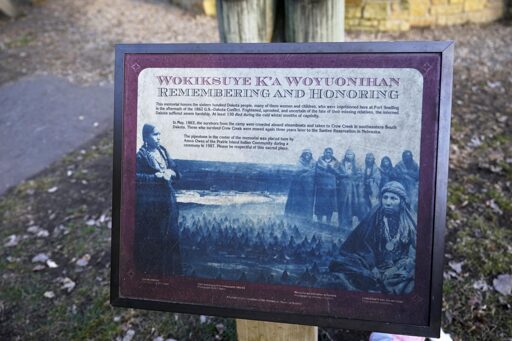
Upwards of 3,000 Dakota and Ho-Chunk people were imprisoned at Fort Snelling, a concentration camp, during the winter of 1862 following the Dakota Indian Wars. Approximately 300 Native people died there.
Aside from being the site of a former concentration camp, the area is also a site of creation for the Dakota people. B’dote, where the Minnesota and Mississippi Rivers meet, is one of the Dakota peoples’ creation sites. Today, B’dote is visible from the bluffs at the historic Fort Snelling complex.
As historic immigration raids pay out across the Twin Cities, several Native people have reported being detained at Fort Snelling. The Bishop Henry Whipple Building in Fort Snelling is being used as an ICE detainment and processing facility by the U.S. Department of Homeland Security.
The encounter
Watso was detained on Wednesday, Jan. 14, in Brooklyn Center, Minnesota, a suburb immediately north of the city of Minneapolis. Watso wasn’t released from ICE custody until Jan. 16, more than 48 hours after her initial encounter with ICE.
The Mdewakanton Dakota woman said she was monitoring ICE activity from her vehicle when agents and another group who she initially believed were local law enforcement approached her in her truck.
The video shows agents with the words “Police ICE” on their vests, which makes Watso believe they were all immigration enforcement personnel. Some agents or officers in the area have had the words “Police” or “ICE” labeled on them.
“It was a very confusing situation,” she said. “Because of the way that they [ICE agents] do not identify themselves, right?”
Dakota citizen arrested by federal officers during Minneapolis protests Saturday
One agent told Watso she was in violation of U.S. Code 18 section 111, which is a federal charge pertaining to imposing, obstructing or assaulting a federal law enforcement agent while on duty. ICE agents are allowed to detain U.S. citizens believed to be in violation of the code.
ICE agents have used this same charge against at least two other Native American people, William LaFromboise, a Sisseton Wahpeton Dakota man arrested while protesting ICE on Jan. 26, and Jose “Beto” Ramirez, a Red Lake Nation descendant detained on Jan. 7. Ramirez was charged nearly two weeks after his detainment.
Watso said one of the men told her she was impeding or obstructing an ongoing federal immigration investigation, but another told her if she didn’t stop what she was doing she would then be in violation of the code.
“A lot of people were talking at the same time,” she said. “At that point, I was already pulled over. So I had already stopped everything I was doing.”
Agents asked for her identification, Watso said she did not feel comfortable stepping out of her vehicle or handing over her ID.
Some tribes have reported incidents where individuals posing as ICE questioned members and asked for their identification.
Roughly three hours south of Minneapolis, the Meskwaki Nation in Tama, Iowa, reported at least one tribal member was questioned by men in nearby Toledo, Iowa, pretending to be immigration agents. The tribe said upon investigation, the individuals were confirmed to not be ICE personnel.

A photo taken after Sophie Watso’s detainment shows her pickup truck’s windows smashed in by immigration agents on January 14, 2026, in Brooklyn Center, Minnesota. Credit: Courtesy Isavela Lopez
“I didn’t know who these people were,” Watso said. “They’re just some masked men that approached my window. So I didn’t feel comfortable giving them my identification.”
Moments later, Watso said the agents used a window breaker to smash in her truck’s driver’s side and passenger side windows.
Watso’s dog, a small pomeranian named Modean, was sitting on the passenger seat. She grabbed Modean to try and shield him from the shattered glass. Around her, prairie sage from her dashboard fell around the drug.
Watso, who is 5 feet, 2 inches tall, said it wasn’t difficult for the agents to pull her out of her truck from the broken window and place her on the ground. She held tight to her dog, who she feared was injured from the broken glass.
“There was nothing I could hold on to,” she said. “I was just holding on to my dog, and they put me on the ground on top of the glass that they just broke. And that’s when they were just trying to rip my dog from my arms.”
Watso said agents grabbed Modean from her arms and took him away from her before laying her face down on the ground, on top of the broken glass, a few agents leaned their full weight on her back and placing her in handcuffs. She could barely breathe, she said.
Fortunately, some of her friends were in the area and able to record the interaction, she said.
“I was yelling to them,” she said. “I told them, ‘Tell them where my dog is,’ and they were also malicious about that.
Watso said her friends were able to locate her dog at a nearby pound while officers drove her to the Whipple building in Fort Snelling for processing. Her friends then took her dog to stay with Watso’s mother.

Sophie Watso and her dog Modean pose in front of a mural she painted. Watso, Mdewakanton Dakota, was detained by immigration agents outside Minneapolis on January 14, 2026, and held for 48 hours. Credit: Courtesy of Sophie Watso
In detainment
At this point, knowing she was on her way to Fort Snelling, Watso began to sing.
“So it was important to me to sing a song, one of the only songs that I know by heart,” she said. “It’s a prayer song, and it’s asking for help.”
She felt like she was captured, she said, and began reflecting on what her Mdewakanton ancestors had experienced a century ago.
“The words in this song are asking for help, telling the creator that I want to live,” she said. “Not only am I praying for my safety, but I was also praying and wanting to greet my ancestors, in our language, with a song, because I know that my ancestors are there.”
Agents began to make fun of her singing, she said, asking if she was on drugs. But she didn’t care.
“I don’t do drugs and I don’t drink alcohol, but I expected that from them,” she said. “I understood that these people are colonized and they have the intention of degrading you.”
So she made sure to look them in the eyes as she sang.
“I wasn’t going to show them that I’m a spectacle,” she said.
Once inside of the Whipple building, Watso said she waited for several hours in a warehouse-like facility, her arms and legs shackled. She felt scared but oddly enough comforted at the same time, knowing her ancestors were there, she said.
“I knew that I wasn’t alone,” she said. “I knew that my people have suffered here, but I also knew that people have lived here.”
She said she took comfort in that fact.
Former Native American concentration camp lies beneath current immigration detention center
While detained, Watso said she was not offered an opportunity to speak with a lawyer. Watso said she at one point verbally requested to speak with a lawyer, but was not given the opportunity. Since she was not able to speak with a lawyer, Watso was further transferred out of the Whipple building to an ICE partner facility, the Sherbourne County Jail.
Sherbourne was a much better experience than being kept at the Whipple building, she said.
“The people at Sherburne County, these are just sheriffs, people who work there, and they’re actually nice to you,” she said. “They actually treat you like a human. They ask you if you want water and they give it to you. They talk to you normally like you’re a person.”
‘I’m traumatized’
In Sherbourne on Thursday, Jan. 15, Watso said was finally given an opportunity to make phone calls. Watso was then able to contact a lawyer and has since been working with the Native American Rights Fund, a non-profit organization dedicated to the legal protection of Indigenous people, tribes and tribal organizations.
Because no charges were filed against her, Watso was let go from Sherbourne after a 48-hour hold on Friday, Jan. 16.
Following her release from Sherbourne, Watso said was taken back to the Whipple building in Fort Snelling by two Homeland Security department agents. Watso was given paperwork and her possessions back at Fort Snelling and informed she could now go home, but it wasn’t the end, she said.
While leaving, Watso said she wasn’t given clear instruction by the agents on how to exit the building. While making her way through the parking lot, jogging to speed up her journey due to the below freezing temperatures, Watso was tackled by several ICE agents who assumed she was attempting to break out of the facility.
Watso said at least four agents dressed in full gear tackled her, leaving her with back pain and further traumatizing her. She was placed back in handcuffs and again taken into the Whipple building where another agent verified she had been released from custody, at which point she was freed again, this time with a ride home.
“It’s all on surveillance video,” she said. “Here I am free, running, and then I’m tackled, brutalized, cuffed back up and brought back inside. Every time I go outside now, my head is on a swivel, like, left, right, left, right, turn behind you. ‘Is there anyone behind me?’ I’m traumatized.”

A young Dakota woman incarcerated at the Fort Snelling concentration camp is photographed in 1862. Survivors of the camp were sent via steamboat to the Crow Creek Reservation in South Dakota and the Santee Reservation in Nebraska. (Courtesy Minnesota Historical Society)
Watso said as of Jan. 26 she had not yet been able to go to the hospital to have her injuries evaluated. She has, however, been able to visit with a therapist and is staying with friends for safety, she said.
The experience has left her completely terrified, she said. Since she’s staying with friends, on one occasion she accidentally locked herself out of the apartment and began to panic.
“I was here alone, and I was outside, and I didn’t have anything, any identification on me, so I was immediately terrified,” she said.
Fortunately, a couple welcomed her into their home until her brother was able to come pick her up.
“That was a crazy feeling,” she said. “For people like me, who look like me, you don’t even want to leave your house because you’re scared ICE is going to take you.”
Watso said she wants to share her story to raise awareness to what’s really happening in Minneapolis, a place she moved to two years ago to be closer to her ancestral homelands.
“[I moved back] to reconnect to the land and my people and to live on this land,” she said. “So many people don’t get to live on their ancestral homelands in America, so I felt like it was important to do that.”
After hearing about charges pressed against Jose Ramirez, a Red Lake nation descendant who was detained by ICE the week prior, Watso was scared of the potential for the same thing to happen to her.
“I feel like it’s important to speak out about what happened to me,” she said.
Being surrounded by friends and family is helping her heal, she said. Leaning on prayer and medicine has helped to center her.
“I haven’t been to sweat yet but I’m planning on it,” she said. “I know that there’s definitely a lot to process, but at the same time I don’t want to. I don’t want to think about it.”
The post Dakota woman recounts more than 48 hours in immigration detainment appeared first on ICT.
From ICT via This RSS Feed.