

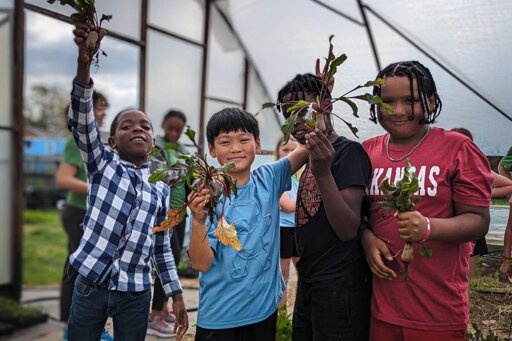
Article Summary
• Arkansas has had the highest food insecurity rate in the nation for three years in a row, according to data from the U.S. Department of Agriculture (USDA).
• In the town of Fayetteville, food security efforts have spanned the private and public sectors for many years. At the heart of the work is the community’s approach to nutrition education for youth, including growing food.
• Leading the charge: Apple Seeds, a nonprofit teaching farm, and the Arkansas Hunger Relief Alliance, in collaboration with Fayetteville’s public school district.
• Federal budget cuts for programs like SNAP-Ed and the Farm to School Program have impacted this work, but most of Fayetteville’s efforts will continue regardless.
At Apple Seeds teaching farm, in Fayetteville, Arkansas, the simple act of unearthing a carrot can be life changing.
Executive Director Mary Thompson remembers one child in particular, a fourth-grader who had just harvested a carrot. “He washed it and put it in his pocket. Later, he took it out and took a nibble like he was really savoring it, then put it back,” she says. “I told him we could harvest another carrot, and he said, ‘Oh my gosh, thank you. I’ve really, really been trying to save this to take home to show my mom. She would never ever believe where this carrot came from.’”
In Washington County, food insecurity rates are among the lowest in Arkansas. Those low rates are driven at least in part by over many years of remarkable community-driven hunger relief efforts there.
Since 2007, Apple Seeds, a nonprofit, has worked to teach children about the wonders of fresh produce and inspire healthy eating through garden-based education. Recently, this mission took on new urgency: The state of Arkansas has had the highest rates of food insecurity in the nation for three years running, according to the U.S. Department of Agriculture’s (USDA) latest Household Food Security report.
In Washington County—where Fayetteville is located—food insecurity rates are among the lowest in Arkansas. Those low rates are driven at least in part by many years of remarkable community-driven hunger relief efforts there, led by Apple Seeds and the Arkansas Hunger Relief Alliance (AHRA), in collaboration with the Fayetteville Public School District.
The 2025 One Big Beautiful Bill terminated SNAP-Ed and trimmed funding for the Farm to School program, among other budget cuts. The federal policy changes, which reduced nutrition education for children and are likely to exacerbate food insecurity for many Americans, are affecting Fayetteville too.
While only a small portion of farm to school grant funding has been reinstated for 2026, most of Fayetteville’s efforts continue regardless, providing a look at how proven solutions are adapting to address hunger.
Fighting Hunger in Fayetteville
Nearly 20 percent of Arkansas households lacked adequate access to nutritious foods in 2024, based on the most recent USDA data available. That equates to nearly 600,000 Arkansans facing hunger, as well as 1 in 4 children.
Washington County had one of the lowest food insecurity rates in Arkansas at 17.4 percent, according to the most recent Map the Meal Gap data collected in 2023 by Feeding America. Though higher than the national average of 13.5 percent, it is significantly lower compared to other areas in the state, such as Searcy County, where 24.3 percent of residents experienced food insecurity that year.
For Searcy County children, the rate was much higher than for the county’s general population—32.2 percent—which is a common pattern in counties across the state. Washington County, however, is an outlier; the rate of food insecurity among children there in 2023 was lower—16.8 percent—compared its general population. And Washington County’s childhood hunger rate was the second lowest in the entire state.

Apples are just one of many kinds of fruits and vegetables that grow on the two acres of land that make up Apple Seeds Teaching Farm, which students can pick themselves and enjoy as a healthy snack. (Photo courtesy of Apple Seeds)
These numbers reflect local efforts to focus on students. The work spans the public and private sectors: For roughly 20 years, nonprofit organizations like Apple Seeds and the AHRA, in collaboration with the Fayetteville Public School District, have shown how giving kids access to fresh produce and helping them have positive experiences with vegetables early in life can have lasting and far-reaching impacts.
The AHRA started working to boost food security in 2004. The Little Rock–based nonprofit began as a coalition of six Feeding America food banks in the state, which continue to operate. In addition to providing food for Arkansans in need, AHRA also partners with local and federal organizations on advocacy and educational programming to mitigate hunger in the long term. This includes everything from leading cooking classes to helping people enroll in the SNAP program to coaching volunteers on how to ask lawmakers to negotiate additional funding for the program.
Another driving force is the Fayetteville Public School District, which created edible gardens at its 17 schools between 2009 and 2014. In 2013, the school district received a $99,000 USDA Farm to School grant to expand a sustainable farm-to-school program, and in 2021 it received a second Farm to School grant for $82,000, but this latter grant was never implemented due to COVID restrictions and staffing issues. Currently, the gardens are managed with $450 per school per year.
In 2015, Apple Seeds signed a 20-year lease for 2 acres from the City of Fayetteville at no cost—the land was a gift from the city “in exchange for the services we provide the community,” said Thompson. They built a barn with a kitchen and dining space, placed wooden benches in a semicircle around an old pecan tree for an outdoor classroom, and cleared a plot to plant vegetables. The teaching farm is just 14 miles from the Northwest Arkansas Foodbank, one of the six food banks that form the AHRA.
“While they might not have [had] any interest in trying broccoli at first, if they grew it,…they would literally eat the broccoli off the plant.”
The initial Apple Seeds curriculum was created with the Arkansas Children’s Research Institute, based on seven years of lessons developed by the Fayetteville Public School District. The curriculum covered nutrition, cooking, and gardening with hands-on activities in the school gardens and field trips to the Apple Seeds teaching farm.
In 2018 came a moment of synergy: The farm, the research institute, and the school district combined forces with the AHRA to further develop the on-farm curriculum with components of the AHRA’s nutrition education program, Cooking Matters.
“I learned with my own kids that while they might not have [had] any interest in trying broccoli at first, if they grew it, we wouldn’t even bring it inside; they would literally eat the broccoli off the plant,” says Stephanie Jordan, a nutritionist and the school district’s part-time garden coordinator.
Jordan helps kids plant, harvest, sort through seed catalogs, study pollinators, manage a compost bin, and supply leafy greens to the cafeteria salad bar. Jordan’s enthusiasm for these programs is formidable, limited only by resources.
“Being only half-time and having 17 schools, it’s just not feasible for me to maintain all of the spaces,” says Jordan. “Maintenance is what I’m most worried about. I think if these spaces don’t look beautiful, they’ll just be mowed over.”
Working from its one teaching farm location in Fayetteville, Apple Seeds partners with 74 schools throughout western and central Arkansas, and its curriculum is integrated into the daily schedule for K-5 students at 36 of those schools.
“In kindergarten, they pull a carrot out of the ground and start to formulate the concept of where food comes from,” Thompson said. “At first, we’re building a fun experience with a vegetable. Then we layer in cooking skills as they get older. By the time they finish elementary school, they know how to prepare vegetables for breakfast, snacks, lunch, and dinner.”
In other words, students learn how to harvest, wash, and cut that carrot before eventually baking it into carrot muffins or another Apple Seeds recipe. The hands-on group fun transforms tasks from dreaded chores into pleasant experiences kids can look forward to recreating at home.
Outside the K-5 curriculum, Apple Seeds also offers summer camps and workshops at its farm to teach real-world agricultural and culinary skills to teenagers. Programs focus on growing and cooking fresh produce, in the belief that understanding and enjoying the farm-to-table process is one step toward greater food sovereignty.
Turning Kids Into Veggie-Lovers

In the Apple Seeds kitchen, kids learn basic cooking skills, like how to chop a cucumber for a salad. (Photo courtesy of Apple Seeds)
AHRA food banks provide ingredients while culinary and nutrition education programs teach kids how to prepare healthy meals for themselves and their families. Food access and education, however, aren’t always enough to inspire healthy eating habits. Nothing changes unless a kid wants to taste those foods.
“I think one of the biggest things we’re doing is trying to change the mindset of kids from ‘Ooh, vegetables are gross’ to ‘Wow, I like vegetables, and cooking them is really fun,’” Thompson said.
Only 3.6 percent of Arkansas kids eat the daily recommended servings of vegetables—about 1.5 to 3 cups depending on factors like age and gender—according to the Centers for Disease Control and Prevention (CDC).
Apple Seeds measures the impact of its programs and shares the results publicly in its annual Impact Report. All students are surveyed before and after the program, with images of vegetables and the question: If this were on your plate, would you eat it?
“It takes five to seven points of interaction with a new vegetable to start to shift the mindset of a kid around what they think of that vegetable,” Thompson explained.
“It takes five to seven points of interaction with a new vegetable to start to shift the mindset of a kid around what they think of that vegetable.”
This year, there was a 91 percent increase in the number of kids willing to eat turnips after participating in an Apple Seeds program, Thompson said. And roughly three-quarters of participating students are willing to eat leafy greens—compared to less than 30 percent of American adults.
Also this year, Apple Seeds saw increases in kids’ willingness to try the vegetables used in the program, their retention of nutrition information, and behavioral changes such as cooking at home or using a nutrition label to make a decision, Thompson said.
Apple Seeds grows produce year-round using organic farming practices, and its staff select crops for educational and nutritional purposes, not commercial value. Two examples: sweet peppers and cherry tomatoes, which kids can harvest without a sharp knife.
Apple Seeds also increases food access through donations of “produce bundles.” In 2024, the farm supplied students with 16,854 of these bags of fresh vegetables.
“Whatever we’re growing, we bundle it up with a recipe and the kids who participate in the programs get to take home a cooking kit that includes everything needed to make that recipe,” says Thompson.
The produce bundles are delivered monthly directly to the schools that offer the Apple Seeds K-5 core curriculum. The bundles change seasonally—in the spring, for example, students may receive carrots, assorted herbs, and fresh greens such as spinach, kale, and lettuce. “Ninety-eight percent of the families that get access to our food say that it increases their consumption of fresh vegetables at home.”
At Asbell Elementary in Fayetteville, 90 percent of the roughly 300 students are eligible for free and reduced price lunch through the USDA National School Lunch Program. Every grade level there also offers an annual field trip to Apple Seeds and access to their produce bundles.
“The first couple of times that we had the produce bundles, students were a little hesitant, but now they will come right up and they’ll show so much excitement, they’ll want to take five different bags,” says Asbell Principal Jamie Baureis. “It’s completely changed the level of engagement with vegetables.”

At the Apple Seeds Teaching Farm in Fayetteville, Arkansas, staff and volunteers help students plant vegetable seeds to learn about where our food comes from and increase interest in healthy ingredients. (Photo courtesy of Apple Seeds)
The Future for Fayetteville’s Nutrition Education
Apple Seeds’ concept was inspired in part by Zenger Farm in Portland, Oregon, and Jones Valley Teaching Farm in Birmingham, Alabama. Tucson Village Farm in Tucson, Arizona, and Cedar Circle Farm in East Thetford, Vermont, also offer interesting models for on-farm growing and nutrition education for schoolkids.
Perhaps the most well-known and broad-reaching initiative is Alice Waters’ Edible Schoolyard, which was founded in California in 1995 and now comprises 6,500 programs across 47 countries, according to its most recent impact report.
These organizations all manage to address hunger and health issues in their communities without significant federal funding.
But for many others, including in Fayetteville, the sudden loss of federal funding last year is forcing abrupt shifts in how they operate and fulfill their missions.
For many others, including in Fayetteville, the sudden loss of federal funding last year is forcing abrupt shifts in how they operate and fulfill their missions.
AHRA took an $800,000 hit to its annual budget last year, with $600,000 cut from nutrition education for children and adults due to the termination of SNAP-Ed. “We lost that funding without warning,” said AHRA CEO Sylvia Blain. “We still had one year left on our agreement, so there was confusion about whether or not we would be allowed to finish out our contract which would go through September 2026. We have not yet secured new partnerships to fund this work.”
Since July 2025, when the One Big Beautiful Bill set an Oct. 1 end date for SNAP-Ed, the AHRA has pared down programming and tried to fill the gap by focusing on individual and corporate donors. This hasn’t been easy, because the coalition must compete with other nonprofits for a limited pool of resources.
Apple Seeds typically relies on government grants for about a third of its funding, with events and donations from individuals, family foundations, and corporations bringing in the rest. In 2025, several grants that Apple Seeds had received or applied for were unexpectedly discontinued.
When the Farm to School grant program was reinstated in September 2025, AHRA and Apple Seeds co-submitted a proposal in the hopes of receiving some of the allotted $18 million in funds for all states, to be announced in April 2026.
Depending on Diversified Income
The funding cuts from the past year confirmed the importance of having diversified streams of income, Thompson said. “They can balance each other whenever one area is not as strong in any given year. This is across individual giving, corporate giving, grants, and services we offer at a fee.”
In the future, this could mean that Apple Seeds plans more ticketed events, like a Kitchen Table dinner series they have hosted monthly since 2017. “We love to fundraise around the same mission of our work with our kids—building community around good food,” Thompson said.
Last year, 20,155 students from central and northwest Arkansas (including Fayetteville) participated in Apple Seeds programs. This year, the organization expects to reach capacity and is planning to build two additional teaching farms over the next few years. This will, of course, depend on funding.
“I think we’re going to see a highly competitive fundraising environment in 2026, and that is concerning, because there’s a lot of great work that needs to be done,” Blain said. “Hope is the flip side of that—it’s the coalition building that’s happening right now across sectors to make sure that this work continues. People realize that we’ve got a lot to do in the grassroots sector, and that our communities have got to support one another.”
The post Fighting Hunger in Fayetteville, Arkansas appeared first on Civil Eats.
From Civil Eats via This RSS Feed.