

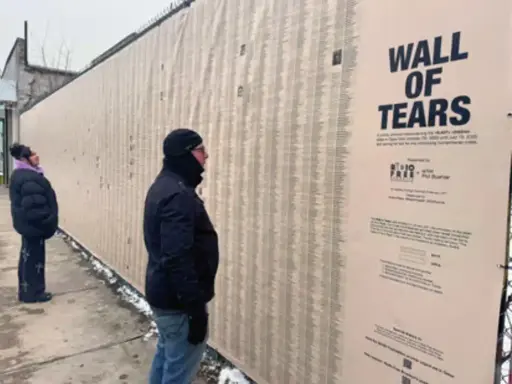

While Western governments continue to provide political and military cover for Israel, within Western societies themselves, there are growing spaces for challenging the official narrative, led by independent artistic and cultural initiatives that redefine the victim and break down their reduction to numbers. In this context, art is no longer merely a symbolic expression, but a tool for moral questioning, bringing the tragedy of Gaza from the margins of the news to the heart of public consciousness. In New York City, one of the world’s most influential cultural capitals, a huge artwork entitled ‘Wall of Tears’ has emerged, documenting the names of thousands of Palestinian children Israel has killed in the Gaza Strip, transforming them from numbers in military reports into an indelible human memory.
Names instead of numbers from Gaza on the Wall of Tears
On Grattan Street in Brooklyn, the wall was built approximately 15 metres long and three metres high, made of weather-resistant vinyl in a sandy colour that mimics the besieged land of Gaza. On its surface are written the names of 18,457 Palestinian children who were killed between 7 October 2023 and 19 July 2025, according to data from the Ministry of Health in Gaza.
The list begins with the name of 14-year-old Wissam Iyad Mohammed Abu Faisaf and ends with eight-year-old Sabah Omar Saad Al-Masri, arranged chronologically according to the date of their martyrdom, in a visual documentation that restores each child’s name and age and refutes the description of ‘collateral damage’ promoted by the occupation machine.
The work is by American artist Phil Buehler, known for his politically charged art projects. In a statement to the Guardian, he said that from a distance, the wall ‘looks like an abstract painting,’ but it draws passers-by closer, before they discover that they are looking at the names of children killed in Gaza.
Art as a tool for accountability
The artist points out that reading the names, accompanied by selected photos and stories taken from press reports, forces the viewer to make comparisons and imagine their own children or family members in the same place, creating a human shock that transcends traditional political and media language.
The Wall of Tears is not an isolated initiative, but part of a clear artistic trajectory in Buehler’s work, who has previously carried out projects such as The Wall of Lies, documenting false statements by US President Donald Trump, and The Wall of Shame about the 2021 storming of the US Capitol, as well as Empty Beds, which highlighted the abduction of Ukrainian children.
In this context, Buehler treats art as a tool for political and moral accountability, rather than as an aesthetic act detached from reality.
The work was carried out in collaboration with the non-profit organisation Radio Free Brooklyn. Buehler emphasises that the project was ‘behind the times’ even before its opening, as it documents the names of children only up to July 2025, while Israel continued to kill hundreds of children after that date, including during the period following the ceasefire agreement last October.
Hind Rajab: the memory that opens the wall
The opening of the wall coincided with the second anniversary of the martyrdom of the child Hind Rajab, who was shot dead by occupation soldiers inside a car carrying her and her relatives as they tried to reach a safe place on 29 January 2024. Her final cries for help became documented testimony, forming the basis of the film ‘The Voice of Hind Rajab’ by Tunisian director Kawthar Ben Hania, which has been nominated for prestigious international awards, including the Oscars and BAFTA.
The work comes amid heated political debate in New York, home to the largest Jewish community outside Israel. In this context, Buehler emphasised his rejection of the deliberate conflation of opposition to genocide in Gaza with anti-Semitism, arguing that this conflation is used to silence moral criticism and shut down any public discussion of the crimes committed.
Testimony on the Wall of Tears
The ‘Wall of Tears’ was not the only event in Brooklyn. Over the past few months, the city has witnessed other artistic initiatives in support of Gaza, most notably the non-profit exhibition space Recess hosting the American debut of the ‘Gaza Biennial’ under the title ‘From Gaza to the World,’ with the participation of 25 Palestinian artists.
The works on display documented life under bombardment, famine and displacement, affirming that Palestinian art continues despite war and siege.
The Gaza Biennial is an international art project that was launched in April 2024 on the initiative of artists from Gaza and the West Bank, with the participation of more than 50 artists, to transform art into an act of survival and resistance, and to redefine the artistic space in a time of extermination.
Thus, dismantling the Israeli narrative is no longer the exclusive domain of human rights reports or political statements. In the streets and on the walls of Western cities, art stands as a moral witness to a crime that the official world is trying to overlook, while the human conscience insists on fixing it in memory… name after name.
Featured image via the Canary
By Alaa Shamali
From Canary via This RSS Feed.