

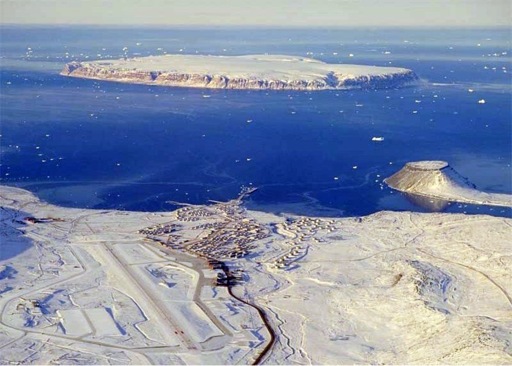

Pituffik Space Base with Saunders Island in the background and Mount Dundas at right.
Learn about plans for the Feb. 21-23, 2026, Global Days of Action to #CloseBases on the Feb. 3 Zoom calls: https://daytoclosebases.org/
Pituffik Space Base and the Politics of Control: U.S. Overseas Basing, Indigenous Dispossession, and Arctic Escalation in Greenland
By Mohammed M.A. Abunahel, World BEYOND War, February 1, 2026
The U.S. installation historically known as Thule Air Base, renamed Pituffik Space Base in April 2023 and placed under the U.S. Space Force, is routinely described as a remote technical site for missile warning and space surveillance. That description narrows the story to hardware and omits the human and political costs that made the base possible, and that still follow from its presence.
Pituffik Space Base should be read as a long-running case of overseas basing as a form of coercive statecraft. It began with a foundational legal instrument, the 1951 U.S.–Denmark Agreement on U.S. Military Access to Greenland, which granted the United States extraordinary latitude within a designated area, while leaving Greenlanders with limited ability to refuse, shape, or reverse decisions. The results are visible in three overlapping harms:
- Displacement and rights violations affecting the Inughuit (Thule Inuit);
- Nuclear-era secrecy and accident risk, most dramatically the 1968 B-52 crash with nuclear weapons;
- Environmental liabilities from Cold War infrastructure treated as “buried and forgotten,” now complicated by Arctic warming.
An anti-bases stance is not rhetorical here. The record indicates that “strategic necessity” repeatedly functioned as an all-purpose justification to override local rights and externalize risk to a remote Indigenous homeland.
Pituffik is often called the U.S. military’s northernmost installation. Operationally, its significance comes from its role in missile warning, or what is so-called missile defense, and space surveillance, functions tied to worst-case planning rather than everyday safety.
This matters because the missile and the missile-warning architectures are not politically neutral. They sit at the center of escalation dynamics: each side can plausibly claim to be “defending,” while the other reads the same infrastructure as enabling faster strike decision-making or reducing the credibility of retaliation. The 2004 Thule radar upgrade agreement is a concrete example: it explicitly enabled modernization of the radar in ways linked to U.S. missile while providing consultation to Denmark and Greenland without granting either a veto over “significant changes.”
So, the base is not merely “a site.” It is an enduring strategic node that helps normalize a security posture premised on high-end confrontation, and in the Arctic, that posture now intersects with renewed imperialist-power competition.
Thule’s construction occurred in the early Cold War under conditions shaped by urgency and secrecy. The base’s strategic value lay in geography: a position across polar routes that mattered for nuclear-era planning. Even when official narratives emphasize NATO or collective defense, the operational logic at Thule was closely aligned with U.S. strategic requirements.
This “build first, justify after” rhythm is a recurring pattern in overseas basing: construction and capability expansion create facts on the ground that later become the argument for permanence (“too important to close,” “too expensive to move,” “too integrated to replace”). Pituffik is a textbook case.
The most direct harm is the 1953 forced relocation of the Inughuit from the Thule/Dundas area in connection with the U.S. base’s needs. Legal and scholarly sources document that Danish authorities carried out the relocation, and courts later recognized it as a serious interference with the local population’s rights and livelihood.
The story is sometimes softened into a tale of compensation and “settled history.” That is misleading. Compensation does not erase the coercion or the cultural loss; nor does it resolve what is structurally at stake: an Indigenous community’s relationship to land and subsistence was subordinated to foreign military requirements. The European Court of Human Rights (Hingitaq 53) materials and related analyses capture how the dispute traveled across decades, reflecting the depth of unresolved grievance.
Pituffik exists because the Inughuit were moved out of the way. That remains the base’s original Immoral signature.
On 21 January 1968, a U.S. B-52 crashed near Thule while carrying nuclear weapons, triggering contamination and a major cleanup operation, known as Project Crested Ice. Two harms follow from this episode:
- Environmental contamination and incomplete accountability. Even under heavy cleanup, nuclear accidents are rarely clean in the moral sense; they leave disputes about what was recovered, what remained, and who is responsible for long-term monitoring.
- (b) Worker health and institutional defensiveness. Danish workers involved in cleanup later pursued compensation and recognition.
The key point for anti-base work is not to cherry-pick a single statistic; it is to emphasize the structural reality: a nuclear accident occurred, and ordinary workers carried the burden of exposure uncertainty and bureaucratic resistance.
Recent reporting continues to revisit the crash as one of the Cold War’s worst nuclear accidents and highlights ongoing compensation struggles—evidence that the social consequences did not end with the cleanup.
Pituffik is part of a wider Greenland basing legacy that includes abandoned sites like Camp Century—a Cold War installation later associated with Project Iceworm concepts and long-term waste burial under the ice.
The most important peer-reviewed anchor here is Colgan et al. (2016, Geophysical Research Letters), which assessed the wastes at Camp Century and modeled how climate-driven shifts could turn the site from net accumulation to net melt, making it plausible that buried hazards could re-emerge over coming decades.
Reuters also reported Greenlandic demands that the United States and Denmark address toxic remnants of Cold War installations, reflecting the political salience of this issue well beyond academic debate. Two points matter for the anti-base narrative:
- The original “solution” was concealment by geography and ice. That is not responsible governance; it is deferral.
- Climate change turns deferral into liability. Even if waste stays buried for decades, the risk is transferred to future Greenlanders, not to the institutions that created it.
This is why bases should be evaluated not only by present-day operations but by full lifecycle costs, including decommissioning, waste, and long-term remediation.
Since Trump’s return to the presidency in November 2024, Pituffik has taken on a new and more volatile role. It no longer functions only as inherited Cold War infrastructure; it has become a material anchor for claims about U.S. entitlement, control, and “necessity.” The base helps turn rhetoric into plausibility. That is precisely why it is dangerous.
Pituffik sits in northwest Greenland, far above the Arctic Circle. Its remoteness is part of its value. The base hosts critical components of U.S. missile warning, space domain awareness, and satellite tracking systems, including radar tied historically to the Ballistic Missile Early Warning System (BMEWS).
Overseas bases are not neutral installations; they are political facts on the ground. Pituffik’s continued operation rests on agreements negotiated between Washington and Copenhagen, not on democratic consent from Greenland’s population. This structure matters because it creates a persistent gap between sovereignty in theory and control in practice.
For decades, that gap was managed through quiet diplomacy and Cold War routine. Under Trump, it has been exposed.
When a U.S. president claims that “ownership and control of Greenland” are an “absolute necessity” for U.S. national security, that claim does not float in a vacuum. It is materially underwritten by the existence of Pituffik. Without the base, such statements would sound like fantasy. With the base, they sound like escalation.
Donald Trump publicly asserted that U.S. “ownership and control of Greenland” were an “absolute necessity” for national security.
This was not an idle comment. It had immediate political consequences in Greenland. The intervention destabilized internal politics to the extent that Greenland held an early parliamentary election on 11 March 2025, well ahead of schedule. That is an extraordinary outcome: a foreign leader’s territorial rhetoric precipitating democratic disruption in a self-governing society.
Pituffik sits at the center of this dynamic. Trump’s claim implicitly treats the base not as a negotiated military presence, but as a strategic down payment, evidence that U.S. interests already supersede Greenlandic self-determination.
The internal consequences of Trump’s Greenland rhetoric reached the base itself. In April 2025, Susannah Meyers, a senior officer of the United States Space Force and the highest-ranking U.S. officer in Greenland, publicly stated that Trump’s threats against Greenland were “not reflective of Pituffik Space Base.”
That statement was notable for its moderation. Meyers did not challenge U.S. presence in Greenland. She did not question the base’s mission. She merely attempted to separate Pituffik’s day-to-day operations from presidential rhetoric implying territorial control. For that, she was relieved of her command.
Trump’s Greenland statements did not emerge from abstract nationalism. They emerged from a strategic environment in which the United States already enjoys de facto military primacy on Greenlandic soil. Bases make escalation thinkable.
This is how bases provoke war: not by firing first, but by reshaping what leaders believe they can demand without consequence.
In conclusion, Pituffik’s story is not a complicated history. It is a consistent pattern: strategic infrastructure is planted in a peripheral Indigenous homeland; consent is treated as secondary; secrecy and risk travel downward to workers and local communities; long-tail environmental problems are deferred; and the base’s existence becomes a platform for future coercive politics.
Overseas bases are not merely military facilities; they are political structures that manufacture vulnerability. Pituffik contributes to Arctic militarization and, in the Trump era, to renewed sovereignty tensions that do not make Greenland safer, only more strategically contested.
The post Already Causing Trouble in Greenland: The U.S Space Force appeared first on World BEYOND War.
From World BEYOND War via This RSS Feed.