

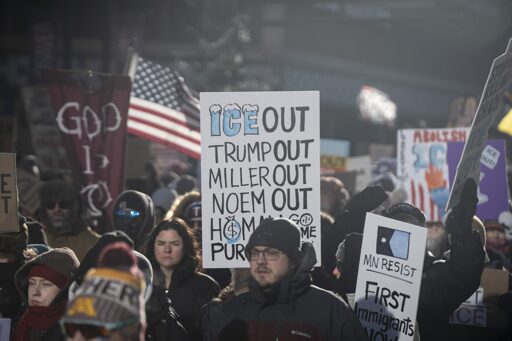
Minneapolis has been the vortex of American politics for weeks. The administration chose to send 3,000 ICE agents — the largest ICE operation in history — to impose its immigration policy and make an example of the city. The latter goal has failed. After months of organizing by communities and neighborhoods, the deaths of Renee Nicole Good and Alex Pretti by federal immigration agents sparked massive outrage across the Twin Cities and the nation, putting Minneapolis at the center of Trump’s immigration policies and the resistance to them.
Trump has been using these policies, particularly via ICE, to instill fear among the multiracial working class in America. The response in the streets has followed a different script. Far from having fear and caution set the tone of the political climate, workers and the broader community all over the country are trying to find ways to respond in kind. The Trump administration is perturbed and overextended, with several difficult “fronts” opened at the same time, domestically and internationally. The tensions at the heart of U.S. imperialism have put the Trump administration in a bind. The harder it tries to respond to the mobilization from below, the more it risks an “uncontrollable” scenario, a strategic concern shared by all sectors of the bipartisan regime. That includes the Democrats, who are deeply invested in trying to avoid this possibility.
This means that what happens in Minneapolis will shape the rest of Trump’s term and consequently the direction of the American regime in its decline. What is at stake in Minneapolis is nothing other than the glue that keeps his coalition together: immigration. And now that glue is cracking.
These killings have forced the administration to change command in Minnesota, ousting Greg Bovino and replacing him with Obama favorite Tom Homan, architect of the family separation policy in the previous Trump administration. Pretti’s murderers have been placed on administrative leave, and a civil rights investigation will be led by the Justice Department. The Democratic Party has finally been pressured to mount some opposition in order to rein in ICE, reaching a deal to revisit the agency’s funding in two weeks. These are just a few examples of the ongoing bipartisan operation to de-escalate tensions around immigration nationally and in Minneapolis in particular. They want to keep workers and the community at large from taking the fight against ICE even further.
Still, ICE and CBP are not yet out of Minneapolis. The raids, arrests, and deportations continue. Good’s and Pretti’s murderers have not yet been brought to justice. Trump has not ruled out ramping up ICE operations in other Blue cities.
Without these demands being met, it will be difficult to diffuse the situation in Minneapolis — a city where nearly every one of its nearly 450,000 inhabitants is touched in some way by the resistance to ICE’s presence in their communities. The immense showing in the streets on January 30 — despite the lack of participation of key unions and organizations — is an indication that the efforts to de-escalate have not yet brought down the heat; adding fuel to the fire is that protests in solidarity with Minneapolis across the country grew on Friday, with student walkouts playing a particularly important role.
The next weeks are critical to push the fight forward and overcoming any attempts to de-fang the struggle to defend immigrants, abolish ICE, and fight all of Trump’s attacks.
A New Chapter of Working-Class Activity
Communities have taken up the defense of their neighbors against ICE. Teachers, social workers, parents, and educators are making sure students continue to get the education they deserve. In doing so, they draw on worker and community solidarity from a reservoir that only deepens when used, defying a logic that counterposes the interests of the working class and oppressed. Recently formed community groups, including education workers, organize grocery runs and food preparation so their students’ families can eat and stay safe in their homes.
Hundreds of small business closed their doors on January 23. Fewer businesses, though still a significant number, shut down on January 30. More significantly, in the last month several stores have helped protesters recover from clashes with ICE or shelter those targeted by immigration officials. One restaurant even opened its doors to the community, converting to a free kitchen where anyone (except federal agents) can come in and get a meal.
The outrage against ICE and the organization of the resistance to its operations have even pushed workers toward more organization within their workplaces. Unionized and un-unionized workers alike mobilized on January 23. Significantly, two of the six Starbucks stores that were forced to close their doors that day were non-unionized. Workers are seeing that when they unite in their workplaces, they can make their presence known and fight for their demands.
What has occurred in Minneapolis has been in the making for several years. The 2008 crash gave way to a deeper questioning of the status quo, and even of capitalism. Different chapters of class struggle have been written since: The Arab Spring, with its massive rallies at Tahrir Square; Occupy Wall Street; the Black Lives Matter movement in both 2014 and 2020; the Yellow Vest movement and pension reform struggle in France; the uprising in Chile, and more.
Most recently, in response to Israel’s continued genocide of Palestinians, millions of people have taken to the streets all over the world. The United States witnessed a wave of encampments at universities that revitalized the student movement and echoed the fight against the Vietnam War. Last December, Italian workers not only took to the streets against the genocide, but forced a national strike to keep armaments from being shipped to Israel, marking a leap in the role of the labor movement in international struggle. In several other European countries, the labor movement has engaged in significant demonstrations of solidarity.
The working class in the United States has been hit hard by neoliberalism. After all, the relation of forces between classes in the heart of the empire was decisive in the viability of that once new form of capital accumulation. Yet the impacts of the crisis of neoliberalism and the end of that order run deep. An entire generation has now lived in a post-2008 world and in the post-2016 political order in the United States. In other articles, we have discussed the impact of the Pandemic, the rise of Generation U (for union), the increase in support for unions, the increase in unionization efforts, and an overall uptick in labor movement activity since 2017.
The deep bonds between teachers, students, families, and the broader community have been among the most invigorating aspects of the labor movement. The uptick in labor activity began with the so-called “Red State Revolt” in 2018, a massive teachers’ strike whose demands were not limited to their immediate interests, particularly wages and pensions. Teachers in Oklahoma demanded increased funding for schools even after they won wage increases. In 2019, teachers in Chicago even made demands for public housing. This instilled a deeply felt sentiment among educators that their teaching conditions are students’ learning conditions.
During the Pandemic, the bipartisan regime made a concerted effort to break the bonds between teachers and the community. There were countless statements and policies that sought to pit one against the other, reinforcing the idea that when teachers fight for their interests — especially by withholding their labor — they are harming their students and their families. With the benefit of hindsight, we can see that these efforts did not succeed. In several strikes and contract negotiations across the country in recent years, teachers have made demands that benefit all those who work in schools, as well as their students and their communities. In Minneapolis, the same teachers and staff who are now defending students against ICE are the ones who went on strike in 2022 to demand better wages and class sizes at the same time that they linked their conditions and those of their students to racism in the education system, showing the deep influence of the Black Lives Matter movement.
In fact, Minneapolis was the spark that lit an international movement against police brutality after the murder of George Floyd. In that moment, the city was the site of new ways of organizing as well, with massive protests and spontaneous face-offs with the police. These events culminated in the burning of the Third Precinct and the creation of “George Floyd Square,” an autonomous zone that saw the community come out to provide for each other, cooking meals, holding teach ins, and organizing to keep the police out of south Minneapolis. If you travel to the corner where Floyd was murdered, the memorial still stands; the gas station at the intersection still sits empty, with “Where there’s people there’s power” spray-painted across the top.
The lessons learned in 2020 are being drawn on now in the fight against ICE. Many of the tactics protesters are using now to push ICE out of their neighborhoods — as we saw during the face-off with federal agents following Pretti’s murder — were developed in the fight against the police. In every chant of “Abolish ICE” today on the streets of Minneapolis, there is an echo of “Abolish the police.” While a cautious and uneasy peace may exist with the Minneapolis Police Department (MPD), what remains stronger than ever from 2020 is the conviction among neighbors, coworkers, and schoolmates that “we keep us safe” from state violence and the attacks against the most vulnerable sectors of society. One of the objectives of the operation to draw down the situation in the city is to not sever the MPD’s years-long efforts to restore some level of “confidence” in the police — a worry made explicit by Police Chief Brian O’Hara, who was dispatched to Minneapolis after the 2020 BLM movement.
That spirit is reflected in the way the entire city of Minneapolis has mobilized to defend its immigrant communities and to denounce ICE’s presence. It is an understanding that their interests are inextricably tied and that an attack on the most vulnerable members of the community is an attack against all. That’s precisely what was so monumental about the mobilization of workers in the march on January 23 — workers organized for the interests of their entire community, not just those of their particular workplace or industry. While the mobilizations on January 30 were somewhat smaller, that spirit persists.
These are the deeply felt changes — concentrated in, but not only found in Minneapolis — that challenge the main pillar of the Trump administration and threaten to further erode the legitimacy of both parties of capital.
A Bipartisan Effort to De-escalate tensions at the Heart of Trump’s Coalition
Immigration is at the center of Trump’s coalition. It is where now-mainstream Republicans intersect with the different wings of the MAGA base. It is also the core of more extreme-right sectors of the coalition. As a result, the agencies responsible for different aspects of immigration policies are uncoordinated and divided, and their aggressive, erratic behavior is prone to serious “errors,” like the murders of Good and Pretti. The aggressiveness of ICE agents and their resolve to continue kidnapping people on the streets and in their workplaces should not be taken as a sign of political homogeneity within DHS. The central agencies involved in Trump’s immigration offensive, while united in their reactionary agenda, are riddled with in-fighting over how to carry it out and with what forces; this adds to the confusion within the administration and makes further missteps all the more likely.
That is why, after Good’s murder and the subsequent mobilizations in Minneapolis, Trump seemed to have little room to maneuver to pull back ICE operations in the Twin Cities without it seeming like an important retreat that would alienate hardline sectors of his base who, dissatisfied with his handling of the economy and other issues, still cling to immigration as a clarion call. Pretti’s murder — coming less than 24 hours after a historic economic blackout — changed everything. The bold-faced lies parroted by the administration about both victims and the circumstances of their deaths only fueled the outrage and accelerated the de-legitimization of ICE and the Trump administration.
Pretti’s murder — and the absence of any repercussions for Good’s killing — pushed Trump’s continued offensive outside the relation of forces, alienating sectors that previously supported his immigration crackdown. Today, over 63 percent of the population disapproves of ICE’s actions; 53 percent disapproves of Trump’s immigration policies as a whole, a reversal from his first months in office. Nearly 20 percent of Republicans think ICE is going too far. According to a recent YouGov survey, more Americans support abolishing ICE than ever before, including 19 percent of Republicans.
Trump and the broader bipartisan regime have started to orchestrate a de-escalation of tensions in Minneapolis and across the country, especially in so-called sanctuary cities. Trump has to perform a careful balancing act between not pushing the far right of his coalition too far and not alienating more moderate sectors appalled by ICE’s unbridled rampage. Trump’s equivocating statements about mistakes in Minneapolis, coupled with replacing Bovino with Homan — who has made vague and conditional statements on the possibility of a withdrawal of federal agents — is an attempt to do just that. The president is trying to deflate the pressure in Minneapolis in order to continue his immigration policies without being afflicted by scandals — a tall order.
For their part, the Democrats use harsh rhetoric against Trump, but they jumped on the first opportunity the White House offered to try and de-escalate. Despite corruption scandals that have kept Tim Walz from running for governor in November, the former vice-presidential candidate has gained political clout by harshly criticizing ICE’s actions in the state.
Democrats in Congress have played their part by leveraging the situation to negotiate the budget this week, threatening to block a new spending bill unless the administration made promises to rein in ICE. In an episode that allowed Democrats to appear as an oppositional force while Trump’s immigration offensive remains operational, the budget ultimately passed with a promise to re-discuss “reforms” to ICE in the coming weeks.
Building Toward Independent Working-Class Struggle
Friday’s actions across the country suggest that efforts to turn the heat down on a national repudiation of ICE face serious challenges.
The people of Minneapolis have not simply resisted ICE’s presence in their city, they have taken measures to actively expel it and organize themselves in new ways to protect their communities. In the weeks since Good’s murder, the working class and sectors of the middle class in the Twin Cities have taken the Trump administration head on, uniting their interests and fighting in their schools and communities. ICE’s campaign of terror against immigrants continues — including arrests, detentions, and abuses inside immigration facilities — but so, too, do the daily patrols, grocery runs, and community organizing of thousands of people. Minneapolis’s neighborhoods and communities are not content with less violence; they want ICE out for good. They want dignity and safety for their immigrant neighbors and an end to the militarization of their streets.
Trump and the entire bipartisan regime want the country to turn their faces away from Minneapolis. However, the growing protests across the country — incorporating the tactics used in Minnesota to stop work, school, and shopping — suggest that this will not be easy. But winning our demands means pushing the fight forward with all our might.
Resisting the pressure to de-escalate the struggle means rejecting the politics of the Democratic Party, because they are the second pillar of an operation to regain control in Minneapolis. The Democrats are trying to paint the partial retreat of the Trump administration this week as a total “victory” that they brokered. Calls to abolish ICE and replace it with some more “humane” immigration enforcement or reform ICE itself are not calls to end the targeting and violence against immigrants. They are not paths toward full economic, social, and political rights for immigrants. To carry those demands forward and to not allow another single deportation requires organizing outside and against the Democrats who try to contain the struggle.
Unions must rise to the occasion, following the important days of action on January 23 and 30. Several unions endorsed the call for a shutdown on January 23, though they did not fully mobilize their members. Even fewer unions endorsed the call on January 30 nationally and in Minneapolis, with several going so far as to refuse to protect workers who chose not to work. Aligned as they are with the Democratic Party, which wants a de-escalation of tensions in the Twin Cities and nationally, union leaders aim to channel the widespread activity of the working class into actions that cause the least possible disruption. Rank-and-file members of their unions — many of whom showed up in force last week — must make it unacceptable that their unions did not go all out for the historic shutdowns.
Instead, unions must put all their resources — money, energy, meeting halls, and influence — toward organizing anti-ICE committees in every workplace and across the city. That means uniting with existing response networks and creating spaces where workers, students, and communities can discuss and organize next steps. Those next steps must include mobilizing the full firepower of the working class to directly defend immigrants in their communities, refusing to adapt to anti-worker laws against political strikes and actions, as well as laws that allow the “peaceful” enforcement of immigration operations.
Putting up this fight in the labor movement in Minneapolis would strengthen the entire labor movement. Active solidarity across the country — as we saw firsthand on January 30 — means supporting and replicating these efforts in affiliate unions everywhere. This would give the labor movement the strength it needs to build a national strike that will shut it down to abolish ICE in the here and now, not months or years from now. With this force — utilizing all the methods at their disposal — workers can ensure that there will not be another death or another arrest.
The following weeks and months in Minneapolis are shaping the next three years of the Trump administration, but not only; they are starting to write the next chapter of class struggle in the United States.
The post The Deep Roots of the Fight Against ICE Pose Challenges for Trump appeared first on Left Voice.
From Left Voice via This RSS Feed.