

Bullets:
The Pacific ocean floor is rich with cobalt, nickel, and platinum.
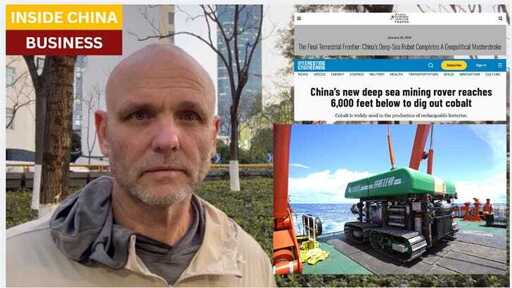
Chinese researchers have deployed numerous deep-sea vehicles, drones, and rovers to map the ocean in a bid to recover the next generation of minerals.
Western countries are struggling to re-open old mines and kickstart production. The Pentagon is offering large contracts to miners, and policymakers are enacting “price floors” to encourage new mining.
Inside China / Business is a reader-supported publication. To receive new posts and support my work, consider becoming a free or paid subscriber.
Report:
Good morning.
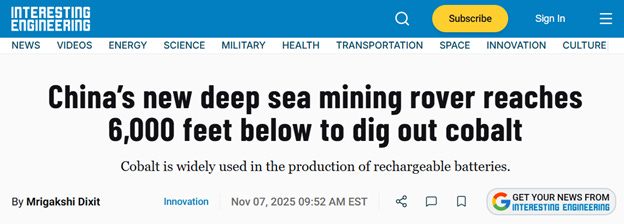
Late last year China sent an intelligent mining robot to the ocean floor, 2,000 meters down. It was in international waters, and geologists are aware that this part of the ocean floor is rich with cobalt and other minerals. Experts estimate that there are billions of tons of cobalt on the ocean floor, 600 times more than can be found on land. “Cobalt crusts” contain other critical metals, including nickel and platinum, and the richest deposits found so far are in the Pacific.
In another trial, by another group, Chinese engineers deployed a robot that performed three-dimensional drilling of the seabed floor. This was at over 1200 meters of depth. This robot can drill, and position itself inside deep-sea formations. Next step for that group is to explore and develop more resources, including rare earth elements.
The 3D mapping and drilling that this robot was doing is particularly transformative. It turns the layers of sediment under the ocean floor into map, that is then used to inform operations with deep-sea drones and robots.

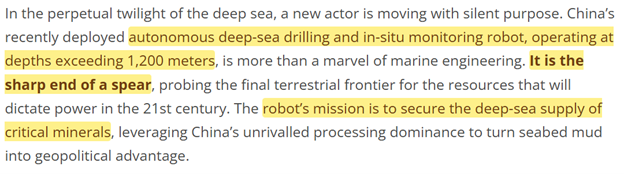
These developments should not be thought of “merely as breakthroughs in oceanography” and maritime engineering. They are “masterstrokes of geopolitics.” “The sharp end of the spear”. The technical achievements are impressive, but the objective of these technologies and research is to locate and scoop up cobalt, nickel, and rare earth elements.
What’s more, the Chinese researchers are not doing so out of scarcity, or out of desperation. They’re simply accelerating, going even faster in a race that they’re mostly already won. China already owns the markets for rare earth metals mining, refining and processing. And that leads to near-monopolies on almost everything down the supply chain for the metals, such as rare earth magnets.
So that’s what we need to know, to better understand the significance of China’s deep-sea mining robots. They already enjoy foundational sovereignty, and continue to make breakthroughs in technologies to mine the metals and turn them into usable products.
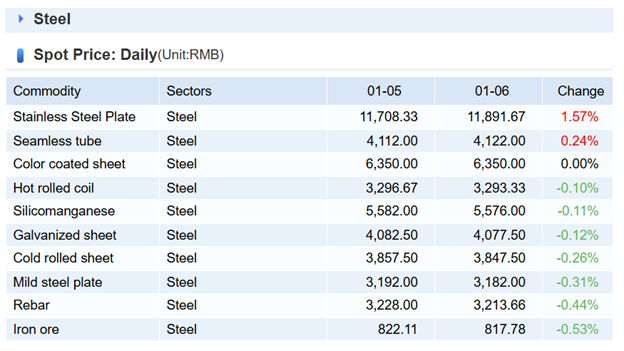
Next step is finding new applications and new products. Engineers in the rare earth industry here in China develop new markets, and a strong example of that is here—Baotou Steel Union Company adds some rare-earth elements, dug out of the ground in Inner Mongolia, to steel. The steel becomes stronger, resistant to high heat and low temperatures, and so is now in high demand by builders of spacecraft, pipelines, and high-speed railroads. Baotou Steel earns a premium of 3,000 RMB per ton, which is over half a billion dollars a year in extra profits. Add 3,000 RMB to these spot prices, and the company earns 40% more money just by adding rare earth elements in:
They’re new markets, and new profit centers. But that’s not all—the cobalt test was performed in international waters, at depth. China can get down to them, build 3-D maps of the floor, and send mining rovers in, and they are the only country who can.
Contrast all that, to efforts by Western countries to catch up. The strategy from the United States, for example, is direct investment by the Pentagon, into mining firms, and price floors. Then comes new efforts to restart mines in the United States, and find partners in friendly countries to do the same. The analysts here are arguing that Western governments are just starting a race that began decades ago. The Chinese rare earth metals monopolies were built over half a century, by the way at a time when everything cost less. Now the Chinese are building deep-sea robots and drones to get to the next generation of metals, while everyone else is scrambling around to get old mines started up again.

And that’s not even working. We see a lot of headlines about the big plans that are announced, and then when we follow up, we learn they didn’t go anywhere.
Cobalt again: the Pentagon budgeted $500 million last year to source 7,500 tons of cobalt over five years, the first time in 35 years anyone at the Defense Logistics Agency thought to look for cobalt. They hoped that a company in Canada, or another in Japan, or Glencore in Switzerland from its plant in Norway, would bid on the contract, but none of them did, so the offer was dropped. So they will try again later. Maybe.
Meanwhile, Chinese robots are running vacuums across the bottom of the Pacific.
Be Good.
Resources and links:
Chinese Researchers Deploy First Deep-Sea “Earthworm” Robot for 3D Strata Drilling
https://modernmechanics24.com/post/china-launches-deep-sea-drilling-robot/
China’s new deep sea mining rover reaches 6,000 feet below to dig out cobalt
https://interestingengineering.com/innovation/chinas-new-deep-sea-mining-rover
China unveils undersea drilling robot to boost deep-sea exploration
https://www.chinadaily.com.cn/a/202601/15/WS6968a94ea310d6866eb33f4e.html
Bloomberg, US Cancels $500 Million Cobalt Tender in Critical Minerals Blow
https://www.bloomberg.com/news/articles/2025-10-16/us-cancels-500-million-cobalt-tender-in-critical-minerals-blow
The Final Terrestrial Frontier: China’s Deep-Sea Robot Completes a Geopolitical Masterstroke
https://chinaeconomicindicator.com/the-final-terrestrial-frontier-chinas-deep-sea-robot-completes-a-geopolitical-masterstroke
Why China’s growing demand for rare-earth steel is bad news for US F-35
https://www.scmp.com/news/china/science/article/3336457/why-chinas-growing-demand-rare-earth-steel-bad-news-americas-f-35
China steel, spot price
https://www.sunsirs.com/uk/sectors-13.html
Inside China / Business is a reader-supported publication. To receive new posts and support my work, consider becoming a free or paid subscriber.
From Inside China / Business via This RSS Feed.
Mining The Deep Sea Is A Horrible, Deeply Irresponsible Idea