

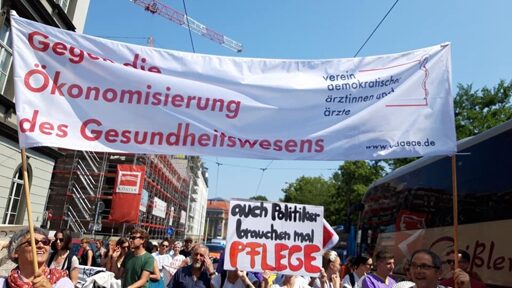
Europe’s militarization drive is gathering pace, with Germany leading the charge. People’s Health Dispatch spoke with Manuel Funk and Nadja Rakowitz from the Association of Democratic Doctors (Verein demokratischer Ärzt*innen, vdää*) about the consequences for the health system and for people’s right to health.
People’s Health Dispatch: Militarization has become a central political issue across Europe, and the German government is investing heavily in military spending. Large amounts of public money are going into defense, there is renewed discussion about conscription, and public debate increasingly frames war as inevitable. From the perspective of the Association of Democratic Doctors’ (vdää*) members, how do you interpret the current political moment?
Manuel Funk and Nadja Rakowitz: Our solidarity goes to the victims of the war, war opponents, deserters, and healthcare workers on all sides. Current developments have also affected our association, where members hold diverse views. While we have faced criticism and (very) few resignations, we continue to engage in debate and education.
At this point, in Germany, public funds are being used not only for defense, but also for shaping public attitudes. The Bundeswehr (the German armed forces) now publishes official videos showing German soldiers at night, by firelight, shouting “hurrah” when their general tells them they are working toward becoming “capable of winning.” The German army wants to win again. Beware, Europe. When they discuss a possible war, officials speak of the “Eastern Front,” and the “enemy” in public debate is clearly Russia – often personalized as Vladimir Putin. In our view, this taps into old anti-Russian sentiments and is becoming increasingly irrational.
Nowadays, it is once again socially acceptable to express pride in a grandfather who “fought against the Russians back then” – that is, in the Nazi Wehrmacht or even the SS. Statements like this no longer cause scandal, and even politicians from parties such as the Green Party sometimes make them.
As opponents of war, we are also critics of Russia’s war against Ukraine. Violations of international law, such as attacks on healthcare facilities, must be condemned. However, we believe this war cannot be won, and cannot be ended, with more weapons and more warfare. It can only come to an end through diplomacy and negotiations, which were lacking beforehand.
Overall, we see the current situation as deeply troubling and frightening. International law has become almost irrelevant, replaced by the rule of the strongest. Developments in the United States show that this dynamic is also deeply rooted in Western democracies, extending even to the rise of new forms of fascism. This has always been a political possibility. We have never doubted it, because capitalism contains this potential within itself.
Right now, there is no large left-wing mass movement against war and capitalism. There are many small resistance movements, and debate is increasingly taking place, at least within the Left Party (Die Linke), but this is very little compared to the peace movement of the 1980s. And compared to the strong, international working-class movement that would be necessary to resist effectively, we are almost starting again from the beginning. Trade unions are still not paying enough attention to this issue, yet the massive debt taken on by the German government for rearmament will require high interest payments, which will certainly lead to intensified social cuts in the coming years.
PHD: Are health workers already seeing the effects of these cuts?
MF/NR: In Germany, we are not only experiencing militarization, but also an ongoing economic crisis. GDP has been shrinking for several years, and unemployment is rising. In such situations, politicians always threaten cuts to social spending. We are currently seeing this in the solidarity-based health insurance system, which covers about 90% of the population. A hospital reform is also underway, aiming to close hundreds of hospitals and centralize services in large facilities. This reform was originally justified as a cost-saving move, regardless of militarization. Since last year, however, militarization has added a new layer, leading to new austerity measures in the social sector.
This is all happening alongside the development of a war economy. Large sums are being invested not only in arms production, but also in preparing society for war. Roads and bridges are therefore being built or renovated, and the German Hospital Association has even proposed building underground hospitals. A first concrete project of this kind already exists in Cologne.
Read more: “Militarization of rules and minds” in Europe threatens workers and welfare
In this context too, the Bundeswehr actively lures people with financial incentives: a salary of around €2,600, along with benefits such as a driver’s license for all those who enlist. For young people facing unemployment or precarious job prospects, this can be a convincing option. And once again, it is certainly not the children of doctors or politicians who are affected, but again people from working-class backgrounds. This also applies to people whose parents or grandparents migrated to Germany: those with German citizenship who often face discrimination in the labor market and are therefore more vulnerable to this kind of recruitment.
NATO’s demand that members raise military spending to 5% of GDP will affect roughly 45% of the total federal budget in Germany. It is clear that such spending will lead to terrible social cuts, exacerbating inequality and social disadvantage.
Healthcare will worsen further if the ongoing economization of the system is not stopped, but instead accelerated. In the event of an actual war, civilian needs would be subordinated to military priorities, all official documents on “civil-military cooperation” make this clear. Current scenarios on “war-readiness” assume around 1,000 additional injured people per day. This means military hospitals would reach capacity within two days. Civilian hospitals would then be used, but by that point, they will already have been drastically weakened by the upcoming hospital reform. And this even leaves aside another likely number – up to 50 people per day with psychological trauma and subsequent disorders.
This reality is not yet widely understood by the public. We see it as our responsibility to make these consequences explicit.
PHD: Vdää* has been following the militarization trend in healthcare for a long time. Where do you see the origins of this militaristic approach to healthcare, and how has it developed over the years?
MF/NR: We have been part of the anti-militarist movement since the vdää*’s founding in the 1980s. This has always been a central part of our anti-fascist commitment. In that period, together with International Physicians for the Prevention of Nuclear War (IPPNW), we developed the slogan “We will not be able to help you.” It expressed a simple truth: in the event of a nuclear war, the scale of destruction and injury would be so immense that even doctors would not be able to provide meaningful help to the population.
At that time, the peace movement in Germany was strong enough to politically block a proposed “Health Security Act.” This law was meant to regulate hierarchical relations between healthcare institutions, healthcare workers and the German army in the event of war: who could be ordered to do what, who would set medical priorities, and how triage decisions would be made. Today, a similar law is once again being prepared and is expected to be passed this spring. This time, however, we do not believe the movement is strong enough to stop it.
We began engaging with these developments early on, as professional medical associations acted quickly to cooperate with the military. Medical chambers offered their support to the army, and their journals reported on joint events organized together with the armed forces. What stood out immediately was that there was not one word of criticism or resistance. On the contrary, any criticism was dismissed or discredited.
Given Germany’s history, we are extremely attentive to these developments. We see it as our duty to provide an alternative voice from inside the medical profession, one that opposes war and resists all preparations for it.
PHD: How have health workers’ professional associations and trade unions responded to these developments in general?
MF/NR: The largest trade union representing health workers in Germany is the United Services Union (ver.di). There are also several much smaller unions for specific professional groups, the best known is the Marburger Bund (MB), which represents doctors only.
The Marburger Bund largely shares the federal government’s position and advocates to make the healthcare system “fit for war.” We are not aware of any organized resistance to this stance within the MB. Ver.di, on the other hand, has had difficulty maintaining a clear left-wing position. At the local level, and among individual union secretaries, there is strong engagement against militarization. The same can be said for IG Metall (IGM), Germany’s largest industrial union. However, at the federal level, both ver.di and IGM are still struggling to take a clear stand against militarization.
The anti-militarist, left-wing history of the trade union movement is no longer part of the active or accessible memory of today’s unions. In our view, many unions have not yet grasped how preparations for war, and war itself, directly undermine their achievements, including at the level of collective bargaining.
Many medical professional associations, on the other hand, are openly supporting militarization. There appear to be two main reasons for this: first, doctors feel they are finally important again as a profession. In the past, doctors in Germany enjoyed high social status, but this has declined noticeably with the economization of the healthcare system, where hospital management and financial considerations now dominate. Second – and this is a reason to be afraid – many doctors hope to benefit financially from militarization.
Professional associations, including those representing surgeons, have already voiced demands for millions of euros to make their fields “fit for war.” Others are seeking access to the large, open-ended funds approved by parliament for rearmament and the military. We fear this leads to a backdoor legitimization of rearmament, too.
The medical chambers, of which every doctor in Germany is an obligatory member, are also participating in militarization. While there are differences between federal states, there is no meaningful resistance from the official medical profession. A similar situation exists in nursing organizations. One association would have probably even openly welcomed the return of compulsory military service, seeing that people who object to military service for conscience reasons could then be employed as cheap labour in hospitals or nursing homes.
PHD: Do you know if health worker groups in other European countries are facing similar developments?
MF/NR: We are only just beginning to build contacts with colleagues in other countries. We are already in touch with VitalSigns magazine in Britain, which has published an interview with us on this topic. We are also connected with Médecins pour le Peuple (MPLP-GVHV) in Belgium, and we are planning a workshop on militarization at their Manifiesta Festival. As a board member of the International Association of Health Policy Europe, Nadja is also taking part in the organization of international events on militarization this year and next year. However, these efforts are small, initial steps toward international networking. We are a small association, and our capacities are limited. It would make a significant difference if a large trade union like ver.di were to take a more proactive role. This is a debate we are actively engaging in.
PHD: How is vdää involved in efforts currently underway in Germany to oppose the war agenda and rising military spending?
MF/NR: At the moment, there is still relatively little organized resistance to militarization in Germany. Since 2023, an annual peace conference has been organized by parts of the trade union movement together with the Rosa Luxemburg Foundation. In October 2025, two national anti-war demonstrations took place on the same day, with around 15,000 participants in Stuttgart and 10,000 in Berlin. A week earlier, approximately 100,000 people demonstrated in Berlin under the slogan “All Eyes on Gaza.”
The climate movement is also beginning to engage more seriously with the issue and increasingly recognizes it as a central question. At the local level, small demonstrations and actions against war, war preparation, and militarization are taking place in many cities. Members of the vdää* often participate in these actions and try to raise awareness about the militarization of the healthcare system.
In November, around 50,000 students organized a school strike against plans to reintroduce compulsory military service in Germany. This surprised many. It turns out that not everyone in Germany supports the government’s war agenda, and most young people say they would not join the military. But we do not yet see mass proactive resistance. Government propaganda efforts are enormous, and every attempt is being made to secure public consent. There is still a great deal of work ahead.
Our focus is on educating healthcare workers about current developments, exploring possibilities for refusal and resistance together, and encouraging them to become active. When the proposed Health Security Act is published, a public debate will follow. We see it as essential to intervene forcefully and loudly in that discussion, and we hope it will help generate new momentum.
Looking ahead, it is important that future initiatives do not lose sight of the connection between militarization, the war economy, and social cuts – because these dynamics are linked to even more struggles for social justice.
People’s Health Dispatch is a fortnightly bulletin published by the People’s Health Movement and Peoples Dispatch*. For more articles and subscription to People’s Health Dispatch, click* here.
The post Militarization is spreading through Germany’s health sector appeared first on Peoples Dispatch.
From Peoples Dispatch via This RSS Feed.