

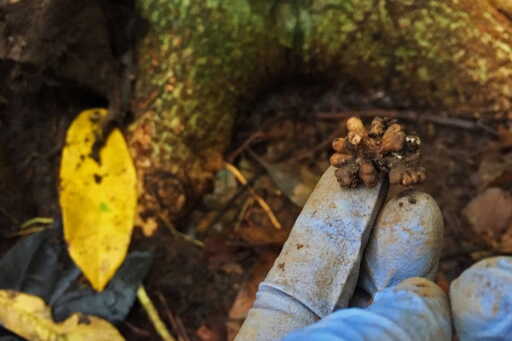
Regenerating tropical forests pull carbon dioxide from the air, but a lack of nitrogen in the soil could slow this process, a new Nature Communications study has found. Restoring tropical forests is widely seen as one of the most important ways to mitigate climate change, but scientists still don’t fully understand how nutrient availability may constrain tree growth. That means we can’t really predict how quickly regenerating forests will accumulate carbon. Both nitrogen and phosphorus are critical for plant growth, but when forested land is cleared, nitrogen in disturbed soils can evaporate or wash away. Phosphorus is also thought to be limited in many tropical soils. Now, a large-scale experiment in Panama finds that a lack of nitrogen in soil limits the early stages of tropical forest regrowth. When researchers added nitrogen to recently cleared land, the trees grew nearly twice as fast. Recovering forest in Panama. Image by Wenguang Tang. The finding “totally blew us away” says study author Susan Batterman, an ecologist at the Cary Institute of Ecosystem Studies and associate professor at the University of Leeds. “We didn’t realize that nitrogen could be that important in tropical forests, and the fact that the forest grew back twice as fast in the first decade was just kind of amazing.” The study took place within the Panama Canal Watershed in lowland tropical forest. To understand the impact of nutrient availability on tree growth, the researchers applied nitrogen and phosphorus, alone or in combination, to forest plots at different stages…This article was originally published on Mongabay
From Conservation news via This RSS Feed.