

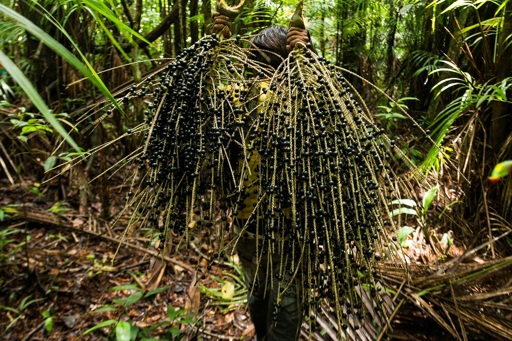
Brazil recently passed a law to recognize açaí, a berry endemic to the Amazon, as a national fruit, citing concerns about biopiracy — the commercial exploitation of native species and traditional knowledge without consent or fair compensation. Açaí is a staple food in northern Brazil, where it’s eaten as a savory paste typically served with fish and manioc flour. Globally, it’s gained a reputation as an energy-dense “superfood,” often used in smoothies, amid growing international demand and investment in traditional bioeconomy products derived from Amazonian biodiversity. The new law, sanctioned by President Luiz Inácio Lula da Silva, recognizes both the açaí tree (Euterpe oleracea) and its berries as part of Brazil’s biodiversity heritage. “The legislative recognition of açaí as a national fruit will have a mostly symbolic value. It seeks to reinforce the identity of açaí as a Brazilian product,” Sheila de Souza Corrêa de Melo, an intellectual property analyst at Embrapa Oriental, the Amazon branch of Brazil’s Agricultural Research Corporation, told Mongabay by phone. In 2021, Brazil ratified the Nagoya Protocol, a global treaty governing access to genetic resources and benefit-sharing. It has helped improve international guidelines to prevent biopiracy and related disputes, de Melo said. The new law amends a 2008 law that granted similar recognition to cupuaçu (Theobroma grandiflorum), another fruit endemic to the Amazon Rainforest, closely related to cacao, following a trademark dispute with Japan in the early 2000s. Before that, in 2003, another dispute arose from Japanese company K.K. Eyela Corporation registering açaí as its…This article was originally published on Mongabay
From Conservation news via This RSS Feed.