

“The underlying message of this trumped-up case is clear—criticism of the regime will be met with legal harassment. This fascist attack seeks to discourage public participation in the movement to hold corrupt officials and a corrupt system accountable.”
MANILA — More than 60 individuals who received a subpoena from the Department of Justice for sedition filed their counteraffidavits, January 28 and January 29, 2026.
“Telling the truth is not sedition; it is the people’s right,” said Aldrin Kitsune, secretary general of anti-corruption group Kalayaan Kontra Korapsyon (KKK), after filing his counter-affidavit before the DOJ.
The complainant, police officer Jonathan Estrada, claimed in his affidavit that Kitsune and KKK are actively disseminating “provocative and seditious” statements that encourage the youth to participate in the September 21, 2025 protest actions.
The right to protest, however, is not only guaranteed by the 1987 Philippine Constitution under the Bill of Rights but also an inherent right of the people recognized internationally.
The Philippines is a party to the International Covenant on Civil and Political Rights (ICCPR). The Philippine government has the obligation to respect and protect people’s right to protest.
Read: Beyond the Philippines, right to protest under fire in many countries
At least 72 individuals have been charged with sedition and inciting to sedition, in connection with the Cybercrime Prevention Act, according to human rights group Karapatan.
“Significantly, many of the targeted protesters had urged thoroughgoing systemic change to stamp out corruption, a call that goes beyond merely demanding the prosecution of corrupt elements from both the Marcos Jr. and Duterte cliques,” said Karapatan Secretary General Cristina Palabay.
The group added that many of the individuals accused of sedition suffered arbitrary detention and torture.
First responder lawyers from the National Union of People’s Lawyers (NUPL), Public Interest Law Center (PILC), Karapatan, and Sentro para sa Tunay na Repormang Agraryo (Sentra) confirmed that there were indications of torture – bruises, fractures, head injuries, and trauma – among those arrested. Minors were even forced to hurt fellow minors. These accounts were also corroborated by a study from the Amnesty International.
Read: Police violence, torture cases surface as new anti-corruption protest looms
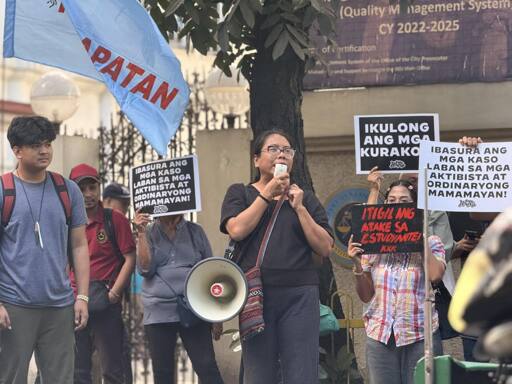
Karapatan and Alyansa Laban sa Korapsyon at Brutalidad ng Pulis (AKAB) led a picket in front of the Department of Justice to express their solidarity with the anti-corruption protesters.
“Doubling down on the persecution of anti-corruption protesters, only reinforces our doubts on the sincerity of the government’s drive against bureaucratic corruption,” Palabay said.
Read: Activists face sedition charges from DOJ
The first batch of sedition cases involved at least 37 individuals; and the second batch, at least 35 individuals. The criminal complaints were referred by the Criminal Investigation and Detection Group-Major Crimes Investigation Unit to the DOJ.
One of those who received DOJ subpoenas was Bagong Alyansang Makabayan (Bayan) President Renato Reyes Jr.
“The underlying message of this trumped-up case is clear—criticism of the regime will be met with legal harassment. This fascist attack seeks to discourage public participation in the movement to hold corrupt officials and a corrupt system accountable,” Reyes said in a previous Bulatlat report.
At least four student leaders also received summons to appear before the DOJ. They are Jacob Baluyot, national chairperson of Alyansa ng Kabataang Mamamahayag and associate editor of The Catalyst; Tiffany Faith Brillante, president of the Polytechnic University of the Philippines (PUP) Sentral na Konseho ng Mag-aaral; Joaquin Buenaflor, chairperson of the University of the Philippines Diliman University Student Council; and Kitsune. (RTS, RVO)
The post Anti-corruption activists fight back against sedition complaints appeared first on Bulatlat.
From Bulatlat via This RSS Feed.