

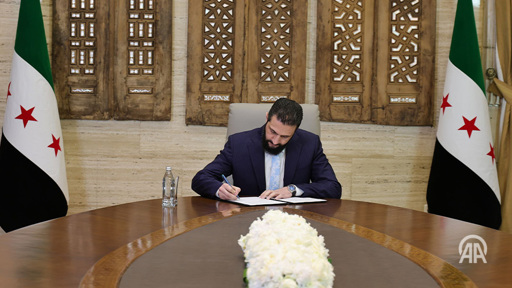
Less than two weeks after clashes re-erupted between Syria’s interim government forces and the Kurdish-led Syrian Democratic Forces (SDF), a 14-point ceasefire and full integration deal between both sides was reached on Sunday, January 18.
According to Syrian Arab News Agency (SANA) the agreement stipulates:
- An “immediate and comprehensive” cessation of hostilities.
- The withdrawal of all troops affiliated with the SDF to the east of the Euphrates River, “as a preliminary step for redeployment”.
- Handing over administrative and military affairs in the eastern governorate of Deir ez-Zor, and the northern governorate of Ar-Raqqa instantly and completely to the government.
- Integrating all civilian institutions in the northeastern governorate of al-Hasakah into the institutions of the Syrian state.
- Confining the control of all border crossings, oil fields, and gas fields in the region under SDF’s control to the Syrian state and keeping them under the protection of its forces, while maintaining the privacy of Kurdish areas.
- The full integration of all SDF military and security personnel into the Syrian Ministries of Defense and Interior on an “individual” basis, after carrying out necessary security vetting.
- SDF’s commitment not to incorporate remnants of the former regime into its ranks, and to provide the government with the names of the former regime’s remnants deployed in northeastern Syria.
- Appointing a governor to administer al-Hasakah, to ensure political participation and local representation.
- Removing heavy military presence from the city of Ain al-Arab (Kobani) in Aleppo, drafting city residents in a new security force and the retention of a local police force, administratively affiliated with the Ministry of Interior.
- Integrating the SDF’s administration in charge of handling the file of ISIS prisoners and camps, and the forces responsible for securing these facilities, into the Syrian government’s institutions.
- Adopting a list of candidates, submitted by the SDF to keep high-ranking military, security, and civil positions within the central state structure in order to guarantee national partnership.
- Welcoming Presidential Decree No. 13 of 2026, which stipulates the recognition of Kurdish cultural and linguistic rights, and addressing their outstanding rights-based and civil issues.
- SDF’s commitment to remove all non-Syrian leaders and members of the Kurdistan Workers’ Party (PKK) outside Syria’s borders to maintain sovereignty and regional stability.
- The commitment of the Syrian State to continue the fight against terrorism, and terrorist groups, particularly ISIS in cooperation with the US-led International Coalition.
- Working towards reaching understandings for ensuring “the safe and dignified return” of the residents, who were displaced from Aleppo’s Afrin and Sheikh Maqsoud areas to their homes.
Syrian government forces take over eastern and northern governorates after SDF withdrawal
The days that followed the sealing of the deal saw the advancement of Syria’s interim government forces in areas northeast of the country, which had been under the control of Kurdish-led groups for over a decade, after the withdrawal of SDF troops.
Media reports said that Arab tribes, who were for many years allies of the SDF in its fight against ISIS, have turned on the Kurdish group, facilitating the mission of the Al-Sharaa administration to reclaim the territories.
US envoy Tom Barrack urges SDF to uphold the ceasefire after reported breaches
Despite the government’s ability to recapture the territories from the SDF, the Syrian army announced on Wednesday, January 21, that the Kurdish organization breached the ceasefire deal by carrying out multiple attacks on military sites inside the al‑Yarubiyah crossing near the Syrian border with Iraq.
The army condemned the attack as a “serious escalation” that “reflects the SDF’s desire to continue targeting Syrians and their army and to disregard all previous agreements.”
The alleged violations of the agreement entailed the intervention of US envoy to Syria, Tom Barrack, who called on both sides on Thursday, January 22, to adopt “confidence-building measures”, after a meeting with SDF’s commander-in-chief, Mazloum Abdi, and leading Syrian Kurdish politician, Ilham Ahmed.
“We were honored to meet today with General Mazloum Abdi and Ilham Ahmed. The United States reaffirmed its strong support for and commitment to advancing the integration process outlined in the January 18 agreement between the Syrian Democratic Forces and the Syrian government,” Barrack wrote on X following the meeting.
“All parties agreed that the essential first step is the full upholding of the current ceasefire, as we collectively identify and implement confidence-building measures on all sides to foster trust and lasting stability,” he added.
The pressure exerted by the US envoy on the SDF, reveals the Trump administration’s intention to abandon the group in favor of Al-Sharaa’s administration, after an alliance that lasted for several years.
This move has been interpreted as part of Washington’s efforts to enhance its ties with Ankara by undermining the Kurdish rivals of the Erdogan administration in Syrian areas bordering Türkiye.
The post Reached but breached: the ceasefire between Syria’s interim government and SDF appeared first on Peoples Dispatch.
From Peoples Dispatch via This RSS Feed.