

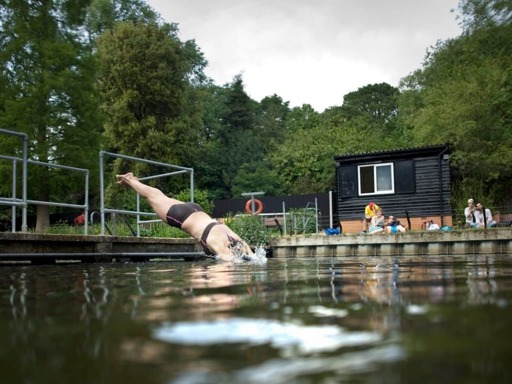

Transphobic pressure group Sex Matters has just had its legal case against a London swimming pond dismissed by the High Court.
Sex Matters claimed that allowing trans people to use the changing facilities aligned with their identities at the Hampstead Heath ponds amounted to discrimination. The judge, in reply, told them to take the case to the lower county court where it belongs.
And in a further blow, a consultation published by the City of London Corporation (CLC) — which runs the pools — found that the vast majority of respondents support trans people getting changed wherever they like.
Sex Matters — ‘The wrong way for doing these things’
Sex Matters — which is currently under investigation by the Charity Commission — argued that the CLC’s trans-inclusive changing policy was unlawful and discriminatory.
They based this assertion on the 2025 Supreme Court ruling that status as a woman is defined by sex as-assigned-at-birth under the Equality Act 2010. This ruling led to an immediate interim ban on trans people using their chosen single-sex spaces. However, the guidance was later taken down, and is currently being redrafted.
Daniel Stilitz KC, representing the CLC, pointed out that the trans-inclusive policy had been in place since 2017. As such, Sex Matters’ claims were out of time, along with being:
unhelpful, premature and the wrong way for doing these things.
Justice Lieven, who presided over the case, clearly agreed that with that last point. She dismissed Sex Matter’s challenge, informing the group that the “appropriate forum” for their case was the lower-level county court.
‘Significant time and resources’
Following Lieven’s decision, the CLC highlighted that Sex Matters’ case had diverted the corporation’s attention and funding away from its actual job. This includes managing charitable funds supporting London communities.
A spokesperson for the corporation announced:
This case has required significant time and resources, which could otherwise be focused on managing Hampstead Heath as a charity and providing high-quality public services.
We have now published the results of a consultation on future access arrangements at the heath’s bathing ponds.
The findings will be presented to City Corporation committees, which will consider them alongside legal duties, equality impact assessments, safeguarding responsibilities and operational considerations.
In the meantime, the current admission rules will remain in place until a final decision has been made by members.
The results of that consultation are particularly damning for Sex Matters. The research surveyed more than 38,000 members over the course of two months. It found that the vast majority of respondents backed the corporation’s trans-inclusive changing policy.
The CLC also published findings showing that:
Of six options considered for the Kenwood Ladies, Highgate Men’s and Hampstead Mixed Ponds, the most popular, with support from 86% of respondents, was retaining the existing access arrangements, in which trans men and women are able to use the pond of their choice.
The same percentage opposed introducing strict single sex access, 90% of people rejected requiring trans swimmers to use separate changing rooms or have separate swimming sessions, while 66% opposed making all ponds mixed sex. […]
Alongside the consultation, feedback was received from pond users via a series of independently-run focus groups. Here also, retaining current trans-inclusive arrangements was the option receiving broadest support, while introducing strict single sex rules or making all ponds mixed-sex ponds received very little support.
Overwhelming support
So, what lessons can we take from both Sex Matters’ case itself, and the CLC’s consultation results?
First, as the corporation stated, transphobic lawfare like that from Sex Matters is diverting time and resources away from charitable endeavours.
This echoed sentiments recently voiced by third-sector organisers in a recent open letter to the Charity Commission. The signatories stated that transphobic pressure groups were trying to strong-arm their organisations into adopting unwanted trans-hostile policies.
Second, it wasn’t even the case that the consultation respondents simply didn’t care about having sex-specific spaces at all. Two in every three respondents opposed making all of the ponds mixed-sex.
From this, we can conclude that even when the respondents supported the idea of having pools dedicated to men and women only, they wanted those categories to include trans men and women, respectively.
And so, third and finally, Sex Matters’ case wasn’t actually representing women at all. Rather, it represented a small group of cis women who were hostile towards the mere presence of trans women and non-binary people. And, as the CLC clearly demonstrated, these transphobes were a tiny minority of the pool-users.
Featured image via the Outdoors Swimming Society
From Canary via This RSS Feed.