

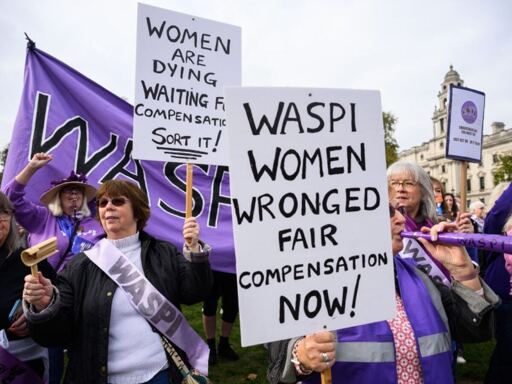

Work and pensions secretary Pat McFadden today – 29 January – announced that the government would not alter its decision not to compensate thousands of women affected by changes to the state pension age – the so-called WASPI women.
The decision comes after months of back-and-forth on the issue – and marks yet another instance of Labour going back on its word.
Parliament had recently undertaken to review its decision in light of evidence it previously overlooked. Today, though, McFadden stated in front of the Commons that:
There are legitimate and sincerely held views about whether it was wise to increase the state pension age, in particular, whether the decision taken in 2011 by the coalition government to accelerate equalisation and the rise to the age of 66 was the right thing to do or not.
However, the pensions secretary held that the policy decision was a separate matter from the DWP’s failure to send letters out in time. He went on to say that:
We accept that individual letters about changes to the state pension age could have been sent earlier.
For this, I want to repeat the apology that (former work and pensions secretary Liz Kendall) gave on behalf of the Government.
And I am sorry that those letters were not sent sooner.
We also agree with the (Parliamentary and Health Service) ombudsman that women did not suffer any direct financial loss from the delay.
WASPI
Campaign group WASPI – Women Against State Pension Inequality – represents millions of women born in the 1950s whose retirement plans were suddenly dashed. This was a result of the 2011 coalition government’s decision to raise the state pension age from 60 to 66.
Whilst the original 1995 legislation stated that the WASPI women should have received at least 10 years notice of the change, they instead received just 18 months.
Last week, on 23 January, WASPI issued an update ahead of McFadden’s decision. It stated that:
The injustice we continue to experience as WASPI women is not news, but each and every day it impacts on huge numbers of us who were not told that our State Pension age was increasing soon enough for us to do anything about it. Most of the general public agree with us. Most Labour MPs agreed when in opposition – including Kier Starmer and Angela Rayner.
WASPI also pointed out that the injustice they faced wasn’t simply a matter of personal (or even public) opinion. Rather, it was also verified by the “the most time-consuming and resource-intensive” investigation ever carried out by parliamentary ombudsman.
‘Logical flaw’
-
DWP research showed many 1950s-born women were unaware of our own increased State Pension age, even if they knew pension ages were changing generally;
-
DWP research further established that direct, personalised letters were the most effective means of informing this demographic – who relied on written communication – of our own increased State Pension ages, after other methods had proved ineffective; and
-
having decided a direct mailing campaign was needed, the DWP maladministratively delayed its launch by years.
As a result, the ombudsman then recommended that compensation should be paid to the 1950s-born women for the injustice of “lost opportunities and distress”. However, the government dismissed the decision out of hand, claiming that it:
contained a “logical flaw” and it failed to take into account the fact that sending letters was “often not an effective way to change levels of awareness”.
Then, in November 2025, the government announced that a new document had come to light. At the time of the initial decision, then-work and pensions secretary Liz Kendall hadn’t seen a survey from 2007 which may have altered the government’s choice.
McFadden stated that the government would undertake a reconsideration of its WASPI decision, and ensure that no other evidence was missing. However, today (29 January) we learned that this reconsideration has come to nothing. Parliament remains firm in its decision that the women affected will receive no compensation.
Another broken promise
Back in 2019, the Labour manifesto contained the following statement:
A generation of women born in the 1950s have had their pension age changed without fair notification. This betrayal left millions of women with no time to make alternative plans – with sometimes devastating personal consequences. Labour recognises this injustice, and will work with these women to design a system of recompense for the losses and insecurity they have suffered. We will ensure that such an injustice can never happen again by legislating to prevent accrued rights to the state pension from being changed.
Then, in 2022, then-leader of the opposition Kier Starmer called for “fair and fast” compensation for WASPI women. However, the 2024 Labour manifesto – immediately before their election – was mysteriously silent on the subject.
When, in 2024, Liz Kendall finally announced that the women affected would not receive the planned compensation of £1,000 and £2,950 each, it prompted uproar from both campaigners and Labour MPs themselves.
Even when McFadden undertook to reconsider, he warned that the scheme could cost some £10bn in all.
‘Disgraceful political choice’ against the WASPI women
Angela Madden, the WASPI chair, stated that McFadden’s decision today demonstrated “utter contempt” for the women affected. She also added that:
The government has kicked the can down the road for months, only to arrive at exactly the same conclusion it has always wanted to.
This is a disgraceful political choice by a small group of very powerful people who have decided the harm and injustice suffered by millions of ordinary women simply does not matter.
Today’s announcement was not a surprise – it’s merely another disappointment. It’s become routine at this point for Labour to renege on its promises in the name of its coffers.
This party is happy to recognise and name a clear injustice when it’s in opposition, but when it comes time to put its money where its mouth is, they’ll opt to keep the money every time.
Featured image via the Canary
From Canary via This RSS Feed.