


Darren Thompson
Special to ICT
MESA, Arizona — More than a hundred people gathered at an intersection on Sunday evening to acknowledge 14-year-old Emily Pike’s disappearance one year ago. It was the last place she was seen.
“What we have here means something, not just to us, but to her family, her siblings,” said Jared Marquez, a missing and murdered Indigenous people advocate, at the Jan. 25 vigil. “Not only do we honor the love we have as a community for this girl to the family and her siblings, but we seek justice.
“May we pray here today and hope that fear leaves the body of the person who knows something and let them come forward,” Marquez said.
Pike went missing on January 27, 2025. Her body was found by hikers on February 14, 2025, off Highway 60, near her home community of the San Carlos Apache in Globe, Arizona, more than a 100 miles away from Mesa.
Her death has been investigated as a homicide, but her death remains unsolved. Federal investigators are offering a $200,000 reward for an arrest related to Pike’s death.
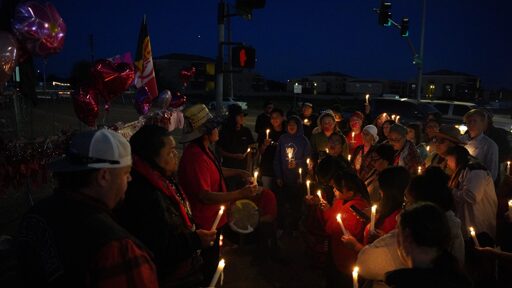
Pike’s siblings and family attended the candlelight vigil at the intersection of Mesa Drive and McKellips Road, where she was last seen and not far from the group home she ran away from.
Her disappearance sheds light on the already strained state-funded and managed behavioral health system that has defrauded the state more than $2.8 billion while targeting members of federally recognized tribes from beyond the state of Arizona.
Earlier this month, Pike’s memorial items were removed from the northwest intersection and placed in the trash, but her supporters quickly replaced the site with flowers, signs, balloons, and candles honoring her memory. Several reports indicate that the city of Mesa did not remove her memorial and that a private owner of the vacant lot removed them without not knowing.

A group of Indigenous women sang at a candlelight vigil in honor of Emily Pike on January 25, 2026, where she was last seen at the intersection of Mesa Drive and McKellips Road on January 27, 2025. Credit: Darren Thompson/Special to ICT
There are formal efforts to memorialize Pike though.
A memorial will be added to Fitch Park in Mesa this year and will include a bench and a tree planted in Emily Pike’s honor. An Arizona Department of Transportation highway memorial sign will be erected at milepost 277, north of Gila County Highway 60, near where her body was found.
Several groups of people, including men, women, and youth sang traditional songs to honor Pike. Her story has inspired many and people from various walks of life joined to honor her life.
“She was in the midst of her childhood and you know, still trying to understand what it means to be here, what her purpose is,” said Gabriel Garcia, Tohono O’odham Nation, who sang a traditional O’odham song. “She didn’t get the same family treatment that other kids get. And this is something that all children should be able to experience. The goodness of understanding who they are, where they come from, embracing who they are and where they want.”
He sang about his O’odham ancestors planting crops, and having to nurture each seed so that one day that seed matures and can feed the next generation.
“I wanted to share that song because that’s what I want all of our young ones to experience,” Garcia said. “I want them to be able to have the opportunity to learn what it is, to live life, and understand our role in this life.”
After Emily’s death, the state legislature passed a statewide alert system, called the “Turquoise Alert” and is also known as Emily’s Law. The alert system is similar to other alert systems and is used for at-risk individuals from Indigenous communities whose circumstances do not fit Amber or Silver alert criteria.
An investigative law enforcement agency may request a Turquoise Alert when specific criteria are met, and as established in the statute.
They include when all five of the following criteria:
-
a person who is reported missing must be under the age of 65;
-
the law enforcement agency leading the investigation must have used all available local resources;
-
the person reported missing must have gone under unexplained or suspicious circumstances;
-
belief that the missing person is in danger, in the company of a dangerous person, or that there are other factors indicating that a person is in danger and;
-
there is belief that if a person’s missing is shared with the public that the public can assist in the safe recovery of a missing person.
However, its effectiveness was questioned when last weekend an 8-year-old girl on the Navajo Nation named Maleeka “Mollie” Boone was found dead within 24 hours of being reported missing on Jan. 15.
Many in northern Arizona said they never received the alert that authorities say was issued on the morning of Jan. 16. Her body was later found that afternoon, and there have been no arrests made in connection with her death.
Justine Robertson, White Mountain Apache Tribe, is raising Pike’s other siblings and told ICT, “Everyone has to keep an eye on their kids — that’s the main thing. Awareness that our children can go missing is one thing, and unity and coming together as a community is another thing.”
Kris Dosela, Gila River Indian Community and San Carlos Apache, is the brother of Pike’s mother, Stephanie Dosela, and said at the conclusion of the vigil that typically communities do not gather to sing songs for someone who has passed on.
“This is a different time, so you need that strength, strength that comes with these songs to help, and her justice has not been delivered yet,” he said.
This reporting was supported by the International Women’s Media Foundations Fun for Indigenous Journalists: Reporting on Missing and Murdered Indigenous Women, Girls, Two-Spirit and Transgender People (MMIWG2T).
The post Family, supporters mourn Emily Pike one year after her disappearance appeared first on ICT.
From ICT via This RSS Feed.