

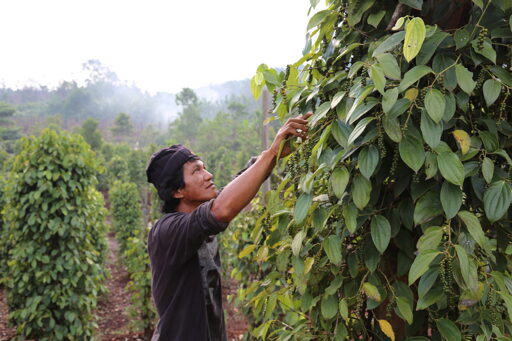
LOEHA RAYA, Indonesia — The road to the headquarters of the Loeha Raya Farmers’ Cooperative is inundated from the monsoon, and a baby cayman splashes around in a puddle formed in a natural crater by the side of the road. The forests surrounding the adjacent Lake Towuti, the second-largest freshwater lake in Indonesia, are rich in plant and animal life only found here on the island of Sulawesi. They include the crested hornbill, babirusa “deer-pig” and spectral tarsier, one of the smallest and most endangered primates on the planet. A land cruiser pulls up to the entrance of the farmhouse, and Rahman steps down to retrieve several 20-kilo (44-pound) sacks of freshly harvested produce from the trunk. Inside the sacks is one of Sulawesi’s most valuable agricultural commodities, the white peppercorn. Rahman, who is of Torajan and Padoe ethnicities, is recognized by his community as one of the main ancestral landholders in this part of Indonesia’s South Sulawesi province. Rahman’s land and the surrounding forest of Loeha Raya, a group of five villages to the east of Lake Towuti, sit within the longest-operating nickel mining concession in Indonesia, the Sorowako Block, operated by PT Vale Indonesia. The onsite smelter and processing facilities were inaugurated in 1968 by then-President Suharto. Today, the block sprawls over 70,566 hectares (174,000 acres) of rainforest and farmland on the lake’s shores. In 2024, Indonesia extended PT Vale Indonesia’s license until 2035. Now the company is looking to expand its operations within the concession, amid an…This article was originally published on Mongabay
From Conservation news via This RSS Feed.