

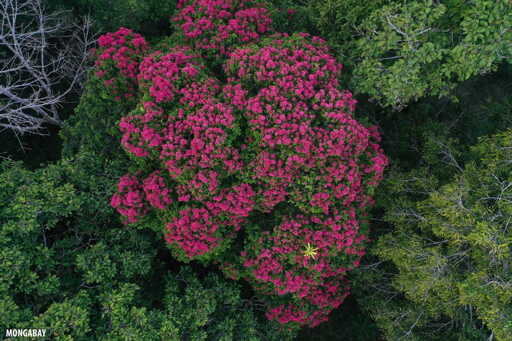
What’s lurking in and around the rainforest canopy? That’s a hard question to answer, especially in tall and dense forests. Traditional tracking methods, like camera traps, often miss out on elusive species that live high in the canopies. Acoustic monitoring might help detect some species, but not the relatively quiet ones. Scientists are now using a combination of drone technology and environmental DNA (eDNA) analysis to unravel the mysteries unfolding in the treetops. A team at the Environmental Robotics Lab at ETH Zürich collaborated with nonprofit organization Wilderness International to deploy drones to collect eDNA samples from rainforest canopies in Peru. Environmental DNA is the genetic material left behind in the environment by animals via their hair, fur or saliva. These flow into water or float around in the air before settling on leaves, branches and canopies. For a long time, scientists have focused on extracting genetic material from water samples to detect the animals living in a forest or ecosystem. However, this often left out arboreal, or tree-dwelling, species. “We have researchers who cover the ground level when it comes to traditional biodiversity research,” Marie Schreiber, head of science communication at Wilderness International, told Mongabay in a video interview. “But what is going on in the treetops is very difficult to understand and assess.” A team of scientists collaborated to deploy a combination of drone technology and environmental DNA analysis to collect DNA samples from treetops in the Peruvian Amazon. Image courtesy of Matthis Weber. It was to fill…This article was originally published on Mongabay
From Conservation news via This RSS Feed.