

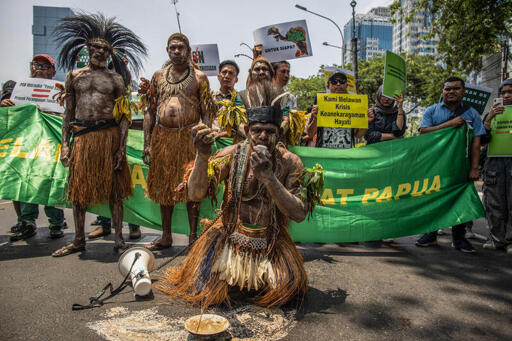
JAKARTA — Indigenous rights activists have condemned the Indonesian government’s decision to grant 328,000 hectares (810,505 acres) of cultivation rights for a massive rice plantation project in Papua, warning that the final land permit was issued at unusually rapid speed, compared with the years-long process typically required for large-scale plantation permits. The process is also criticized for taking place without the free, prior and informed consent (FPIC) of Indigenous communities whose customary lands are affected. The permit — known as Hak Guna Usaha (HGU) — is the last and most decisive license required before large-scale agricultural operations can begin. Activists say its issuance reflects a pattern of fast-tracked regulatory changes under the government’s food estate program that sideline Indigenous land rights and environmental safeguards in the name of national food security. They warn that the project risks triggering large-scale deforestation, land dispossession and social conflict in southern Papua, echoing past food estate failures elsewhere in Indonesia. Map of area earmarked for the rice project in Merauke. Image courtesy of Pusaka. Since the government announced plans to establish vast rice fields in southern Papua in early 2024, the project has advanced rapidly. Civil society groups report the deployment of heavy machinery and security forces to support land clearing and infrastructure development in areas earmarked for the project. The legal groundwork has moved just as quickly. In September 2025, the government reclassified 486,939 hectares (1.2 million acres) of forest estate into non-forest land (Areal Penggunaan Lain (APL), or ‘Area for Other Land…This article was originally published on Mongabay
From Conservation news via This RSS Feed.