

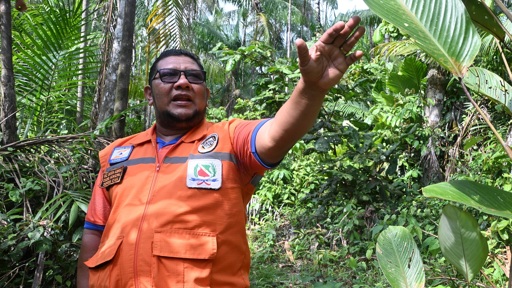
ACARÁ, Brazil — In August 2024, a wildfire broke out in Acará, a rural municipality in Brazil’s eastern Amazon state of Pará. Local civil defense coordinator Edson Abreu dos Santos, 48, knew he had to act quickly. Acará has no fire brigade, no water trucks, no firefighting drones and no helicopters. And because the fire was burning along the stream Itapecuru, accessible only by boat, vehicle support was out of the question. As the flames advanced into the forest, Santos set up an improvised command post in a ribeirinha (riverside) stilt house. From the porch, he used WhatsApp to message dozens of community members asking for help. More than 100 neighbors answered the call, pulling up to the house in rabetas — small, narrow wooden boats designed to navigate the winding Amazonian rivers. He instructed volunteers to fill 20-liter (5.3-gallon) water barrels — known locally as carotes — with river water. Forming a single line, they carried the containers on their shoulders for nearly a kilometer (0.6 mile) into the dense forest, throwing the water on the flames one barrel at a time. Many made the trek in flip-flops, while the men worked shirtless due to the intense heat. The small but steady effort managed to hold the line of fire until 30 firefighters arrived from a neighboring municipality, Macarena, more than 100 km (62 miles) away. They brought support in the way of backpack sprayers and a single water hose. In a makeshift setup, they patched the hose to…This article was originally published on Mongabay
From Conservation news via This RSS Feed.