


Gaza’s children were suffering from trauma symptoms such as depression, grief, and fear long before October 2023. They’d had 15 years of life under Israeli blockade, siege, and repeated military attacks.
But now, after Israel destroyed 90% of schools, 94% of healthcare and 92% of residential buildings, the mental health crisis is far worse. UNICEF has stated that:
all children in the Gaza Strip are in need of mental health support.
Gaza: innovation through necessity
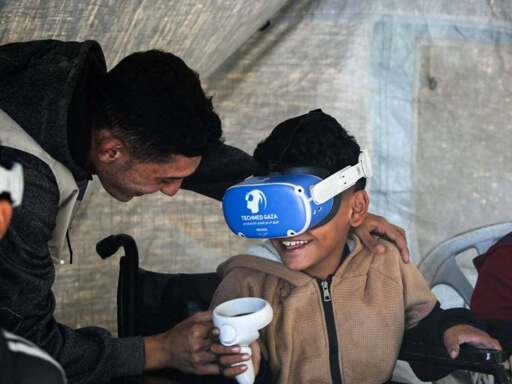
In central Gaza, mental health professionals are responding with an innovative approach: virtual reality therapy. Through headsets, traumatised children are transported from their harsh realities to experience peaceful islands, woodland walks and calming natural environments. This is imagery that can initiate the healing process, especially when other treatments have failed.
Most children arrive at the makeshift therapy tents excited for this temporary escape. But the therapists themselves carry the double burden of treating others’ trauma while navigating their own.
Abdallah Abu Shamla, mental health programme manager at TechMed, has lost his brother, his home, friends and colleagues to Israeli assault. Despite this – and while studying for his master’s degree in psychology through online classes – he finds hope and purpose in facilitating healing for others. He says:
The war has stripped away much of what defined my life. My brother was killed, leaving a void that no words can fill. Friends and colleagues, once my companions in building hope, are gone. My home, the place where I once welcomed patients and family, lies in ruins.
In Gaza, grief is shared across families, neighbourhoods and generations. Trauma is not an exception, it is the atmosphere we breathe.
How trauma healing through a headset works
Abu Shamla is one of five mental health therapists working for TechMed. It’s a Palestinian-run organisation founded by software engineer Mosab Emad Ali in April 2024 after his son was severely injured in an airstrike.
In partnership with The Sameer Project, TechMed has treated over 450 cases since October 2025, providing psychotherapy, physiotherapy and speech therapy for individuals, mainly children. Abu Shamla and his team see 10-15 cases daily.
Over a patchy internet connection, Abu Shamla described a recent case of a 15-year-old girl suffering post traumatic stress disorder after her father was killed in an airstrike and she suffered a serious leg injury.
This young person was debilitated by anger, depression, insomnia, and social withdrawal. Abu Shamla explains:
Across six sessions of talk therapy, physiotherapy and virtual reality lasting 45-60 minutes, she was able to sleep better, be more social, reconnect to her mother, talk about her father and understand loss and death.
Given the extreme levels of trauma children have been exposed to – family members killed, their homes destroyed, repeated displacement, and dire humanitarian conditions – therapists are seeing children with psychosomatic symptoms, social withdrawal, speech difficulties, and other presentations of trauma.

The virtual imagery isn’t just a brief escape, it provides a vital channel for children to talk (often when previously too traumatised to speak), process emotions, calm their nervous systems and learn self-regulation through grounding techniques. Abu Shamla continues:
We have six tools, each with different imagery, for mental health and one for physical therapy. The speech therapists use the headsets too.
One of the tools teaches patients how to breathe in a better way and talk about their traumatic incidents.
Abu Shamla and his team achieve these outcomes working from two tents, one no more than a few metres square. Lack of space means no privacy for patients and limits movement for those wearing the headset during sessions.
These constraints reflect the continuing challenges across Gaza. Despite a so-called ceasefire in October 2025, Palestinians still face desperate shortages of shelter, food and safety as Israel continues blocking aid and medical supplies.
This month, the occupying power suspended the operating licences of 37 international aid organisations, including Doctors Without Borders, leaving millions without essential aid and healthcare.
Healing while surviving their own trauma
The role of therapists and doctors is not just urgent but profoundly challenging. By mid-2025, over 1500 healthcare workers had been killed and hundreds detained and tortured. As Abu Shamla says:
As a psychotherapist, I am trained to hold space for others’ pain. But here, I am both witness and participant.
I sit with patients who describe the same explosions I heard, the same funerals I attended. My professional role does not shield me from trauma – it deepens my responsibility.
Abu Shamla’s story is far from unique:
Thousands of therapists, doctors and caregivers in Gaza carry the same double burden of loss and responsibility. We continue because we must.
For these healthcare professionals, their roles and personal identities have become inseparable. Abu Shamla explains:
My losses shape my work, and my work gives meaning to my losses.
Through TechMed, we are proving that even in the harshest conditions, innovation and compassion can coexist.
VR therapy does not erase trauma, but it creates a fragile sanctuary – a reminder that joy and agency are still possible.
Healing as resistance
In Gaza, trauma therapy is both an act of defiance against persistent death and a way to rebuild the human spirit when everything else has been shattered. Abu Shamla adds:
I continue to believe in the necessity of therapy, because healing – even in fragments – is an act of resistance against despair.
As our call ended, I learned that Abu Shamla would be attending his uncle’s funeral later that day. A sharp reminder that when the VR headset comes off, the reality of trauma continues.
Images via AFP
From Canary via This RSS Feed.