

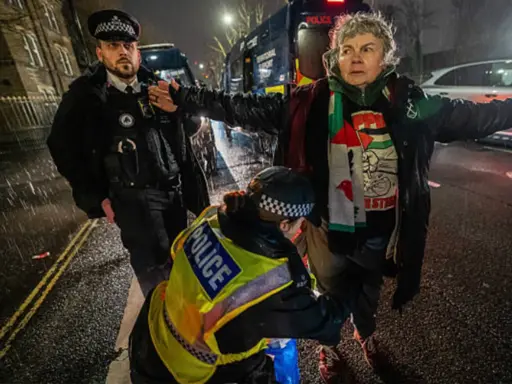

A Freedom of Information (FOI) request submitted to the Metropolitan Police has revealed the staggering costs of the recent mass-arrests of activists voicing their support of Palestine Action.
Palestine Action was the first non-violent direct action organisation ever to be proscribed as a terrorist organisation by the UK government. As such, showing support for the group could carry a 14-year prison sentence.
However, rather than being cowed into submission, Palestine Action supporters have continued to turn up to protests in their hundreds. The resulting mass arrests under the Terrorism Act have, predictably, put massive strain on the UK police forces.
Now, thanks to an FOI submitted to the Canary by an anonymous source, we know exactly how much the ban is costing. That is to say, enforcing the Palestine Action ban has cost £12m, in the Greater London area alone, over the course of just three months.
Palestine Action protests: month-by-month breakdown
So, let’s break that down, shall we? The FOI response from the Met covered September-November 2025. It provided details on arrest numbers, costs, and resourcing issues solely for policing ‘Palestine-Israel protests’.
In September alone, the Met spent just under £3.8m policing the protests. That included 4,247 shifts for police officers purely focusing on the protests, along with 755 ‘mutual aid’ shifts.
That is to say, the Met had to borrow hundreds of officers from other precincts to patrol Palestine protests. These ‘mutual aid’ powers are only meant to be used in anticipation of a major incident. Oh, and those extra shifts cost nearly £610,000 for the month alone.
Then, in October, the Met shelled out well over £4m to show up at the Palestine protests in force. That included just shy of 4000 regular officer shifts, and 1418 extra mutual aid shifts.
Likewise, November’s expenses were similarly astronomical, with 5,558 regular shifts and 246 mutual aid shifts. These added up to a total cost of over £4m for the second month running.
1441 arrests for terrorism offences
Beyond those raw figures, the FoI data become even more telling.
Over those three months, the Met made 1441 arrests arrests under Section 13 of the Terrorism Act – i.e. supporting a proscribed organisation.
Often, the Section 13 arrests targeted pensioners and disabled people holding up placards reading:
I oppose genocide, I support Palestine Action.
At the time of the FOI, 510 of the arrests were subject to a Postal Charge Requisition. That is to say that the arrestees were charged via letter, rather than at a police station. In total, 45 of the offences were under Section 14 of the Public Order act – likely for failing to observe movement restrictions imposed on a protest.
For comparison, the Met made just 124 other arrests at protests between September and November. Of these, just 25 resulted in actual charges at the time of the FoI request.
From this, we can draw two conclusions. First, the costs of enforcing the Palestine Action ban are eye-wateringly high for the police. Second, if you’re given to the belief that police actually do anything useful, it’s also diverting thousands of officers from their actual jobs to arrest non-violent protesters.
‘Emotionally and physically exhausted’
Police themselves seem divided on whether they agree with the proscription of Palestine Action. However, both camps seem united in the belief that they are utterly overwhelmed trying to enforce the ban.
Deputy assistant commissioner Claire Smart, who led a policing operation against a September protest focusing on Palestine Action’s proscription, stated that:
The tactics deployed by supporters of Palestine Action in their attempt to overwhelm the justice system, as well as the level of violence seen in the crowd, required significant resource which took officers out of neighbourhoods to the detriment of the Londoners who rely on them.
Similarly, Metropolitan Police federation chair Paula Dodds stated in October that:
There aren’t enough of us. Hard-working police officers are continually having days off cancelled, working longer shifts and being moved from other areas to facilitate these protests.
Our concentration should be on keeping people safe at a time when the country is on heightened alert from a terrorist attack. We are emotionally and physically exhausted.
Meanwhile, even some police officers have admitted to being disgusted at what the government is calling on them to do. One anonymous officer toldNovara:
I was told to help in the arrest of a disabled person for holding up the sign stating they opposed genocide and supported Palestine Action, which I did.
I did it knowing it had nothing to do with upholding justice or our professional values, just to protect my job and livelihood. My father was an officer, and the reason I came into the police. I know he would be ashamed and turning in his grave if he saw what I did.
Is this the best use of our money?
We know, we know, poor cops. However, it’s abundantly clear – from both the officers’ own reports and the information contained within the FOI – that the UK justice system is utterly overwhelmed.
We’ll leave aside, for the moment, all question of whether the ban on Palestine Action is righteous, justified, or -for instance – a symptom of deepening authoritarianism from a Labour government that crossed the line so long ago it’s a mere speck on the horizon. All of that’s a matter for the philosophers and the courts.
From a purely practical standpoint, the UK cannot afford to enforce this ban. The police already cannot cope. The Met alone spent £12m arresting pensioners holding placards. The courts were underwater even before they were flooded with thousands of extra ‘terrorism’ charges.
Surely, as a society, there’s something better we could be spending this time and money on?
Featured image via the Canary
By The Canary
From Canary via This RSS Feed.